100 Life in the UK Test Real Questions with Answers – Preparing for the Life in the UK Test becomes much easier when you practice with real questions and accurate answers. This article on Top 100 Life in the UK Test Real Questions with Answers is designed to help applicants understand the actual exam pattern, commonly asked topics, and the type of multiple-choice questions you may face in the official test.
Top 100 Life in the UK Test Real Questions with Answers
Whether you are applying for British citizenship or Indefinite Leave to Remain (ILR), these carefully selected questions will improve your confidence, boost your knowledge of UK history, culture, laws, and values, and increase your chances of passing the test on the first attempt.
About the Test
- Total Questions: 24 multiple-choice questions
- Pass Mark: 75% (18 out of 24 correct)
- Time Limit: 45 minutes
- Based on: Life in the United Kingdom: A Guide for New Residents, 3rd Edition
Life in the UK Test Questions and Answers
British History
1. Who were the first people to arrive in Britain in what we call the Stone Age?
- A) Farmers
- B) Hunter-gatherers ✓
- C) Warriors
- D) Pirates
Answer: B) Hunter-gatherers The first people to live in Britain were hunter-gatherers, in what we call the Stone Age.
2. When did Britain become permanently separated from the continent by the Channel?
- A) 10,000 years ago ✓
- B) 50,000 years ago
- C) 15,000 years ago
- D) 18,000 years ago
Answer: A) 10,000 years ago Britain only became permanently separated from the continent by the Channel about 10,000 years ago.
3. When did the Wars of the Roses start?
- A) 1388
- B) 1455 ✓
- C) 1462
- D) 1478
Answer: B) 1455 In 1455, a civil war was begun to decide who should be king of England. It was fought between the supporters of the House of Lancaster and the House of York.
4. Which of the following statements regarding the Black Death is NOT true?
- A) One third of the population of England died
- B) It was one of the worst disasters ever to strike Britain
- C) It affected children and old people only ✓
- D) Following the Black Death, there were labour shortages
Answer: C) It affected children and old people only The Black Death affected people of all ages, not just children and old people.
5. Who was reigning in England when Wales became formally united with England?
- A) Henry VIII ✓
- B) Henry VII
- C) Elizabeth I
- D) James I
Answer: A) Henry VIII During the reign of Henry VIII, Wales became formally united with England by the Act for the Government of Wales.
6. The Elizabethan period is known for the richness of its poetry and drama, especially for the plays and poems of which playwright?
- A) Alexander Dumas
- B) William Shakespeare ✓
- C) Charles Dickens
- D) Thomas Hardy
Answer: B) William Shakespeare The Elizabethan period is remembered for the richness of its poetry and drama, especially the plays and poems of William Shakespeare.
British Values and Principles
7. Which of the following is NOT a fundamental principle of British life?
- A) Tolerance of those with different faiths and beliefs
- B) The rule of law
- C) Autocracy ✓
- D) Democracy
Answer: C) Autocracy The fundamental principles of British life include: tolerance of those with different faiths and beliefs, the rule of law, democracy, individual liberty and participation in community life.
8. What does the UK offer to its residents or citizens? (Choose FIVE answers)
- A) Freedom of belief and religion ✓
- B) Freedom of speech ✓
- C) Free university tuition fees
- D) Freedom from unfair discrimination ✓
- E) A right to a fair trial ✓
- F) A right to join in the election of a government ✓
Answer: A, B, D, E, F The UK offers: freedom of belief and religion, freedom of speech, freedom from unfair discrimination, a right to a fair trial and a right to join in the election of a government.
UK Geography and Symbols
9. Which flag has a diagonal red cross on a white ground?
- A) The cross of St George, patron saint of England
- B) The cross of St Patrick, patron saint of Ireland ✓
- C) The cross of St David, patron saint of Wales
- D) The cross of St Andrew, patron saint of Scotland
Answer: B) The cross of St Patrick, patron saint of Ireland The cross of St Patrick, patron saint of Ireland, is a diagonal red cross on a white ground.
10. Where is the city of Swansea located?
- A) In England
- B) In Scotland
- C) In Wales ✓
- D) In the Isle of Man
Answer: C) In Wales Swansea is located in Wales.
11. What is the name of the centrepiece to the Remembrance Day service located in Whitehall, London?
- A) Cenotaph ✓
- B) Stonehenge
- C) Grimsby
- D) Scunthorpe
Answer: A) Cenotaph The Cenotaph in Whitehall is the site of the annual Remembrance Day service attended by the King, politicians and foreign ambassadors.
British Culture and Society
12. When is Christmas Eve celebrated?
- A) 24th of December ✓
- B) 26th of December
- C) 25th of December
- D) 27th of December
Answer: A) 24th of December Christmas Eve is celebrated on the 24th of December.
13. Pool and darts are traditional pub games.
- A) True ✓
- B) False
Answer: A) True
14. The most famous Tennis tournament hosted in Britain is:
- A) The French Open
- B) The US Open
- C) The Wimbledon Championships ✓
- D) The Australian Open
Answer: C) The Wimbledon Championships The Wimbledon Championships takes place each year at the All England Lawn Tennis and Croquet Club.
British Sports and Achievements
15. Which British sportsman won five consecutive gold medals at the Olympic Games in the rowing category?
- A) Sir Chris Hoy
- B) Christopher Dean
- C) Bradley Wiggins
- D) Sir Steve Redgrave ✓
Answer: D) Sir Steve Redgrave Sir Steve Redgrave won gold medals in rowing in five consecutive Olympic Games and is one of Britain’s greatest Olympians.
16. Who was the inventor of the World Wide Web?
- A) Sir Tim Berners-Lee ✓
- B) Sir Peter Mansfield
- C) Sir Ian Wilmut
- D) Sir Bernard Lovell
Answer: A) Sir Tim Berners-Lee The inventor of the World Wide Web, Sir Tim Berners-Lee (1955-), is British. Information was successfully transferred via the web for the first time on 25 December 1990.
Government and Politics
17. How many members does the Scottish Parliament have?
- A) 60
- B) 90
- C) 120
- D) 129 ✓
Answer: D) 129 There are 129 members of the Scottish Parliament (MSPs), elected by a form of proportional representation.
18. What does the term ‘coalition’ refer to?
- A) If no political party wins a majority, a new election is held
- B) The candidate who gets the most votes is elected
- C) If no political party wins a majority, two parties may join and govern together ✓
- D) If an MP dies or resigns, there will be a fresh election
Answer: C) If no political party wins a majority, two parties may join and govern together The government is usually formed by the party that wins the majority of constituencies. If no party wins a majority, two parties may join together to form a coalition.
19. The public can listen to debates in the Palace of Westminster from public galleries in both the House of Commons and the House of Lords.
- A) True ✓
- B) False
Answer: A) True
20. Civil servants cannot stand for public office:
- A) True ✓
- B) False
Answer: A) True Most citizens of the UK, Ireland or the Commonwealth aged 18 or over can stand for public office. There are some exceptions, including: members of the armed forces, civil servants, people found guilty of certain criminal offences.
21. Who is the spiritual leader of the Church of England?
- A) The Pope
- B) The Archbishop of Canterbury ✓
- C) St Augustine
- D) St Columba
Answer: B) The Archbishop of Canterbury The spiritual leader of the Church of England is the Archbishop of Canterbury.
Charities and Organizations
22. Which TWO of the following are environmental charities?
- A) Crisis
- B) The National Trust ✓
- C) Friends of the Earth ✓
- D) PDSA
Answer: B) The National Trust and C) Friends of the Earth The National Trust and Friends of the Earth are environmental charities.
Recent UK History
23. When did the UK formally leave the European Union?
- A) 31 January 2019
- B) 30 January 2020
- C) 31 January 2020 ✓
- D) 30 January 2019
Answer: C) 31 January 2020 The UK formally left the European Union on 31 January 2020.
Laws and Regulations
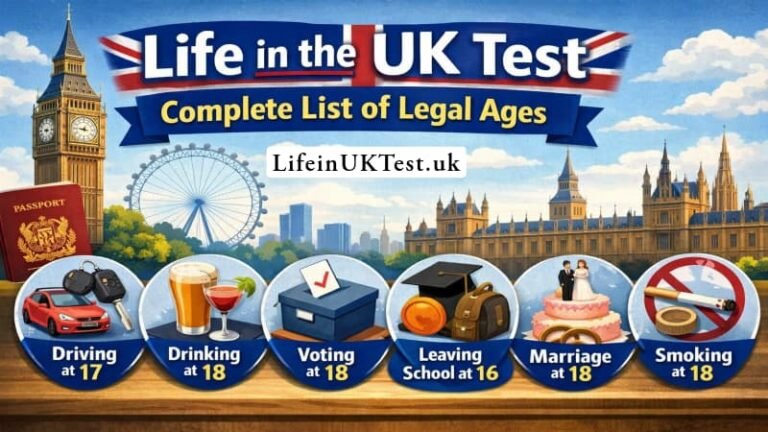
24. What is the minimum age requirement in the UK to drink wine or beer with a meal provided you are with someone over 18?
- A) 14 years old
- B) 15 years old
- C) 16 years old ✓
- D) 17 years old
Answer: C) 16 years old When they are 16, people can drink wine or beer with a meal in a hotel or restaurant as long as they are with someone over 18.
25. The Commonwealth has no power over its members and it cannot suspend their membership:
- A) True
- B) False ✓
Answer: B) False The Commonwealth has no power over its members, although it can suspend membership.
Additional Questions
26. How old is Big Ben (the bell housed in the Elizabeth Tower)?
- A) Over 100 years old
- B) Over 150 years old ✓
- C) Over 200 years old
- D) Over 250 years old
Answer: B) Over 150 years old Big Ben is over 150 years old and is a popular tourist attraction.
27. The words ‘Britain’, ‘British Isles’ or ‘British’ are used to refer to everyone in: (Choose any 4 answers)
- A) England ✓
- B) Scotland ✓
- C) Wales ✓
- D) Northern Ireland ✓
- E) Republic of Ireland
Answer: A, B, C, D (England, Scotland, Wales, Northern Ireland)
28. What residence is currently one of the residences of the British Royal Family?
- A) Buckingham Palace ✓
- B) The White House
- C) 10 Downing Street
- D) Edinburgh Castle
Answer: A) Buckingham Palace (also Balmoral Castle) Balmoral Castle is currently one of the residences of the British Royal Family.
29. Members of the House of Lords are not elected by the public:
- A) True ✓
- B) False
Answer: A) True Members of the House of Lords are appointed, not elected.
30. The UK is a constitutional monarchy. What does this mean?
- A) The monarch rules the country alone
- B) The monarch has absolute power
- C) The monarch’s powers are limited by the constitution ✓
- D) There is no monarch
Answer: C) The monarch’s powers are limited by the constitution
31. Which of these is a Crown Dependency?
- A) Gibraltar
- B) Jersey ✓
- C) Scotland
- D) Wales
Answer: B) Jersey Crown Dependencies include Jersey, Guernsey, and the Isle of Man.
32. The Ashes is a famous sporting event between England and which country?
- A) India
- B) Australia ✓
- C) South Africa
- D) New Zealand
Answer: B) Australia The Ashes is a cricket competition between England and Australia.
33. Which TWO landmarks are in Northern Ireland?
- A) Giant’s Causeway ✓
- B) Loch Lomond
- C) Snowdonia
- D) Carrickfergus Castle ✓
Answer: A) Giant’s Causeway and D) Carrickfergus Castle
34. The Magna Carta was signed in which year?
- A) 1066
- B) 1215 ✓
- C) 1314
- D) 1415
Answer: B) 1215 The Magna Carta was signed in 1215 and is an important historical document limiting the king’s power.
35. What is the capital city of Scotland?
- A) Glasgow
- B) Aberdeen
- C) Edinburgh ✓
- D) Dundee
Answer: C) Edinburgh
36. Which of these is NOT a British overseas territory?
- A) The Falkland Islands
- B) Gibraltar
- C) Malta ✓
- D) St Helena
Answer: C) Malta Malta is an independent country and EU member, not a British overseas territory.
37. Which king was executed during the English Civil War?
- A) King Henry VIII
- B) King Charles I ✓
- C) King James I
- D) King Edward VI
Answer: B) King Charles I
38. The Battle of Hastings took place in which year?
- A) 1066 ✓
- B) 1166
- C) 966
- D) 1266
Answer: A) 1066 The Battle of Hastings occurred in 1066 when William of Normandy defeated King Harold.
39. The Glorious Revolution took place in which year?
- A) 1588
- B) 1649
- C) 1688 ✓
- D) 1707
Answer: C) 1688
40. Florence Nightingale is famous for her work in which field?
- A) Education
- B) Nursing ✓
- C) Science
- D) Politics
Answer: B) Nursing Florence Nightingale is famous for pioneering modern nursing during the Crimean War.
41. The Union Flag is made up of how many crosses?
- A) One
- B) Two
- C) Three ✓
- D) Four
Answer: C) Three The Union Flag combines the crosses of St George (England), St Andrew (Scotland), and St Patrick (Ireland).
42. What is the national flower of Wales?
- A) Rose
- B) Thistle
- C) Shamrock
- D) Daffodil ✓
Answer: D) Daffodil The daffodil is the national flower of Wales (also the leek).
43. The National Eisteddfod is a cultural festival held in which country?
- A) England
- B) Scotland
- C) Wales ✓
- D) Northern Ireland
Answer: C) Wales The National Eisteddfod is an annual Welsh language festival of literature, music and performance.
44. Who wrote ‘Pride and Prejudice’?
- A) Charlotte Brontë
- B) Jane Austen ✓
- C) Emily Brontë
- D) George Eliot
Answer: B) Jane Austen
45. Which of these is a bank holiday in the UK?
- A) Thanksgiving
- B) Boxing Day ✓
- C) Independence Day
- D) Halloween
Answer: B) Boxing Day Boxing Day (26 December) is a bank holiday in the UK.
46. Who was the first person to run a mile in under four minutes?
- A) Steve Ovett
- B) Sebastian Coe
- C) Roger Bannister ✓
- D) Mo Farah
Answer: C) Roger Bannister Roger Bannister was the first person to run a mile in under four minutes in 1954.
47. Which of these British scientists developed the theory of evolution?
- A) Isaac Newton
- B) Charles Darwin ✓
- C) Stephen Hawking
- D) Michael Faraday
Answer: B) Charles Darwin
48. The UK has a free National Health Service (NHS):
- A) True ✓
- B) False
Answer: A) True The NHS provides healthcare that is free at the point of use for UK residents.
49. What age can you legally buy alcohol in the UK?
- A) 16
- B) 17
- C) 18 ✓
- D) 21
Answer: C) 18 You must be 18 or over to buy alcohol in the UK.
50. Who appoints the members of the Cabinet?
- A) The King
- B) The Prime Minister ✓
- C) Parliament
- D) The people through elections
Answer: B) The Prime Minister The Prime Minister appoints ministers to form the Cabinet.
ADDITIONAL 50 QUESTIONS
51. What is the capital city of Northern Ireland?
- A) Dublin
- B) Belfast ✓
- C) Cork
- D) Edinburgh
Answer: B) Belfast The capital city of Northern Ireland is Belfast.
52. What name is given to the day when people play jokes on each other until midday?
- A) Remembrance Day
- B) April Fool’s Day ✓
- C) Halloween
- D) Valentine’s Day
Answer: B) April Fool’s Day April Fool’s Day, 1 April, is a day when people play jokes on each other until midday.
53. Who is the fastest person to have sailed around the world single-handed?
- A) Dame Kelly Holmes
- B) Dame Ellen MacArthur ✓
- C) Jayne Torvill
- D) Bradley Wiggins
Answer: B) Dame Ellen MacArthur Dame Ellen MacArthur became the fastest person to sail around the world single-handed in 2004.
54. When did the First World War end?
- A) 9th of November 1918
- B) 11th of November 1918 ✓
- C) 9th of December 1918
- D) 11th of December 1918
Answer: B) 11th of November 1918 The First World War ended at 11.00 am on the 11th November 1918.
55. Where is the London Eye situated?
- A) On the northern bank of the River Thames
- B) On the southern bank of the River Thames ✓
- C) On the northern bank of the River Lea
- D) On the southern bank of the River Lea
Answer: B) On the southern bank of the River Thames The London Eye is situated on the southern bank of the River Thames.
56. Which British scientist was awarded a Nobel Prize for discovering the structure of the DNA molecule?
- A) Alan Turing
- B) Sir Frank Whittle
- C) Francis Crick ✓
- D) Sir Christopher Cockrell
Answer: C) Francis Crick Francis Crick was one of those awarded the Nobel Prize for discovering the structure of DNA in 1953.
57. How much can you be fined if you watch TV but do not have a TV licence?
- A) Up to £500
- B) Up to £1,000 ✓
- C) Up to £2,000
- D) Up to £3,000
Answer: B) Up to £1,000 You will receive a fine up to £1,000 if you watch TV without a TV licence.
58. What name is given to the period in the 18th century when new ideas about politics, philosophy and science were developed?
- A) The Enlightenment ✓
- B) The Glorious Revolution
- C) The Industrial Revolution
- D) Elizabethan Period
Answer: A) The Enlightenment During the 18th century, new ideas about politics, philosophy and science were developed. This is often called ‘the Enlightenment’.
59. What is the meaning of ‘Magna Carta’?
- A) The Big Charter
- B) The Great Charter ✓
- C) The King’s Charter
- D) The Small Charter
Answer: B) The Great Charter The Magna Carta means ‘the Great Charter’.
60. When did the Wars of the Roses end?
- A) 1455
- B) 1462
- C) 1478
- D) 1485 ✓
Answer: D) 1485 The Wars of the Roses ended with the Battle of Bosworth Field in 1485.
61. Which of the following is the responsibility of the Chancellor of the Exchequer?
- A) Education
- B) Agriculture
- C) Economy ✓
- D) Defence
Answer: C) Economy The Chancellor of the Exchequer is responsible for the economy.
62. In which British university did Isaac Newton study?
- A) University of Bolton
- B) University of Cambridge ✓
- C) Cranfield University
- D) University of Dundee
Answer: B) University of Cambridge Isaac Newton studied at Cambridge University.
63. Who invaded England after the Romans left?
- A) The Vikings
- B) The Anglo-Saxons ✓
- C) The Normans
- D) The Scots
Answer: B) The Anglo-Saxons After the Romans left in AD 410, Britain was invaded by the Jutes, the Angles and the Saxons (Anglo-Saxons).
64. Which Scottish city is known as the home of golf?
- A) Dundee
- B) Edinburgh
- C) Aberdeen
- D) St Andrews ✓
Answer: D) St Andrews St Andrews in Scotland is known as the home of golf.
65. What is the best preserved prehistoric village in northern Europe?
- A) Maiden
- B) Skara Brae ✓
- C) Stonehenge
- D) Bayeux
Answer: B) Skara Brae Skara Brae on Orkney is the best preserved prehistoric village in northern Europe.
66. When was the National Trust founded?
- A) 1890
- B) 1895 ✓
- C) 1980
- D) 1910
Answer: B) 1895 The National Trust was founded in 1895.
67. Which of the following operas was written by Gilbert and Sullivan?
- A) The Phantom of the Opera
- B) The Mikado ✓
- C) The Mousetrap
- D) Cats
Answer: B) The Mikado Gilbert and Sullivan wrote comic operas including The Mikado.
68. Where is Loch Lomond and the Trossachs National Park located?
- A) East of Wales
- B) West of Wales
- C) West of Scotland ✓
- D) East of Scotland
Answer: C) West of Scotland Loch Lomond and the Trossachs National Park is located in the west of Scotland.
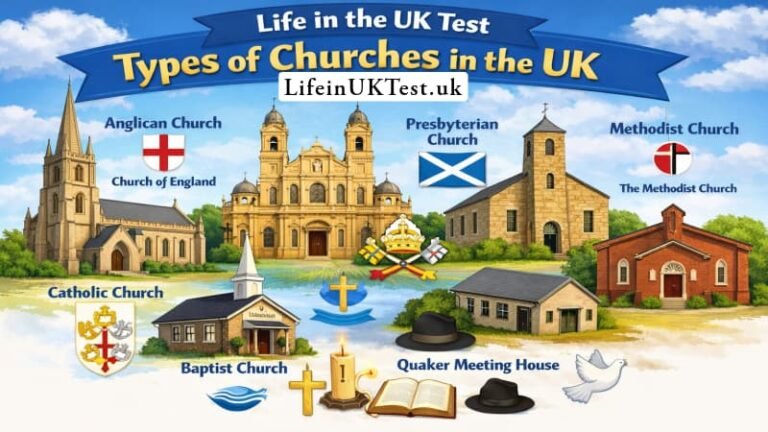
69. By what TWO other names is the Church of England known?
- A) The Anglican Church ✓
- B) The Union Church
- C) The Greatest Church
- D) The Episcopal Church ✓
Answer: A) The Anglican Church and D) The Episcopal Church The Church of England is called the Anglican Church in other countries and the Episcopal Church in Scotland and the United States.
70. Who was the first British Prime Minister?
- A) Henry Pelham
- B) Sir Robert Walpole ✓
- C) Admiral Nelson
- D) Oliver Cromwell
Answer: B) Sir Robert Walpole Sir Robert Walpole was Prime Minister from 1721 to 1742.
71. What day does Lent start?
- A) On Shrove Tuesday
- B) On Ash Wednesday ✓
- C) On Easter Monday
- D) On Easter Sunday
Answer: B) On Ash Wednesday Lent begins on Ash Wednesday.
72. How old do you need to be to apply for a free TV licence?
- A) Over 65
- B) Over 60
- C) Over 70
- D) Over 75 ✓
Answer: D) Over 75 People over 75 can apply for a free TV licence.
73. What is the official home of the Prime Minister?
- A) Buckingham Palace
- B) Windsor Castle
- C) 10 Downing Street ✓
- D) 21 Oxford Street
Answer: C) 10 Downing Street The official home of the Prime Minister is 10 Downing Street.
74. When did the Conservative government call a referendum on the UK’s membership of the European Union?
- A) 23rd July 2016
- B) 23rd June 2016 ✓
- C) 23rd June 2015
- D) 23rd July 2015
Answer: B) 23rd June 2016 The referendum on EU membership was held on 23rd June 2016.
75. Which British sportswoman won two gold medals for running in the 2004 Olympic Games?
- A) Dame Ellen MacArthur
- B) Jayne Torvill
- C) Dame Kelly Holmes ✓
- D) Jessica Ennis-Hill
Answer: C) Dame Kelly Holmes Dame Kelly Holmes won two gold medals for running in the 2004 Olympic Games.
76. What percentage of the total British population is located in England alone?
- A) 60%
- B) 79%
- C) 84% ✓
- D) 58%
Answer: C) 84% England makes up 84% of the total UK population.
77. What was the population of the UK in 2010?
- A) Just over 50 million
- B) Just over 62 million ✓
- C) Just under 50 million
- D) Just under 60 million
Answer: B) Just over 62 million The UK population in 2010 was just over 62 million.
78. In which period did British film studios flourish?
- A) 1920s
- B) 1930s ✓
- C) 1940s
- D) 1950s
Answer: B) 1930s British film studios flourished in the 1930s.
79. Who was Robert Burns?
- A) A British musician
- B) A Scottish poet ✓
- C) A Welsh scientist
- D) An Irish engineer
Answer: B) A Scottish poet Robert Burns was a Scottish poet known as ‘The Bard’.
80. Which flower is associated with England?
- A) Daffodil
- B) Shamrock
- C) Rose ✓
- D) Thistle
Answer: C) Rose The rose is the flower associated with England.
81. What is the name of the building where the Scottish Parliament meets?
- A) Holyrood ✓
- B) Senedd
- C) Westminster
- D) Stormont
Answer: A) Holyrood The Scottish Parliament meets at Holyrood in Edinburgh.
82. When does Prime Minister’s Questions (PMQs) take place?
- A) Every Tuesday at noon
- B) Every Wednesday at noon ✓
- C) Every Thursday at noon
- D) Every Friday at noon
Answer: B) Every Wednesday at noon PMQs takes place every Wednesday at noon when Parliament is sitting.
83. Who chairs debates in the House of Commons?
- A) The Foreign Secretary
- B) The Prime Minister
- C) The Speaker ✓
- D) The Leader of the Opposition
Answer: C) The Speaker Debates in the House of Commons are chaired by the Speaker.
84. Which court deals with the most serious cases of children aged 10 to 17?
- A) The High Court
- B) The Youth Court
- C) The Magistrates’ Court
- D) The Crown Court ✓
Answer: D) The Crown Court The most serious cases involving young people go to the Crown Court.
85. The small claims procedure is used in England and Wales for claims of less than:
- A) £15,000
- B) £5,000
- C) £3,500
- D) £10,000 ✓
Answer: D) £10,000 The small claims procedure handles claims of less than £10,000 in England and Wales.
86. What are Welsh cakes made of?
- A) Suet, onions and oatmeal
- B) Flour, dried fruits and spices ✓
- C) Potatoes and vegetables
- D) Bacon and eggs
Answer: B) Flour, dried fruits and spices Welsh cakes are made from flour, dried fruits and spices.
87. Who was the first woman Prime Minister of the UK?
- A) Theresa May
- B) Margaret Thatcher ✓
- C) Elizabeth II
- D) Nicola Sturgeon
Answer: B) Margaret Thatcher Margaret Thatcher was the first woman Prime Minister of the UK.
88. Who captained the English football team that won the World Cup in 1966?
- A) David Beckham
- B) Bobby Charlton
- C) Bobby Moore ✓
- D) Geoff Hurst
Answer: C) Bobby Moore Bobby Moore captained the English football team that won the World Cup in 1966.
89. In which year was the Spanish Armada defeated?
- A) 1566
- B) 1588 ✓
- C) 1600
- D) 1605
Answer: B) 1588 The English defeated the Spanish Armada in 1588.
90. What is the minimum age required to serve on a jury?
- A) 16
- B) 17
- C) 18 ✓
- D) 21
Answer: C) 18 Anyone on the electoral register aged 18 to 70 can be asked to serve on a jury.
91. When were men and women given the right to vote at the age of 21?
- A) 1918
- B) 1928 ✓
- C) 1945
- D) 1969
Answer: B) 1928 In 1928, women were given the right to vote at the age of 21, the same as men.
92. The UK is located in which part of Europe?
- A) South west
- B) North east
- C) North west ✓
- D) South east
Answer: C) North west The UK is located in the north west of Europe.
93. Who is the patron Saint of Scotland?
- A) St George
- B) St Andrew ✓
- C) St Patrick
- D) St David
Answer: B) St Andrew The patron Saint of Scotland is St Andrew.
94. Which TWO documents do you need to apply for a National Insurance number?
- A) A document with your address ✓
- B) Your birth certificate
- C) Documents proving permission to work in the UK ✓
- D) A driving licence
Answer: A) A document with your address and C) Documents proving permission to work in the UK You need proof of identity/address and documents showing you have permission to work.
95. What are the 40 days before Easter known as?
- A) Advent
- B) Lent ✓
- C) Epiphany
- D) Pentecost
Answer: B) Lent The 40 days before Easter are known as Lent.
96. Which TWO are famous British Paralympians?
- A) Baroness Tanni Grey-Thompson ✓
- B) Mo Farah
- C) Ellie Simmonds ✓
- D) Andy Murray
Answer: A) Baroness Tanni Grey-Thompson and C) Ellie Simmonds
97. There are 15 national parks in England, Wales and Scotland. What are national parks?
- A) Private estates
- B) Areas of protected countryside that everyone can visit ✓
- C) Royal hunting grounds
- D) Military training areas
Answer: B) Areas of protected countryside that everyone can visit National Parks are protected areas where people live, work and look after the landscape.
98. Northern Ireland has its own established church:
- A) True
- B) False ✓
Answer: B) False There is no established Church in Wales or Northern Ireland.
99. Where was Shakespeare born?
- A) London
- B) Stratford-upon-Avon ✓
- C) Edinburgh
- D) Oxford
Answer: B) Stratford-upon-Avon Shakespeare was born in Stratford-upon-Avon, England.
100. Who do MPs represent?
- A) Everyone in their constituency ✓
- B) Only those who voted for them
- C) The House of Lords
- D) Their political party
Answer: A) Everyone in their constituency Each MP represents everyone in their constituency, not just those who voted for them.
Final Study Reminders
Total Questions: 100 Real-Style Practice Questions
Key Test Information
- Format: Computer-based, 24 multiple-choice questions
- Time: 45 minutes
- Pass mark: 75% (18 out of 24 correct)
- Cost: £50
- Based on: Life in the United Kingdom: A Guide for New Residents (3rd Edition)
Top Study Tips
- Read the official handbook thoroughly at least twice
- Practice all 100 questions multiple times until you score consistently above 80%
- Focus extra time on areas where you make mistakes
- Understand the explanations, don’t just memorize answers
- Take timed practice tests to simulate exam conditions
- On test day: read each question carefully and use the full 45 minutes
Coverage Summary
These 100 questions cover:
- ✅ British Values & Principles
- ✅ UK Geography & Symbols
- ✅ British History (Ancient to Modern)
- ✅ Government & Politics
- ✅ Laws & Your Role
- ✅ Culture, Traditions & Society
- ✅ Sports & Achievements
- ✅ Famous British People
Best of luck with your Life in the UK Test! You can do this! 🇬🇧