How to prepare for the Life in the UK Test is a common question for people applying for British citizenship or Indefinite Leave to Remain (ILR). The test assesses your knowledge of British history, culture, values, and everyday life, and proper preparation is essential to pass on the first attempt. This guide explains the best study methods, recommended resources, and practical tips to help you prepare effectively and approach the Life in the UK Test with confidence.
How to Prepare for the Life in the UK Test: Your Complete 2026 Guide
So, you’re getting ready to take the Life in the UK test. First off, let me say this—you’re absolutely capable of passing this. Thousands of people sit this exam every month, and with the right approach and preparation, you’ll be joining them on the pass list. I’ve spoken with countless people who’ve been through this journey, and honestly, the ones who succeed aren’t necessarily the smartest or the most knowledgeable about British history. They’re the ones who prepare strategically and understand exactly what they’re walking into.
Let’s walk through everything you need to know about preparing for this test in 2026, with all the latest updates included.
What’s Actually Changed in 2026?
Here’s what you need to know right off the bat: as of early 2026, the core test hasn’t fundamentally changed. Yes, there was talk in October 2025 about modernizing the content to better reflect contemporary British life, but here’s the important bit—no revised syllabus or new handbook has been officially published yet. The Home Office indicated they’re planning to refresh aspects of the test, but until you see formal materials on GOV.UK, you should continue using the current official handbook.
What has changed are some practical elements:
Updated Booking and Fee Structure
The standard test fee remains £50 for weekday appointments, but here’s where it gets interesting—Sunday slots and peak-time bookings can now cost up to £65. This is a relatively new pricing model, so if you’re flexible with your schedule, booking earlier in the week can save you a bit of money.
eVisa Integration
This is probably the most significant practical change. You can now use your digital eVisa instead of a physical passport when booking your test. This streamlines the entire process considerably and eliminates a lot of paperwork delays. If you don’t have an eVisa yet, don’t worry—traditional ID documents like valid passports, EU/EEA ID cards, or travel documents still work perfectly fine.
By December 31, 2026, the transition to eVisas will be fully integrated into the ILR (Indefinite Leave to Remain) application system, so it’s worth getting familiar with this digital approach sooner rather than later.
Understanding the Test Format
Let me be straight with you: the format is actually quite straightforward. You’ll face 24 multiple-choice questions and you have 45 minutes to complete them. You need to get 18 questions correct to pass, which works out to a 75% pass mark.
The questions are pulled randomly from a larger database, so no two tests are exactly alike. You’ll encounter four different types of multiple-choice questions:
- Select one correct answer from four options
- Select two correct answers from four options
- True or false statements
- Statements requiring you to identify which is correct
The test is entirely computer-based, conducted at approved test centres across the UK. You don’t need to be a tech wizard—just basic computer skills like using a mouse and keyboard are sufficient.
Who Actually Needs to Take This Test?
This is important because not everyone needs to sit the exam. You’re required to take it if:
- You’re aged 18 to 65 years old
- You’re applying for British citizenship or settlement (ILR)
- You haven’t already passed the test in a previous application
Exemptions: Do You Qualify?
You might be exempt if you fall into one of these categories:
- Under 18 or over 65 years old at the time of application
- You have a long-term physical or mental condition that prevents you from studying for or taking the test
- You’ve already passed the test previously (it doesn’t expire!)
- Certain special circumstances covered under the Windrush scheme
A word of caution about medical exemptions: Temporary conditions like short-term depression or stress typically don’t qualify. The Home Office specifically states they’re looking for permanent or long-term conditions that genuinely prevent you from meeting the requirements. If you’re considering applying for a medical exemption, you’ll need comprehensive documentation from a qualified medical professional—usually your GP or a GMC-registered consultant—who must complete an official exemption form explaining why the condition prevents you from taking the test.
The Official Study Material: Your Foundation
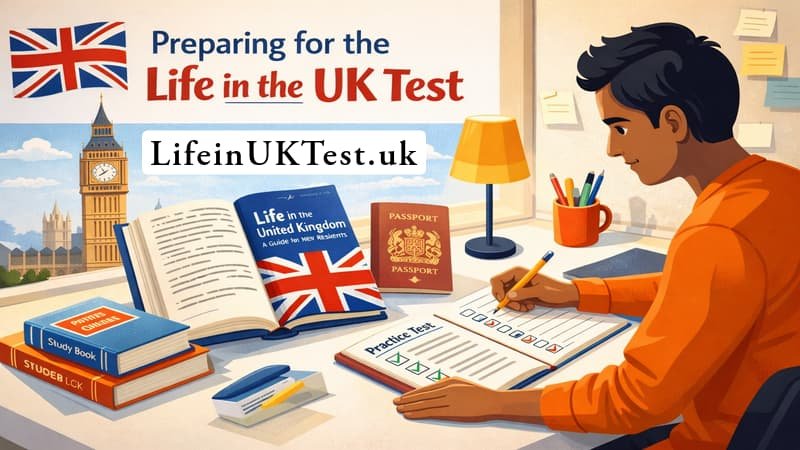
Right, let’s talk about what you actually need to study. The entire test is based on one official source: “Life in the United Kingdom: A Guide for New Residents, 3rd Edition.” This handbook was introduced in 2013 and remains the valid study material for 2026.
The handbook is divided into five key chapters:
Chapter 1: The Values and Principles of the UK
This covers fundamental British values, democracy, the rule of law, individual liberty, tolerance, and participation in community life.
Chapter 2: What is the UK?
Geographic and demographic information about the United Kingdom, its nations, flags, population, and regional characteristics.
Chapter 3: A Long and Illustrious History
British history from early times through to the present day. This is the longest chapter and covers medieval Britain, the Tudor period, the Stuart era, Georgian Britain, the Victorian age, the 20th century, and Britain since 1945.
Chapter 4: A Modern, Thriving Society
Contemporary British culture, sports, arts, media, leisure, and everyday life in modern Britain.
Chapter 5: The UK Government, the Law, and Your Role
How the government works, the legal system, your rights and responsibilities, and civic participation.
Pro tip: You don’t need to memorize birth and death dates of historical figures. The test focuses on understanding events, their significance, and their context rather than exact dates.
Creating Your Study Strategy
Here’s where most people either set themselves up for success or struggle unnecessarily. Let’s be honest—you can’t just skim through the handbook the night before and expect to pass. This requires a structured approach.
Start Early and Be Realistic
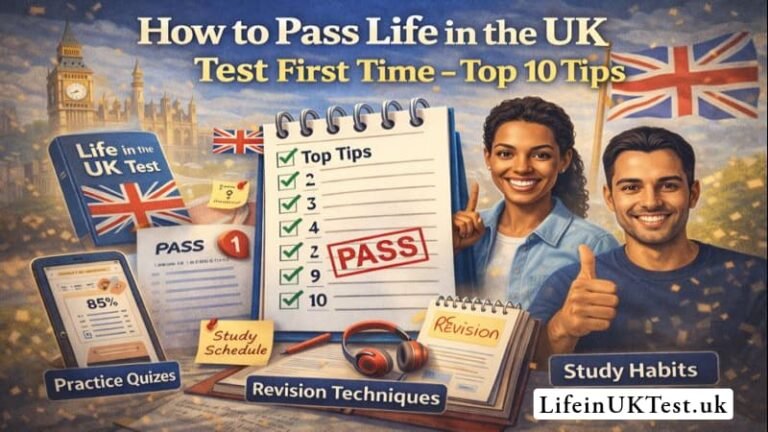
Give yourself at least 4-6 weeks of preparation time. I know that might sound like a lot, but trust me, spreading your study over several weeks is far more effective than cramming everything into a few intense days. Your brain simply retains information better when you learn in smaller chunks over a longer period.
Create a Practical Study Schedule
Here’s what actually works:
Study in short, frequent sessions rather than marathon study sessions. Aim for 15-30 minute sessions when you’re starting out, gradually increasing to 45-60 minutes as you build your routine. Quality beats quantity every single time.
Study at your peak hours. Are you a morning person? Schedule your study sessions before work. Night owl? Set aside evening time. Don’t fight your natural rhythm—use it to your advantage.
Take proper breaks. When you feel your concentration slipping, stop. Take a 10-minute break, stretch, grab a cup of tea, then return to your studies refreshed.
Active Learning Techniques That Actually Work
Reading the handbook passively isn’t enough. You need to engage with the material. Here are techniques that successful test-takers swear by:
Make summary notes as you read each chapter. Write key points in your own words—this forces your brain to process and understand the information rather than just passively reading it.
Create flashcards for important facts, dates, and concepts. There’s something about the physical act of writing and reviewing flashcards that helps cement information in your memory.
Use the buddy system. If you know someone else preparing for the test, study together. Quiz each other, explain concepts to one another, discuss what you’re learning. Teaching someone else is one of the most effective ways to learn.
Take practice tests regularly. This is crucial. Don’t wait until you’ve finished studying to take practice tests—incorporate them throughout your preparation. They help you identify weak areas early so you can focus your study time effectively.
Where to Find Quality Study Resources
Let’s talk about where to actually get your study materials and practice tests. This matters because there’s a lot of outdated or unofficial content floating around online.
Official Resources
The official handbook can be purchased from:
- The official Life in the UK website: https://www.officiallifeintheuk.co.uk/shop
- Online retailers like Amazon and Book Depository
- Many local bookshops
You can also access the handbook content online for free through several legitimate websites that have reproduced the official material.
Reliable Practice Test Website
LifeinUKTest.uk offer free practice tests based on the official handbook.
LifeinUKTest.uk support your exam preparation with easy-to-understand study materials and up-to-date practice tests. Whether you’re just starting or revising before the exam, this website help you build confidence and test your knowledge effectively.
Important note: LifeinUKTest.uk is based on the 3rd edition of the official handbook. Some older sites might have outdated questions. Therefore if you are choosing any other website, please make sure it is up to date as it can impact your test.
Mobile Apps
If you prefer studying on your phone, there are several reputable apps available on both Google Play and the Apple App Store. Search for “Life in the UK Test” and look for apps with high ratings and recent updates. Many offer offline access so you can study during your commute.
The Booking Process: Step by Step
When you’re ready to book your test (and I recommend doing this at least three days in advance, though a week or more is better), here’s exactly what you need to do:
Step 1: Visit the Official Booking Website
The ONLY official booking website is: https://www.lituktestbooking.co.uk
Let me emphasize this—there are fake websites out there that look legitimate but charge extra fees or don’t actually process bookings. Always check that the URL starts with the exact address above.
Step 2: Create Your Account
You’ll need to register with:
- Your full name (exactly as it appears on your ID)
- Date of birth
- Current UK address and postcode
- Valid email address
- Phone number
Critical point: Your details must match your identification documents exactly. Even small variations in how your name is written can cause problems on test day.
Step 3: Upload Your Documents
You’ll need two key documents:
Photographic ID (one of the following):
- Valid passport
- Biometric Residence Permit (BRP)
- Biometric Residence Card (BRC)
- UK photo driving licence
- eVisa share code (if you have one)
Proof of address (dated within the last 3 months):
- Utility bill (gas, electricity, water)
- Bank or building society statement
- Official letter from the Home Office, NHS, or government department
- Council tax bill
Step 4: Choose Your Test Centre
The system will show you the five test centres closest to your home address. You must choose one of these five—if you try to book at a centre further away, you won’t be allowed to take the test and won’t get a refund.
Step 5: Select Date and Time
Choose from available slots. Remember:
- Weekday slots: £50
- Sunday and peak-time slots: up to £65
- You must book at least 3 days in advance
Step 6: Pay the Fee
Payment is taken online via debit or credit card. If you don’t have either, you can use a prepaid credit card.
Step 7: Confirmation
You’ll receive a confirmation email with:
- Your test centre address
- Date and time of your test
- What to bring on the day
- A unique booking reference
Keep this email! You might need it on test day.
Test Day: What to Expect
Let me walk you through what actually happens on test day so there are no surprises.
What to Bring
Essential documents:
- The same photo ID you used when booking
- Your proof of address document (must match booking details)
What NOT to bring:
- Study materials (these aren’t allowed in the test room)
- Mobile phone (it must go in a locker)
- Bags (unless absolutely necessary—there are lockers available)
- Food or drink (get water and use the bathroom before the test starts)
Arrival and Registration
Arrive at least 15-30 minutes early. The registration process can take time, especially if there are several candidates testing at once.
When you arrive:
- Staff will verify your identity using your documents
- You’ll be given the test rules and regulations
- All personal belongings must go into a provided locker
- You’ll be shown to your computer station
During the Test
You’ll sit at a computer with a privacy screen. Your ID will be placed on your desk where staff can see it.
The test experience:
- You can take two practice tests before the real one starts (these don’t count toward your score)
- You have 45 minutes for 24 questions
- Questions appear one at a time on screen
- Click your answer choice to select it
- You can review and change answers throughout the test
- A timer shows how much time remains
- You can see which questions you’ve answered
Time management: With 45 minutes for 24 questions, you have roughly 90 seconds per question. That’s plenty of time if you’ve prepared properly. Don’t panic if you encounter a question you’re uncertain about—mark it mentally and come back to it if time permits.
After the Test
Results are provided immediately on screen. If you pass, you’ll receive a unique reference number (also called a pass notification). You’ll need this number when applying for settlement or citizenship—keep it somewhere safe!
If you don’t pass, you can book another test immediately. There’s no limit to how many times you can retake it, but you’ll need to pay the fee each time.
Common Mistakes to Avoid
Let me share the pitfalls I’ve seen people fall into repeatedly:
1. Underestimating the History Section
Chapter 3 is the longest chapter for a reason—there’s a lot of British history to cover. Many people skim this section because they think dates and old events won’t be important. Wrong. A significant portion of test questions come from this chapter. Give it the time it deserves.
2. Relying Only on Memory
Understanding is more important than memorization. The test questions often require you to understand context and significance rather than just recall facts. If you’re just trying to memorize without comprehending, you’ll struggle with questions phrased differently than you expect.
3. Not Taking Enough Practice Tests
You need to get comfortable with the question format and time pressure. Take at least 10-15 full practice tests under timed conditions before your actual test. This builds confidence and helps identify gaps in your knowledge.
4. Last-Minute Cramming
This is the biggest mistake. Starting your preparation a few days before the test is a recipe for stress and failure. Give yourself adequate time to learn properly.
5. Using Unofficial or Outdated Materials
Make sure your study resources are based on the 3rd edition of the handbook and are kept up to date. Some facts change over time (like current political positions), so outdated materials can actually hurt your preparation.
6. Ignoring British Values Questions
Some people focus heavily on historical facts and neglect the values and principles covered in Chapters 1, 2, and 5. Questions about British democratic principles, the legal system, and civic participation absolutely appear on the test.
7. Panicking About Computer Use
If you’re not comfortable with computers, practice! Most local libraries offer free computer access and even basic training courses. The test itself requires minimal computer skills—you just need to use a mouse to click on answers.
Special Circumstances and Accommodations
The test is designed to be accessible to everyone, regardless of physical abilities or learning differences.
Requesting Special Arrangements
If you have a disability or special needs, you can request accommodations when booking your test. Options include:
- Extra time for candidates with learning difficulties like dyslexia
- Taking the test in Welsh (if your test centre is in Wales)
- Taking the test in Scottish Gaelic (if your test centre is in Scotland)
- Other specific requirements (you’ll need to detail these on a special arrangement booking form)
Special arrangement requests typically take up to 4 working days to process, so factor this into your planning.
If You Can’t Read in Your First Language
If you struggle with reading even in your native language, mention this when requesting special arrangements. Additional time may be granted to accommodate this.
Understanding Your Results
The 75% pass mark means you need to get 18 out of 24 questions correct. Here’s what’s interesting—as of 2025, the Home Office changed how they provide feedback to failed candidates.
Previously, if you didn’t pass, you’d receive a detailed breakdown showing which topic areas you struggled with. Now, you simply receive a pass or fail notification without specific weak area analysis. This means taking regular practice tests during your preparation is even more important—they help you identify your weak spots before the actual test.
If You Pass
Celebrate! You’ll receive a unique reference number immediately. This pass doesn’t expire, so even if it takes you several years to complete your citizenship or ILR application, your test pass remains valid.
If You Don’t Pass
Don’t beat yourself up. Many successful applicants didn’t pass on their first attempt. You can retake the test as many times as needed. Between attempts:
- Review the practice tests you took and identify patterns in the questions you missed
- Focus your study on those specific areas
- Take more timed practice tests
- Consider adjusting your study approach—maybe you need more visual learning, or perhaps studying with a partner would help
Cost Breakdown: What to Budget For
Let’s talk money, because the test is just one part of your overall settlement or citizenship application costs.
Test-Related Costs
| Item | Cost | Notes |
|---|---|---|
| Test fee (weekday) | £50 | Standard rate |
| Test fee (Sunday/peak) | £65 | If weekday unavailable |
| Official handbook | £10-15 | One-time purchase |
| Retake (if needed) | £50-65 per attempt | No limit on retakes |
English Language Requirement
Remember, passing the Life in the UK test is just one part of the Knowledge of Language and Life (KoLL) requirement. You also need to prove English language proficiency at B1 level (ESOL Entry 3) or above unless you:
- Are from a majority English-speaking country (USA, Canada, Australia, New Zealand, etc.)
- Have a degree taught in English (verified by UK ENIC)
- Previously submitted acceptable English language evidence for an earlier application
Approved English language tests cost approximately £150-200, so factor this into your budget.
Real Talk: How Difficult Is This Test Really?
I’m going to be completely honest with you. This test has a reputation for being trickier than people expect. Some of the questions cover quite obscure facts about British history, culture, and governance that many British-born citizens wouldn’t necessarily know without studying.
But here’s the thing—it’s absolutely passable with proper preparation. The pass rate hovers around 70% overall, with people from English-speaking countries passing at a slightly higher rate (around 86%) compared to those from non-English-speaking countries (around 68%).
What separates those who pass from those who don’t usually isn’t intelligence or how well they know Britain—it’s whether they took the time to prepare systematically using the official materials.
Future Changes: What Might Be Coming
As I mentioned earlier, the government announced in October 2025 that they’re planning to modernize the test content. While nothing official has been released yet, the direction suggests:
- Updated content to better reflect contemporary civic life
- Possibly revised questions about current British society
- More emphasis on modern Britain and less on distant historical events
However—and this is important—until you see official materials on GOV.UK, don’t change your preparation strategy. Continue using the current 3rd edition handbook and official practice resources. When changes do come, they’ll be clearly announced through official Home Office channels, and you’ll have adequate notice before implementation.
Also worth noting: there’s talk of broader settlement system changes coming in 2026, with the government proposing an “earned settlement” system that would consider factors like economic contribution and community integration. These changes would affect the pathway to ILR but not the Life in the UK test itself, which remains a statutory requirement.
Your Action Plan: Next Steps
Right, let’s bring this all together with a concrete plan you can start following today:
Week 1-2: Foundation Building
- Purchase or access the official handbook
- Read Chapter 1 (Values and Principles) and take notes
- Complete 2-3 practice tests to establish your baseline
- Create your study schedule for the next 4-6 weeks
Week 3-4: Deep Dive
- Read and study Chapters 2-3 (What is the UK and British History)
- Create flashcards for key facts
- Take 2-3 practice tests per week
- Review any questions you get wrong and study those topics again
Week 5-6: Contemporary Focus
- Study Chapters 4-5 (Modern Society and Government)
- Increase practice tests to daily if possible
- Focus extra time on topics where you’re scoring poorly
- Book your actual test for week 7 or 8
Week 7: Final Preparation
- Review all your notes and flashcards
- Take full-length practice tests under timed conditions
- Don’t cram new information—focus on reinforcing what you know
- Get adequate sleep, especially the night before your test
Test Day
- Arrive early with all required documents
- Stay calm and confident
- Trust your preparation
- Pass your test!
Additional Support and Resources
You’re not alone in this journey. Here are some additional resources that might help:
Official Government Resources
- GOV.UK Life in the UK Test page: Official information, booking system, and updates
- Home Office guidance: https://www.gov.uk/life-in-the-uk-test
Community Support
Many local libraries and community centers offer:
- Free Life in the UK test study groups
- Computer skills training
- English language support
- Study spaces and resources
Check with your local council or library to see what’s available in your area.
Professional Help
If you’re struggling with the English language requirement or have complex immigration circumstances, consider consulting:
- An immigration solicitor specializing in citizenship matters
- ESOL (English for Speakers of Other Languages) courses
- Adult education centers offering citizenship test preparation
Final Thoughts
Look, preparing for the Life in the UK test might feel overwhelming right now, but let me assure you—you’ve got this. Thousands of people in your exact situation have successfully passed this test and gone on to build wonderful lives as permanent residents or British citizens.
The key isn’t about being brilliant or having an encyclopedic knowledge of British history. It’s about being systematic, starting early, using official resources, and actually putting in the study time. Give yourself the gift of proper preparation rather than hoping you can wing it.
And remember, even if you don’t pass on your first attempt, that’s okay. Many successful applicants needed more than one try. What matters is that you keep going until you succeed.
The Life in the UK test is a gateway, not a barrier. With the right preparation and mindset, you’ll walk through that gateway and continue your journey toward making the UK your permanent home.
Good luck—you’re going to do great!
Quick Reference: Key Facts at a Glance
Test Format:
- 24 multiple-choice questions
- 45 minutes duration
- 75% pass mark (18 correct answers needed)
- Computer-based only
- Results immediate
Cost:
- £50 (weekday)
- £65 (Sunday/peak times)
Official Booking Site:
- https://www.lituktestbooking.co.uk
Study Material:
- Life in the United Kingdom: A Guide for New Residents (3rd Edition)
Who Needs to Take It:
- Ages 18-65
- Applying for British citizenship or ILR
- No previous pass
Exemptions:
- Under 18 or over 65
- Long-term physical/mental conditions (with medical evidence)
- Previous test pass
Preparation Time:
- Recommended: 4-6 weeks minimum
- Daily study: 15-60 minutes
Pass Rate:
- Overall: approximately 70%
- With proper preparation: significantly higher
This article is for general guidance only and doesn’t constitute legal advice. Immigration rules and test requirements can change. Always check the official GOV.UK website for the most current information and consult a qualified immigration adviser for advice specific to your circumstances.