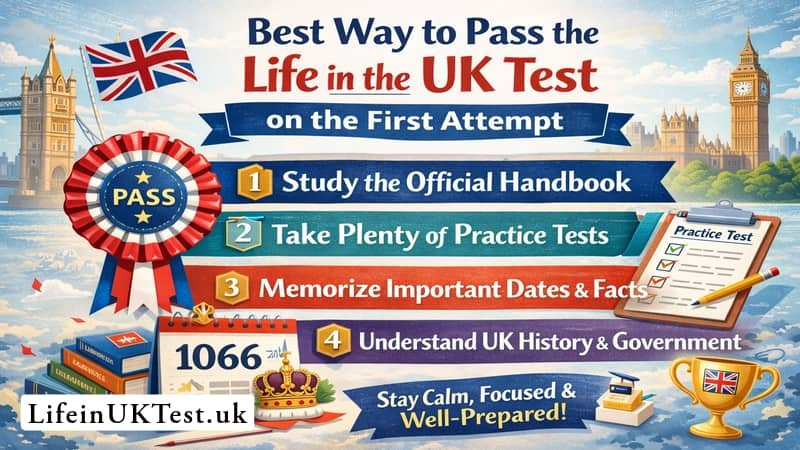
Best Way to Pass the Life in the UK Test on the First Attempt is a common concern for people applying for British citizenship or Indefinite Leave to Remain (ILR). The Life in the UK Test requires a good understanding of British history, values, culture, and everyday life, and passing it first time depends on using the right preparation strategy. In this article, we share proven study tips, effective revision methods, and practical advice to help you prepare confidently and maximize your chances of success.
Best Way to Pass the Life in the UK Test on the First Attempt: Your Complete 2026 Guide
Let’s be real — the Life in the UK test can feel daunting. You’re probably thinking about your citizenship dreams, your family’s future, and honestly, wondering if memorizing centuries of British history is even possible. I get it. But here’s the good news: thousands of people pass this test every month, and with the right approach, you absolutely can nail it on your first attempt.
This guide isn’t just another generic article. I’ve compiled everything you genuinely need to know for 2026, including the latest changes, real student experiences, and practical tips that actually work. No fluff, no corporate speak — just honest advice to help you succeed.
What’s Actually Changed in 2026?
Before we dive in, let’s clear up the confusion about 2026 updates. Here’s what you need to know right now:
The Official Status (January 2026):
- The government announced plans in October 2025 to modernize the test content, but as of now, no new handbook or syllabus has been released
- You’re still using the same official materials: Life in the United Kingdom: A Guide for New Residents, 3rd Edition (from 2013)
- The test format remains unchanged: 24 questions, 45 minutes, 75% pass mark required
- Keep checking GOV.UK for official updates before you book
What HAS Changed Recently:
- eVisa Booking: You can now use your digital immigration status (eVisa share code) instead of a physical passport when booking
- Pricing Updates: Standard test fee is £50 for weekday slots, but Sunday and peak-time appointments can cost up to £65
- No Detailed Feedback: Since 2025, if you fail, you only receive your percentage score — not the question-by-question breakdown you used to get
The bottom line? Don’t wait for a “new” handbook. Study what’s available now, because that’s what the test is based on.
Understanding the Test: What You’re Actually Facing
Let me break down what test day really looks like, because knowing exactly what to expect eliminates about 50% of the anxiety.
The Format
| Test Element | Details |
|---|---|
| Questions | 24 multiple-choice questions |
| Time Limit | 45 minutes (you’ll likely finish in 20-30 minutes) |
| Pass Mark | 75% — that’s 18 out of 24 correct answers |
| Type | Computer-based; you can’t go back once you submit an answer |
| Language | English (or Welsh/Scottish Gaelic by special arrangement) |
What’s Actually Tested?
The questions come from all five chapters of the official handbook:
- The Values and Principles of the UK — British values, rights, and responsibilities
- What is the UK? — Geography, nations, and basic facts
- A Long and Illustrious History — From prehistoric Britain to modern times
- A Modern, Thriving Society — Culture, sports, arts, and everyday life
- The UK Government, the Law and Your Role — Political system, laws, and civic participation
Here’s what students often don’t realize: questions can come from anywhere in the book, including tiny details. The person next to you will get completely different questions. That’s why apps alone won’t cut it — you need comprehensive knowledge.
The Pass Rate Reality
The overall pass rate hovers around 70%, with EU nationals historically passing at about 86% and non-EU candidates around 60%. Why the difference? Honestly, it often comes down to cultural familiarity and English language comfort. But don’t let statistics psych you out — proper preparation is the real differentiator.
How to Book Your Test: The Step-by-Step Process
Booking sounds simple, but people make mistakes here that cost them time and money. Let’s get it right.
Before You Book
1. Confirm You Actually Need the Test
You need this test for:
- British citizenship (naturalization)
- Indefinite Leave to Remain (ILR/settlement)
You DON’T need it if you:
- Are under 18 or over 65
- Already passed it for a previous application
- Have a documented long-term physical or mental condition (requires medical evidence)
2. Gather Your ID Documents
You’ll need:
- Valid photo ID (passport, biometric residence permit/card, or EU/EEA national ID card)
- eVisa share code (if using digital status) — get this from your UKVI account
- Proof of address dated within the last 3 months (utility bill, bank statement, or council tax letter)
- Name-change documents if applicable (marriage certificate, deed poll, etc.)
Critical tip: The name on your booking must match your ID exactly — same middle names, spelling, everything. This trips up so many people.
The Booking Process
Step 1: Create Your Account
- Go to the official GOV.UK website only: www.gov.uk/life-in-the-uk-test
- Register with a valid email address
- Never use third-party booking sites — they charge extra fees for the same service
Step 2: Choose Your Test Centre
- There are 30+ centres across the UK
- Use the postcode search to find options near you
- You can only choose from the five closest centres to your registered address
- Pro tip: Mid-week morning slots are usually less crowded
Step 3: Select Your Date and Time
- Book at least 3 days in advance (this is mandatory)
- Check multiple nearby centres if you need an earlier slot
- Remember: cancellations or changes within 72 hours forfeit your £50 fee
Step 4: Enter Your Details
- Input your ID information exactly as it appears on your document
- Choose whether you’re using eVisa or traditional ID
- Double-check everything before submitting
Step 5: Pay and Confirm
- Standard fee: £50 (weekdays)
- Premium slots: up to £65 (Sundays and peak times)
- You’ll receive a confirmation email — save this and bring it on test day
Test Day Essentials
Bring with you:
- The exact same ID you used for booking (original, not a copy)
- Proof of address (if your centre requests it)
- Your confirmation email (printed or on your phone)
- Nothing else — no bags, phones, notes, or study materials allowed
You’ll have your photo taken at the centre for verification. If you don’t have proper ID or refuse the photo, you can’t take the test and won’t get a refund.
The Real Strategy: How to Actually Pass on Your First Attempt
Alright, let’s talk about what actually works. I’ve seen people fail despite studying for months, and others pass after just two weeks of focused preparation. Here’s the difference.
Start with a Study Plan (Seriously)
Don’t just “wing it” or read randomly. Here’s a proven timeline:
If You Have 4-6 Weeks:
- Weeks 1-2: Read the official handbook cover to cover, taking notes on key facts
- Weeks 3-4: Focus on difficult chapters (usually History and Government), do practice tests
- Weeks 5-6: Take full mock exams daily, review mistakes, memorize weak areas
If You Have 2-3 Weeks:
- Week 1: Speed-read the handbook, highlight important dates, names, and numbers
- Week 2: Intensive practice testing, identify knowledge gaps
- Week 3: Daily mock exams, targeted revision of problem areas
If You’re Down to 1 Week: Listen, this is tight but possible. Focus on high-yield topics: British values, government structure, major historical events, and famous figures. Take as many practice tests as humanly possible. Skip deep dives into minor details.
The Official Resources (Start Here)
| Resource | Where to Get It | Why It Matters |
|---|---|---|
| Life in the UK: A Guide for New Residents (3rd Edition) | Official Shop or Free PDF Online | This is THE source. Every question comes from here. |
| Official Practice Questions & Answers Book | Official Shop | 400+ official practice questions |
| Official E-Learning Course | Official Life in the UK | Interactive modules with quizzes |
The Best Free Practice Resources
Honestly, you don’t need to spend a fortune. Checkout Life in the UK Test 2026 | Free Practice Questions, Exams & Study Guide free resource.
Mobile Apps Worth Using
If you’re constantly on the go, these apps get recommended frequently:
- Life in the UK Test 2026 (iOS/Android) — Over 1,200 questions, dark mode, offline access
- Official Life in the UK Test App — From the official provider
Warning: One student recently shared they scored 95% on three different apps but almost failed the real test because many questions were completely new. Apps are helpful for practice, but don’t rely on them exclusively. You MUST read the handbook.
Study Techniques That Actually Work
1. Active Learning > Passive Reading
Don’t just read the handbook like a novel. Engage with it:
- Take handwritten notes (this forces your brain to process information)
- Create your own flashcards for dates, names, and key facts
- Explain concepts out loud to yourself or a study partner
- Draw timelines for historical events
2. Use Mnemonics for Lists
For example, remembering the order of British monarchs: “Will William And Mary Anne George Victoria Edward Elizabeth” (William and Mary, Anne, Georges I-IV, William IV, Victoria, Edward VII, George V, Edward VIII, George VI, Elizabeth II, Charles III)
Create your own for patron saints, countries in the UK, etc.
3. Focus on High-Risk Topics
These areas trip people up most:
- Dates and numbers: Population figures, ages of monarchs, war dates
- The difference between: Great Britain vs. UK vs. British Isles; patron saints and their symbols
- Government structure: Who does what (Prime Minister vs. Monarch vs. Parliament)
- Historical figures: What they’re famous for and when they lived
4. Take Practice Tests Under Real Conditions
- Set a 45-minute timer
- Use a computer
- Don’t check answers until you’re done
- Track your scores and improvement
If you’re consistently scoring 85-90% on practice tests, you’re ready for the real thing.
Common Mistakes That Cause Failures
Let me save you from these pitfalls:
1. Cramming the Night Before Your brain needs time to consolidate information. One all-nighter won’t cut it.
2. Only Using Apps Apps are great supplements, but the test pulls from the entire handbook. Multiple recent test-takers reported seeing questions they’d never encountered in apps.
3. Memorizing Without Understanding If you just memorize facts without context, you’ll struggle with how questions are phrased. Understand the “why” behind events.
4. Skipping “Boring” Chapters I get it — the History chapter is dense. But questions come from everywhere, including sections that seem irrelevant.
5. Not Reading Questions Carefully Some questions ask for multiple correct answers. Others use tricky wording. Read. Every. Word.
6. Panicking and Second-Guessing Your first instinct is usually right. Don’t change answers unless you’re certain.
7. Booking Too Late in Your Visa Timeline Your pass certificate is valid for two years, but life happens. Book your test well before you need it for your citizenship or ILR application.
What Happens on Test Day?
Let’s walk through the actual experience so there are no surprises.
Arrival
- Arrive 15 minutes early (but not more than that — you’ll just wait around)
- Check in at reception with your ID
- Your photo will be taken for verification
- You’ll be assigned a computer terminal
During the Test
- The test is computer-based with a simple interface
- Each question appears one at a time
- Click your answer(s) and move to the next question
- You cannot go back to previous questions once submitted
- Most people finish in 20-30 minutes, even though you have 45
After the Test
- You’ll see your result immediately on screen
- If you pass (18+ correct): Your account will show your Unique Reference Number (URN) within 24 hours — you’ll need this for your citizenship/ILR application
- If you fail: You’ll see only your percentage score, no question details
- You can retake the test as many times as needed (each attempt costs £50)
- No waiting period between retakes
If You Fail: The Retake Process
First of all, don’t beat yourself up. About 30% of test-takers don’t pass on their first attempt. Here’s how to bounce back stronger:
Immediate Steps
- Log into your account at www.lituktestbooking.co.uk
- Book your retake (minimum 3 days out)
- Pay another £50
What to Do Differently
- Identify your weak areas (even though you don’t get specific feedback, you probably know which topics felt harder)
- Increase your study intensity — more practice tests, deeper reading
- Use different resources — try apps or websites you haven’t used yet to see questions from new angles
- Consider a study partner or online study group for motivation
Quick Reference: Key Facts to Memorize
Since you’ve made it this far, here are some commonly tested facts (but don’t rely only on this — you need the full handbook!):
The UK Nations
- England — Capital: London; Patron saint: St. George; Symbol: Red rose and three lions
- Scotland — Capital: Edinburgh; Patron saint: St. Andrew; Symbol: Thistle
- Wales — Capital: Cardiff; Patron saint: St. David; Symbol: Daffodil and leek
- Northern Ireland — Capital: Belfast; Patron saint: St. Patrick; Symbol: Shamrock
Population (Approximate)
- Total UK population: around 67 million
- Largest countries by population: England > Scotland > Wales > Northern Ireland
Government Basics
- Head of State: The Monarch (King Charles III since 2022)
- Head of Government: The Prime Minister
- Parliament: House of Commons (elected) + House of Lords (appointed)
- Voting age: 18 years old
- Elections: Every 5 years (maximum)
British Values
- Democracy
- The rule of law
- Individual liberty
- Tolerance of those with different faiths and beliefs
- Participation in community life
Important Historical Dates
Checkout Life in the UK Test Study Guide – Life in UK Test
- 1066: Battle of Hastings (Norman Conquest)
- 1215: Magna Carta signed
- 1314: Battle of Bannockburn (Scottish victory)
- 1534: Church of England breaks from Rome
- 1649: King Charles I executed
- 1707: Act of Union (England and Scotland unite)
- 1801: Ireland joins (United Kingdom created)
- 1918: Women over 30 gain the right to vote
- 1928: Women and men have equal voting rights
- 1945: End of World War II
- 1948: NHS founded
Special Circumstances and Exemptions
Medical Exemptions
If you have a long-term physical or mental condition that prevents you from passing the test, you may be exempt. You’ll need:
- A completed exemption form, or
- A letter from your doctor confirming your condition
Submit this with your citizenship or settlement application.
Language Concerns
The test is written at ESOL Entry Level 3 — roughly intermediate English. If you can read and understand this guide, you’re likely fine.
If English isn’t your first language:
- Take your time with questions
- Focus on understanding keywords
- Practice reading the handbook slowly and carefully
- Consider the official e-learning course, which breaks down complex language
Already Passed for Settlement?
If you passed the test for ILR and now need citizenship, good news: you don’t need to retake it. Your pass certificate never expires. Just include your Unique Reference Number (URN) with your citizenship application.
Final Preparation Checklist
Print this out or save it to your phone for the week before your test:
One Week Before:
- [ ] Take at least one full mock test daily
- [ ] Review all “Check that you understand” boxes in the handbook
- [ ] Make flashcards for any facts you keep forgetting
- [ ] Confirm your test booking details and test centre location
Three Days Before:
- [ ] Do a final read-through of the handbook
- [ ] Take 2-3 mock tests
- [ ] Score consistently above 85%
- [ ] Double-check your ID is valid and matches booking details
The Day Before:
- [ ] Light review only (no cramming!)
- [ ] Pack your ID and proof of address
- [ ] Print or save confirmation email
- [ ] Plan your route to the test centre
- [ ] Get a good night’s sleep
Test Day Morning:
- [ ] Eat a proper breakfast
- [ ] Bring your ID (original), proof of address, and confirmation
- [ ] Arrive 15 minutes early
- [ ] Take a few deep breaths
- [ ] You’ve got this!
Frequently Asked Questions
Q: Can I take the test in Welsh or Scottish Gaelic? Yes! Request this when booking through the “Special Arrangements” process.
Q: What if I have a disability? You can request accommodations (extra time, special equipment, accessibility support) when booking. Contact the Life in the UK Test Helpline: 0800 015 4245.
Q: How long is my pass certificate valid? Forever. Your pass never expires, though you must use the URN within two years if taking the test for ILR (since ILR itself has time limits).
Q: Can I bring a calculator or notes? No. The test centre provides a computer and that’s it. No phones, bags, calculators, notes, or study materials allowed.
Q: What happens if my name has changed since I got my ID? Bring supporting documents (marriage certificate, deed poll) and make sure your booking details match your current legal name.
Q: I lost my pass certificate. Can I get a replacement? Your pass is stored electronically. Include a letter explaining the loss with your citizenship/settlement application, or log into your account to retrieve your URN.
Q: Can I leave the test early if I finish? Yes, once you’ve answered all 24 questions, you’re done. Most people finish in 20-30 minutes.
Final Thoughts: You Can Do This
Look, I know this test feels like just another hoop to jump through on your journey to making the UK your permanent home. And honestly? It is. But it’s also entirely passable with proper preparation.
The people who fail usually fall into one of two camps: those who don’t study enough (thinking it’s easier than it is), or those who over-stress and second-guess themselves. Don’t be either person.
Here’s what actually matters:
- Read the handbook — genuinely read it, don’t just skim
- Take lots of practice tests
- Focus on understanding, not just memorizing
- Give yourself enough time to prepare properly
- Show up on test day confident that you’ve done the work
This isn’t a trick or a trap. It’s a straightforward test of whether you understand British culture, history, and values. The government wants you to succeed — they’re literally giving you all the answers in the official handbook.
Thousands of people pass this test every single month. Many of them are juggling full-time jobs, raising families, and dealing with the same language barriers and cultural adjustments you might be facing. If they can do it, so can you.
Book your test, make your study plan, and get to work. In a few weeks, you’ll have that pass certificate in hand and be one step closer to your citizenship or settlement goals.
You’ve got this. Now go ace that test.
Useful Links and Resources
Official Government Sites
- Book Your Test: www.gov.uk/life-in-the-uk-test
- Official Study Materials: www.officiallifeintheuk.co.uk/shop
- eVisa Information: www.gov.uk/get-evisa-share-code
- Test Centre Locations: Check during booking process on GOV.UK
- Life in the UK Helpline: 0800 015 4245 (Mon-Fri, 8am-8pm)
- Email Support: support@lituk.psionline.com
Free Practice Resources
- Life in UK Test Website – LifeinUKTest.uk
Additional Support
- Citizens Advice: For exemptions and special circumstances
- Immigration Solicitors: For complex visa situations or medical exemptions
Last Updated: January 2026
Disclaimer: This guide is for informational purposes only and reflects the most current information available as of January 2026. Always check GOV.UK for official updates before booking your test. Requirements and procedures may change. For specific immigration advice, consult a qualified immigration solicitor.