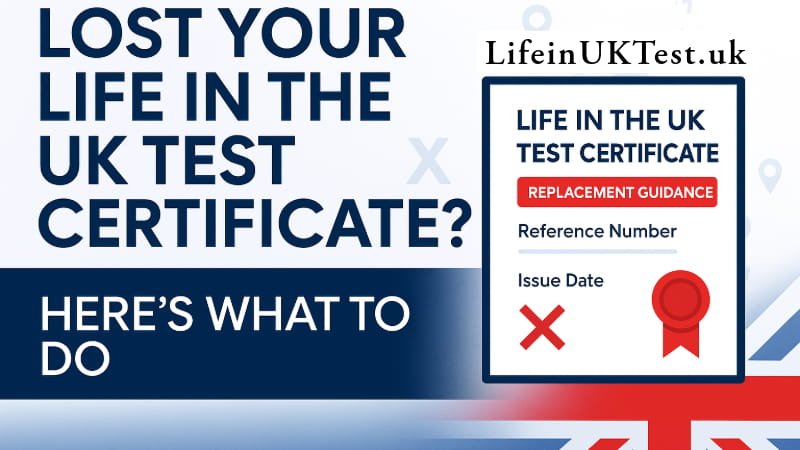
Lost your Life in the UK Test Certificate? This can be worrying, especially if you need it for a British citizenship or Indefinite Leave to Remain (ILR) application. The Life in the UK Test certificate is an important document, but the good news is that it can be replaced. In this article, we explain what to do if you have lost your certificate, how to request a replacement, and the steps you need to take to avoid delays in your application.
Lost Your Life in the UK Test Certificate? Here’s What to Do (2026 Guide)
Let’s be real—life happens. You’ve passed your Life in the UK test, carefully stored that certificate somewhere safe, and now when you actually need it for your citizenship or settlement application, it’s nowhere to be found. House moves, domestic situations, lost emails, or just the chaos of everyday life can make important documents disappear. If you’re feeling that sinking sensation right now, take a breath. You’re definitely not alone, and there are clear paths forward.
Understanding What You’re Actually Missing
First things first: what exactly did you lose? The documentation system for the Life in the UK test has changed significantly over the years, and knowing which version you had matters.
If you took your test after December 17, 2019, you should have received a Unique Reference Number (URN). This is a digital code linked to your test pass record in the Home Office database. Modern certificates include this number, and honestly, this is the golden ticket you need.
If you took your test before December 17, 2019, you received a physical pass notification letter with a test reference ID instead. Here’s the kicker—the Home Office doesn’t issue replacements for these older certificates. None. Zero. This isn’t them being difficult; it’s simply how the system worked back then.
The Hard Truth About Replacements
I wish I had better news, but you need to hear this clearly: the Home Office and test centres do not issue replacement certificates or duplicate pass letters. This policy hasn’t changed as of 2026, and it applies whether you lost your certificate yesterday or ten years ago.
This might seem harsh, especially if you’re dealing with difficult circumstances like domestic abuse, emergency relocations, or simply the aftermath of a house move. But understanding this reality upfront means you can focus your energy on solutions that actually work rather than spending weeks chasing something that won’t happen.
Your Actual Options (That Really Work)
Option 1: Find Your Unique Reference Number
Before you panic about retaking the test, let’s try to track down that reference number. Many people have it somewhere without realising:
Check your emails thoroughly—and I mean really dig:
- Search for “Life in the UK,” “LITUK,” “test confirmation,” “pass notification”
- Check old email accounts, including ones you might not use anymore (yes, even that Hotmail account)
- Look in spam folders and archived messages
- If you used a work or school email that’s no longer active, contact the IT department—they might still have access
Look through your existing immigration paperwork:
- Your ILR application copy (you definitely put it in there)
- Any correspondence from the Home Office about previous applications
- Digital copies of documents you might have uploaded to immigration portals
- Phone photos or scans you took for “backup”
Try to access your test account:
- Visit the Life in the UK test booking website
- Use the “forgot password” function with the email you used for booking
- If you can log back in, your test result and reference number should be visible
Check physical paperwork:
- Look in folders with other immigration documents
- Bank statements from around the time you took the test (the £50 payment might jog your memory about dates)
- Calendar entries or appointment confirmations
Option 2: Apply Without the Physical Certificate
This is where things get interesting, and it’s genuinely worked for many applicants. When you’re filling in your citizenship or ILR application online, you’ll hit the section asking for your Life in the UK test reference number.
If you don’t have the reference number:
- Enter “0” or “N/A” in the reference number field
- The system will then prompt you to provide an explanation
- Write a detailed covering letter explaining your situation
Your covering letter should include:
- The approximate date you took the test (even just the month and year helps)
- The test centre location (city is enough if you can’t remember the exact address)
- Your full name as it appeared on your ID at the time
- Any other identifying details (passport number you used, email used for booking)
- A brief, honest explanation of why you no longer have the certificate
- That you did pass the test and are requesting the Home Office verify this through their records
Here’s a template to get you started:
Dear Home Office,

I am writing regarding my Life in the UK test pass certificate, which I no longer have in my possession.

I successfully passed the Life in the UK test in [month/year, be as specific as possible] at [test centre location]. At the time, my identifying documents were [passport number/BRP number if you remember them].

Unfortunately, I no longer have access to my pass notification letter or unique reference number due to [brief explanation: house move, domestic situation, lost documents during relocation, etc.].

I understand that the Home Office maintains records of all test passes, and I would be grateful if you could verify my test result using the information provided above. I am happy to provide any additional information that may assist in locating my record.

Thank you for your consideration.

Yours sincerely,
[Your name]
The good news? The Home Office genuinely does maintain digital records of everyone who’s passed the test. They can verify your pass status if you give them enough information to find you in their system.
Option 3: Contact the Home Office Directly
This should be your next step after writing your covering letter, not instead of it.
Key contact information (updated for 2026):
| Contact Method | Details | Best For |
|---|---|---|
| Phone (UKVI) | 0300 123 2253 | General guidance about your situation |
| Phone (Test helpline) | 0800 015 4245 | Questions specifically about test records |
| nationalityenquiries@homeoffice.gov.uk | Written queries and follow-ups |
When you call, have ready:
- Your full name and date of birth
- Approximate test date
- Test centre location
- Current immigration status
- Why you’re calling (applying for citizenship/ILR)
Pro tips from people who’ve done this:
- Call early in the morning (lines open around 8am and are quieter then)
- Be patient—wait times can be 30+ minutes
- Write down the advisor’s name and any reference number they give you
- Ask them specifically what they recommend you do for your application
- Don’t expect them to email you your certificate—they can’t do that, but they can tell you the proper procedure
Option 4: Retake the Test
Let’s talk about the nuclear option: just taking the test again. For some people, this is genuinely the most straightforward path forward, especially if:
- You took the test many years ago and honestly can’t remember any details
- You’ve lost absolutely everything and have no paper trail
- You want the peace of mind of having a fresh, current certificate
- The stress of uncertainty isn’t worth it
Life in UK Test can help you in preparation.
The logistics in 2026:
- Test fee: £50 (unchanged)
- Booking: Through the official GOV.UK website only
- Wait time between booking and test: Usually 1-2 weeks, can be same week in busy areas
- Test format: Still 24 multiple-choice questions, 45 minutes, need 75% to pass (18/24 correct)
- Results: Immediate—you’ll know before you leave the centre
Honest assessment: The test hasn’t dramatically changed since 2019. If you passed it once, you can absolutely pass it again. The official handbook (3rd edition) is still the same, and there are loads of free practice tests online. Most people who retake pass comfortably because they’ve actually lived in the UK for years since their first test.
The Digital Revolution Coming in 2026
Here’s something crucial to understand about where things are heading. The Home Office is transitioning to fully digital verification systems throughout 2026. What this means for you:
By December 31, 2026, all immigration documents need to be stored in digital eVisa accounts. This includes:
- Your ILR/settled status
- Your Life in the UK test results
- English language test certificates
- All supporting documents for citizenship applications
Why this matters for lost certificates:
- Future verifications will be entirely digital
- The Home Office is improving their database systems for checking historical passes
- If you’re applying in late 2026 or beyond, digital verification might be more straightforward
- You’ll need basic digital literacy to navigate these new systems
What’s NOT changing:
- The actual test requirement (still mandatory for ages 18-64)
- The test format (24 questions, 45 minutes, 75% pass mark)
- The pass certificate never expires (your old pass from 2008 is still valid)
- The official handbook (3rd edition still current as of early 2026)
Common Mistakes People Make (Learn From Others)
Mistake 1: Contacting the test centre years later Test centres are administered by private companies who delete records after a certain period. They genuinely can’t help you if it’s been more than a few months. Focus on the Home Office instead.
Mistake 2: Paying “services” to get your certificate back There’s no legitimate service that can retrieve lost certificates. Any company claiming they can is either going to retake the test on your behalf (which is fraud) or simply submit the same covering letter you could write yourself.
Mistake 3: Delaying your citizenship application Your certificate being lost isn’t a reason to not apply. Thousands of people successfully apply without having the physical certificate in hand. Submit your application with a covering letter and let the Home Office sort it out.
Mistake 4: Assuming you need to retake immediately Explore all your options first. Retaking is always available as a fallback, but it might not be necessary.
Mistake 5: Not keeping digital backups going forward Once you sort this situation out, scan everything. Upload copies to secure cloud storage. Email PDFs to yourself. Take phone photos. Never go through this stress again.
Special Circumstances
Domestic abuse situations: If you’ve fled domestic abuse and lost documents in the process, the Home Office understands these circumstances. Be honest in your covering letter. Many people in your exact situation have successfully obtained citizenship by explaining their circumstances clearly.
Multiple moves or homelessness: Again, be straightforward. The Home Office has seen every possible situation. What matters is that you passed the test, not that you kept perfect filing systems during difficult life circumstances.
Elderly applicants who passed years ago: If you’re approaching age 65, remember that you become exempt from the test requirement at 65. Depending on when you plan to apply, it might be worth waiting until after your 65th birthday rather than stressing about finding old certificates.
What About Policy Changes and Reforms?
You might have heard rumours about the test changing in 2026. Here’s what’s actually happening:
Confirmed information as of January 2026:
- In October 2025, the Home Office announced intentions to “modernise” the test content
- No new handbook or revised syllabus has been published yet
- Any future changes would focus on British values rather than historical trivia
- The legal requirement to pass the test isn’t changing
- Current test-takers should prepare using the existing 3rd edition handbook
What this means for you:
- If you’re applying now with a lost certificate from years ago, any potential future changes are irrelevant to you
- Your old pass certificate remains valid regardless of future test revisions
- There’s no advantage to waiting for new policies if you’re ready to apply now
Quick Reference: Your Action Plan
Within the next 24 hours:
- Search all email accounts for anything test-related
- Check if you can access your test booking account online
- Look through physical files for ILR paperwork with the reference number
- Scan through phone photos from around your test date
Within the next week:
- Call the Home Office helpline (0300 123 2253) for specific guidance
- Draft your covering letter explaining the situation
- Gather any supporting evidence you can find (approximate dates, locations, etc.)
- Decide whether to apply with the letter or retake the test
When you’re ready to apply:
- Start your citizenship/ILR application as normal
- When asked for reference number, enter “0” or explain you don’t have it
- Attach your detailed covering letter
- Include any supporting documentation
- Submit with confidence—the Home Office can verify your pass
The Bottom Line
Yes, losing your Life in the UK test certificate is frustrating and stressful, especially when you’ve got citizenship or ILR applications on the line. But it’s genuinely not the disaster it feels like right now.
The Home Office processes thousands of applications where people can’t provide their original test certificates. They have systems in place for exactly this situation. They maintain digital records. They understand life happens.
Your job is simply to give them enough information to locate your record in their database. Be honest, be thorough, and provide whatever details you can remember. Most importantly, don’t let this hold up your immigration journey. You’ve already passed the test—that accomplishment doesn’t disappear just because a piece of paper did.
And hey, worst case scenario? You book another £50 test, spend a weekend refreshing your knowledge with practice questions, and walk out with a brand new certificate. You’ve overcome much bigger challenges to get where you are in your UK journey. This is just one more small hurdle.
Frequently Asked Questions
Does my test certificate expire? No, never. Whether you passed in 2005 or 2025, that pass is valid forever for all future ILR and citizenship applications.
Can I apply for citizenship without finding my certificate? Yes, absolutely. Submit a covering letter explaining you’ve lost it, include whatever information you can remember about when and where you took it, and let the Home Office verify through their records.
How long does Home Office keep test records? They maintain digital records indefinitely, especially for tests taken after 2019. Pre-2019 tests exist in older systems but are still retrievable with enough identifying information.
Will losing my certificate affect my application outcome? Not if you handle it properly. Provide a clear explanation and the Home Office will verify your pass status. The lost certificate itself isn’t a reason for refusal.
Should I mention the certificate is lost when booking a new test? If you’re retaking the test, just book as normal. You don’t need to explain that you’re retaking it—the system doesn’t track that or care.
What if I failed the test initially but passed later? Only your pass result matters. If you passed on your second or third attempt, that’s still a pass. Include the date of the test you passed when providing information to the Home Office.
Useful Resources and Contacts
| Resource | Link | Purpose |
|---|---|---|
| Official GOV.UK Life in UK page | https://www.gov.uk/life-in-the-uk-test | Test information and booking |
| Home Office UKVI helpline | 0300 123 2253 | General immigration queries |
| Test helpline | 0800 015 4245 | Test-specific questions |
| Home Office email | nationalityenquiries@homeoffice.gov.uk | Written enquiries |
| Official test booking | https://www.lituktestbooking.co.uk/ | Book or rebook test |
| Official handbook (3rd edition) | Available on Amazon or test centre websites | Study material |
Remember: You’ve already proven you can pass this test once. Don’t let a missing piece of paper define your entire immigration journey. Take action, follow the steps above, and move forward with your citizenship goals. You’ve got this.