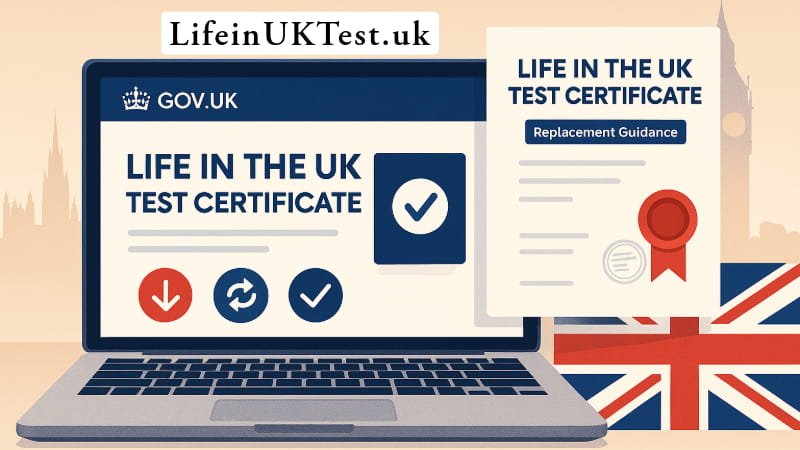
Have you lost the crucial Life in the UK Test Pass Notification Letter and are worried it will delay your application for Indefinite Leave to Remain (ILR) or British citizenship? You’re not alone. Many people misplace their certificate, and the official process for retrieving proof of your successful pass can be confusing, especially with the latest Home Office changes for 2026. Unfortunately, you generally cannot simply ‘download’ a copy.
This complete guide breaks down exactly how to download or replace your Life in the UK Test Certificate—whether you received a physical letter (pre-2019) or a Unique Reference Number (URN) —and what specific actions you need to take to ensure your UK settlement application is successful.
How to Download or Replace Your Life in the UK Test Certificate: The Complete 2026 Guide
Let’s be real—losing your Life in the UK test certificate is stressful. You’ve worked hard to pass that test, and now you’re facing citizenship or settlement applications without your proof. I’ve seen countless people panic about this situation, so let me walk you through everything you need to know about downloading, replacing, or recovering your certificate in 2026.
First Things First: Understanding What You Actually Received
Here’s something that confuses people all the time. The way you receive your test results depends entirely on when you took your test.
If you took your test on or after December 17, 2019: You received a Unique Reference Number (URN) electronically. No physical letter. This digital reference is what you’ll use for your applications. Think of it like a digital passport—it’s stored in the system forever.
If you took your test before December 17, 2019: You got a physical Pass Notification Letter with a Test Reference ID printed on it. This is the old-school paper certificate that people often misplace during house moves or life upheavals.
This distinction is crucial because it determines exactly how you’ll recover your information if it’s lost.
The Good News: Your Pass Never Expires
Before we dive into recovery methods, here’s something you need to know that’ll ease your mind: your Life in the UK test pass is valid forever. There’s no expiration date. Whether you passed last month or a decade ago, that result stays on your record permanently.
You can use the same pass for your Indefinite Leave to Remain application and later for British citizenship. The Home Office maintains digital records of all test results, so even if your physical proof goes missing, your pass is still in the system.
How to Download Your Certificate (Post-December 2019)
If you took your test recently and have a URN, accessing your details is straightforward:
Step 1: Log Into Your Booking Account
Visit the official government website at gov.uk/life-in-the-uk-test and sign into the account you used when booking your test. Use the same email address you provided during registration.
Step 2: Check Your Past Bookings
Once logged in, navigate to your booking history. Your pass notification and URN should be visible there. Take a screenshot or save this as a PDF immediately—honestly, back it up to cloud storage too. You don’t want to go through this again.
Step 3: Can’t Access Your Account?
If you’ve forgotten your password or can’t log in, use the account recovery option on the booking website. You’ll need to provide:
- Your full name (exactly as it appears on your ID)
- Date of birth
- The email address you used for booking
- Test centre location
- Date you took the test
The provider’s support team can help retrieve your URN. Contact them at support@lituk.psionline.com or call 0800 015 4245 (Monday to Friday, 8am to 8pm).
What to Do If You Lost Your Pre-2019 Pass Notification Letter
Here’s where it gets trickier, but there’s absolutely a way forward. The Home Office doesn’t issue replacement certificates for lost pass notification letters. That’s just their policy—frustrating, I know, but workable.
The Official Solution: Write an Explanatory Letter
The Home Office explicitly advises applicants who’ve lost their pass notification letters to include a written explanation with their citizenship or settlement application. Your letter should contain:
Essential Information to Include:
- Your full name (as it appeared on the test)
- Your date of birth
- The exact date you took the test (or your best estimate if you’re uncertain)
- The test centre location where you sat the exam
- Your Test Reference ID or pass number (if you remember it—this is the golden ticket if you have it)
- A clear explanation of why the letter was lost (house move, domestic situation, misplaced during a stressful period—be honest but brief)
Important: The Home Office will use this information to verify your pass in their system. As long as your details match their records, you’re fine. They understand documents get lost—it happens to thousands of people.
Template Letter for Lost Certificates
Date: [Today's Date]

To: UK Visas and Immigration
Home Office

Subject: Lost Life in the UK Test Pass Notification Letter

Dear Sir/Madam,

I am writing to inform you that I have lost my Life in the UK Test pass notification letter, which I require for my [citizenship/settlement] application.

Test Details:
- Full Name: [Your name as it appeared on the test]
- Date of Birth: [Your DOB]
- Test Date: [Date or approximate date]
- Test Centre: [Location/city]
- Test Pass Number: [If you remember it, include it here; if not, state "unknown"]

Circumstances of Loss:
[Brief explanation—e.g., "The certificate was lost during a house move in 2023" or "The document was misplaced following a domestic incident"]

I can confirm that I passed the Life in the UK Test and request that you verify this information through your records. I have attached all supporting documentation for my [citizenship/settlement] application.

Thank you for your assistance.

Yours faithfully,
[Your signature]
[Your full name]
Include this letter with your settlement or citizenship application. Don’t submit it separately—the Home Office processes it alongside your main application.
Can You Call the Home Office?
Yes, and honestly, this is often helpful. Call the Home Office on 0300 123 2253 and explain your situation. They can’t send you a replacement certificate, but they can:
- Confirm you’re on the right track with the explanatory letter
- Verify internally that you passed (though they won’t tell you specifics over the phone)
- Provide guidance specific to your circumstances
Alternative: Check With Your Test Centre
Some applicants have had success contacting the test centre where they sat their exam. While centres aren’t required to keep records long-term, it’s worth a phone call. They may have archived information that could help jog your memory about the exact date or reference number.
Preventing Future Headaches: Protect Your Certificate Now
If you still have your certificate or just passed your test, take these steps immediately:
Create Multiple Backups:
- Scan or photograph your certificate in high resolution
- Save it to multiple locations: Google Drive, Dropbox, email it to yourself
- Print several copies and store them in different safe places
- Text a photo of it to a trusted family member
Record Your Details:
- Write down your URN or Test Reference ID in a secure password manager
- Note the test date, location, and centre address
- Keep this information separate from the physical document
Honestly, this five-minute task could save you hours of stress later.
Common Mistakes to Avoid When Dealing With Lost Certificates
Mistake 1: Assuming you need to retake the test Unless the Home Office explicitly tells you to resit after reviewing your case, don’t book another test. Your pass is almost certainly still in the system.
Mistake 2: Delaying your application Don’t postpone your citizenship or settlement application just because you’ve lost your certificate. Include the explanatory letter and proceed—delays cost you time and potentially money.
Mistake 3: Paying for unofficial “replacement services” There are no legitimate third-party services that can replace your certificate. Anyone claiming they can is scamming you. Only the Home Office holds these records.
Mistake 4: Providing vague information The more specific details you can provide in your explanatory letter, the easier it is for the Home Office to locate your record. “I took the test somewhere in London in 2015” is much harder to verify than “I took the test at Croydon Test Centre on approximately June 15, 2015.”
What Happens If Your Name Changed Since Taking the Test?
This is surprisingly common—marriage, divorce, or deed poll can all create name mismatches between your test records and current applications.
Your pass is still valid. Here’s how to handle it:
- Include name change documentation with your application (marriage certificate, decree absolute, or deed poll)
- Reference both names in your explanatory letter if you’ve lost your certificate
- Ensure consistency across all application documents
The Home Office expects name changes and has processes to match records across different names. Just provide clear documentation showing the legal name change.
Special Circumstances: Domestic Violence, Emergency Situations, or Urgent Applications
If you lost your certificate due to domestic violence, fleeing a dangerous situation, or other emergency circumstances, you deserve extra support:
- Be honest in your explanatory letter about the circumstances (you don’t need graphic detail, just clarity)
- Contact immigration solicitors who can advocate on your behalf if you’re in a vulnerable situation
- Request priority service for your main application if circumstances warrant it
- Document any police reports, refuge stays, or support services you’ve accessed—this corroborates your situation
The Home Office does understand that life happens, and they’ve processed thousands of applications where certificates were lost in difficult circumstances.
The 2026 Update: Digital Verification and eVisa Integration
There’s good news on the horizon. As of 2026, the UK immigration system is moving toward full digital verification. By December 31, 2026, all immigration status will be recorded digitally through the eVisa system.
What this means for you:
- Stronger digital record-keeping reduces the importance of physical documents
- The Home Office can verify your test results electronically more easily
- Future test-takers will have even better digital access to their records
If you’re applying for citizenship or settlement in 2026, the digital verification systems should make the process smoother, even if you’ve lost physical documentation.
Test Content Updates for 2026 (What You Need to Know)
While this article focuses on certificates, it’s worth noting that the Home Office announced plans in October 2025 to modernize the test content. However, as of early 2026, no new handbook has been officially published.
The current situation:
- The existing 3rd edition handbook remains the official study material
- The test format hasn’t changed: 24 questions, 45 minutes, 75% pass mark
- Any future updates will be announced officially on gov.uk
If you passed years ago, your certificate remains valid regardless of any content updates. You won’t need to retake the test.
Quick Reference: Key Contact Information
Keep these details handy:
| Contact Purpose | Phone/Email | Hours |
|---|---|---|
| Life in the UK Test Helpline | 0800 015 4245 | Monday-Friday, 8am-8pm |
| Email Support | support@lituk.psionline.com | Email response times vary |
| Home Office General | 0300 123 2253 | Monday-Friday, 9am-4:45pm |
| Nationality Enquiries | nationalityenquiries@homeoffice.gov.uk | Email for complex cases |
Official Websites:
- Book Life in the UK Test: gov.uk/life-in-the-uk-test
- Official Handbook: officiallifeintheuk.co.uk
- Immigration Advice: gov.uk/browse/visas-immigration
Final Thoughts: You’ve Got This
Losing your Life in the UK test certificate feels overwhelming, but thousands of people successfully navigate this situation every year. The key is understanding that your pass exists in the Home Office system regardless of your physical documentation.
Whether you need to recover your URN, write an explanatory letter, or simply protect your certificate better for the future, you now have all the tools and knowledge to handle it confidently.
Remember: your pass never expires, the Home Office expects lost documents, and there’s always a solution. Take a deep breath, follow the steps outlined here, and move forward with your citizenship or settlement application.
You’ve already done the hard part by passing the test. Don’t let a missing piece of paper hold you back from achieving your UK immigration goals.
Good luck with your application—you’ve got this!
Last updated: January 2026. Information based on current Home Office guidance and official government sources. Immigration rules can change, so always verify the latest requirements on gov.uk before submitting your application.