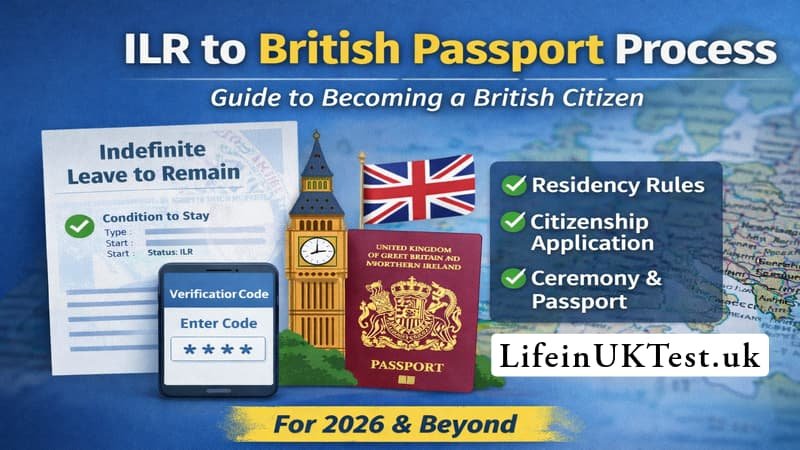
ILR to British passport process – If you hold Indefinite Leave to Remain (ILR) in the UK, you are one step closer to becoming a British citizen and obtaining a UK passport. The transition from ILR to citizenship involves several important stages, including meeting residency requirements, passing the Life in the UK test, and submitting a citizenship application with the correct documentation. Understanding each step of the ILR to British passport process is essential to avoid delays or errors. In this guide, we provide a clear, up-to-date walkthrough for 2026 and beyond, helping you navigate the journey from permanent residency to holding a full British passport with confidence.
ILR to British Passport process: Your Complete 2026 Guide
So you’ve got your Indefinite Leave to Remain—congratulations! That’s honestly a massive achievement, and you should feel proud. But if you’re reading this, you’re probably thinking about the next step: becoming a British citizen and getting that coveted British passport. Let me walk you through everything you need to know about this journey, and trust me, I’ll keep it real about both the exciting parts and the bits that might trip you up.
Why British Citizenship? Is It Worth It?
Look, I get it—you’ve already got ILR, which lets you live and work in the UK permanently. So why bother with citizenship? Here’s the thing: citizenship gives you freedoms that ILR simply can’t match.
With a British passport, you can travel freely without worrying about losing your status if you’re abroad for too long. ILR expires if you stay outside the UK for more than two consecutive years, which can be stressful if you have family overseas or love to travel. British citizenship doesn’t have that restriction—once you’re British, you’re British for life.
You’ll also get the right to vote in all UK elections, access to consular support when traveling abroad, and the ability to pass British citizenship to your children born after you naturalize. Plus, let’s be honest, there’s something incredibly empowering about having that burgundy passport in your hand and knowing you fully belong here.
Understanding the Current Landscape (2026 Update)
Before we dive into the process, you need to know about some major changes happening right now. The UK government published an immigration white paper in May 2025 that’s shaking things up considerably.
The Big Changes Coming
Starting in April 2026, the government plans to extend the qualifying period for ILR from five years to ten years for most work-based routes. While this won’t affect you if you already have ILR, it signals a broader tightening of immigration policies. The government is also introducing an “earned settlement” model where people can potentially reduce their waiting time by contributing to UK society through employment, volunteering, or working in critical sectors.
More importantly for those with ILR, there are hints that citizenship requirements might also change, though details remain unclear. The message is pretty clear: if you’re eligible to apply for citizenship now, don’t wait. Rules can change, and it’s better to secure your citizenship under current requirements than risk new, potentially stricter rules down the line.
Key Immigration Changes (2025-2026)
| Change | Effective Date | Who It Affects | What It Means for You |
|---|---|---|---|
| ILR qualifying period extended to 10 years | April 2026 | New visa applicants on work routes | Doesn’t affect current ILR holders, but signals tighter policies |
| English requirement raised to B2 | January 8, 2026 | New visa applicants | Current B1 requirement for citizenship unchanged (for now) |
| BRPs no longer valid | January 1, 2025 | All ILR holders | Must use eVisa system via UKVI account |
| Irregular entry bar | February 10, 2025 | Anyone who entered UK irregularly | Automatic citizenship ban regardless of current status |
| Earned settlement model | April 2026 | Future ILR applicants | Potential fast-track for contributions to UK |
English Language Requirements Are Getting Tougher
From January 8, 2026, new visa applicants need to demonstrate English proficiency at B2 level (upper intermediate) instead of the current B1 level. While this specifically affects new visa applications, it signals the government’s direction. For ILR holders applying for citizenship in 2026, the requirement remains at B1 level, but honestly, who knows what might change in future consultations?
The Digital Immigration System
Since January 1, 2025, physical documents like Biometric Residence Permits (BRPs) are no longer valid for official checks. Everything has moved digital—your ILR status is now proven through an eVisa linked to your UKVI account. If you haven’t already, you need to create or update your UKVI account and ensure your ILR is visible there. This is crucial because you’ll need to provide evidence of your ILR when applying for citizenship.
Who Can Apply? Eligibility Requirements
Let’s get into the nitty-gritty of whether you’re ready to apply. The requirements depend on your situation, but here are the main pathways:
| Requirement | Standard Route (5 Years) | Spouse/Partner Route (3 Years) |
|---|---|---|
| Residence period | 5 years in the UK | 3 years in the UK |
| ILR waiting period | Must hold ILR for 12 full months | Can apply immediately after getting ILR |
| Physical presence | Must have been in UK exactly 5 years before application date | Must have been in UK exactly 3 years before application date |
| Total absences allowed | Maximum 450 days in 5 years | Maximum 270 days in 3 years |
| Absences in final 12 months | Maximum 90 days | Maximum 90 days |
| Good character | Required | Required |
| English language | B1 level or higher | B1 level or higher |
| Life in the UK test | Must pass | Must pass |
| Additional requirement | None | Must be married to/in civil partnership with British citizen |
The Waiting Period: A Common Mistake
Here’s where people often mess up: unless you’re married to a British citizen, you must wait 12 full months after getting ILR before applying for citizenship. I’ve seen so many applications refused because people applied at 11 months and 28 days. Don’t be that person. Set yourself a calendar reminder and wait for the full 12 months to pass.
The Good Character Requirement: Don’t Underestimate This
This is arguably the trickiest part of the application, and it’s where many people stumble. “Good character” sounds straightforward, but it covers a lot of ground.
What Home Office Assesses for Good Character
| Area | What They Look For | Examples That Could Cause Issues |
|---|---|---|
| Criminal record | Any convictions, cautions, warnings | Drink driving, theft, assault, drug offenses, even spent convictions must be declared |
| Financial conduct | Responsible money management | Unpaid taxes, bankruptcy, CCJs, unpaid council tax, benefit fraud |
| Immigration compliance | Following all visa conditions | Working without permission, overstaying, breaching conditions |
| Honesty and integrity | Truthfulness in dealings | False information on previous applications, undeclared income |
| Debts and obligations | Meeting financial responsibilities | Child support arrears, court-ordered payments not made |
| Entry method | How you originally came to UK | Irregular entry (small boats, hidden in vehicles) = automatic bar |
Critical Honesty Rule
Disclosure is mandatory: You must declare:
- ALL criminal convictions (even spent ones)
- ALL cautions, warnings, or police interactions
- Speeding tickets and driving offenses
- Tax issues or HMRC investigations
- Bankruptcy or Individual Voluntary Arrangements (IVAs)
- Any immigration breaches from your entire history
| What Happens If… | Outcome |
|---|---|
| You disclose honestly | Home Office assesses in context; may still approve if issue resolved/minor |
| You hide information | If discovered = automatic refusal + possible 10-year ban for deception |
| You’re unsure if something counts | Declare it anyway with explanation; better safe than refused |
Recent changes for 2026: From February 10, 2025, anyone who entered the UK through irregular means (such as on small boats or hidden in vehicles) is automatically barred from British citizenship, regardless of how long they’ve been in the UK legally since then. This is a significant hardening of the good character requirement.
Proving Your English: What Counts?
You need to demonstrate English proficiency at B1 level on the Common European Framework of Reference for Languages (CEFR) scale. Here’s what qualifies:
| Method | Details | Who It’s For |
|---|---|---|
| SELT (Secure English Language Test) | Tests like IELTS, Trinity College London, or Pearson from approved providers | Anyone needing to prove English proficiency |
| Degree taught in English | Bachelor’s degree or higher taught/researched in English from recognized institution | Graduates with qualifying degrees |
| Exempt nationality | Passport from USA, Canada, Australia, New Zealand, or other designated English-speaking countries | Nationals from majority English-speaking countries |
| Age exemption | Automatic exemption if 65 or older | Older applicants |
| Already passed for ILR | Previous English test used for ILR application | Most ILR holders |
The Life in the UK Test
If you passed this test when applying for ILR, great news—you don’t need to retake it! Just make sure you have your pass certificate with your reference number ready for the application.
| Test Detail | Information |
|---|---|
| Number of questions | 24 multiple-choice questions |
| Pass mark | 18 correct answers (75%) |
| Test fee | £50 |
| Topics covered | British history, culture, traditions, and values |
| Where to take it | Approved test centers across the UK |
| Validity | Indefinite (no expiry) |
| Book test at | https://www.gov.uk/life-in-the-uk-test |
The government announced in October 2025 that they’re planning to modernize the test content to better reflect contemporary civic life. However, as of early 2026, no new version has been published yet. You should prepare using the current official handbook available on GOV.UK until any updates are formally announced.
Documents You’ll Need: Get Organized Early
One of the biggest causes of delays is missing or incorrect documentation. Start gathering these well before you apply:
Essential Documents Checklist
| Document Type | What You Need | Notes |
|---|---|---|
| Valid passport | Current passport with travel history | Must be valid throughout application |
| Proof of ILR | eVisa via UKVI account (generate share code) | BRP/vignettes acceptable but eVisa preferred |
| Life in the UK certificate | Pass certificate with reference number | If passed for ILR, same certificate works |
| English language proof | Test certificate, degree, or exempt passport | Must meet B1 CEFR level |
| Travel history | Complete record of all trips for 5 years (or 3 for spouse) | Exact dates and destinations required |
| Proof of residence | Council tax, utility bills, bank statements, tenancy agreements | Covering the full qualifying period |
| Marriage/civil partnership certificate | Official certificate | Only if applying as spouse |
| Name change documents | Deed poll, marriage certificate, etc. | If your name has changed |
Additional Documents (If Applicable)
| Situation | Required Documents |
|---|---|
| You have children | Birth certificates, passport copies |
| You have criminal convictions | Court documents, evidence of rehabilitation |
| Claiming language/test exemption | Medical evidence, doctor’s letter |
| Self-employed or director | Business registration, accounts, tax returns |
| Documents not in English/Welsh | Certified professional translations with translator credentials |
| Previous immigration issues | Evidence of resolution, legal documentation |
Finding Your Referees: Choose Wisely
You need two referees who have known you for at least three years. This sounds simple, but there are specific requirements:
Referee Requirements
| Referee | Professional Standing Required | Nationality/Status | Age | Must Have Known You |
|---|---|---|---|---|
| First referee | YES – Must be professional (teacher, doctor, lawyer, accountant, civil servant, etc.) | British citizen | 25+ | 3+ years |
| Second referee | NO – Can be anyone meeting other criteria | British citizen, ILR holder, or EEA national | 25+ | 3+ years |
Who CANNOT Be Your Referee
| Restriction | Explanation |
|---|---|
| ❌ Family members | No relatives by blood or marriage |
| ❌ Related to each other | Your two referees cannot be related to each other |
| ❌ Your solicitor/agent | Cannot be representing you in this current application |
| ❌ Home Office employees | Cannot work for the Home Office |
| ❌ People outside the UK | Both referees must reside in the UK |
Pro tip: Choose people who genuinely know you and can confirm your identity. The Home Office may contact them, so give them a heads-up that they might receive a call or letter.
The Application Process: Step by Step
Alright, you’ve gathered everything. Here’s how it actually works:
Your Application Journey at a Glance
| Step | Action | Timeline | Cost |
|---|---|---|---|
| 1 | Complete online Form AN | 2-4 hours | Free |
| 2 | Pay application fee | Immediate | £1,630 |
| 3 | Book biometric appointment | Within 2 weeks | Free (basic) |
| 4 | Attend UKVCAS appointment | 30-60 minutes | £60-80 for scanning (optional) |
| 5 | Submit documents | Same day or by post | Postage cost if mailing |
| 6 | Wait for decision | Approx. 6 months | – |
| 7 | Attend citizenship ceremony | Within 3 months of approval | £130 |
Step 1: Complete the Online Application
Go to GOV.UK and fill out Form AN (Application for Naturalisation as a British citizen). This is a detailed 29-page form that covers your personal details, contact information, residence history, travel absences, employment, and more.
Take your time with this. Accuracy is absolutely critical. One wrong date or missing piece of information can delay your application by months. Save your progress frequently—you don’t want to lose your work.
Pay particular attention to the section on absences from the UK. You’ll need to list every single trip outside the country during your qualifying period, with exact dates. This is where people most commonly make mistakes.
Step 2: Pay the Fee
The application fee for British citizenship by naturalisation is £1,630 as of 2026 (increased from the 2025 fee due to the annual adjustment in April 2025). Additionally, you’ll pay a £130 ceremony fee when your application is approved.
You must pay the full amount online when submitting your application. There’s no payment plan option, and no fee waivers for adults. The fee is non-refundable even if your application is refused, so make absolutely sure you meet all requirements before applying.
Step 3: Book Your Biometric Appointment
After submitting your online application, you’ll receive instructions to book an appointment at a UK Visa and Citizenship Application Services (UKVCAS) center. At this appointment, you’ll:
- Have your photograph taken
- Provide your fingerprints
- Optionally have your supporting documents scanned (there’s usually an additional fee for this service)
The biometric enrollment itself is free, but UKVCAS offers various paid services like document scanning, premium appointment times, and expedited check-in. These are optional but can be convenient if you’re short on time.
Tip: Standard UKVCAS appointments can fill up quickly, especially in major cities. Book as early as possible and check multiple locations if your nearest center is fully booked.
Step 4: Submit Your Documents
You can either:
- Upload them when completing the online application (if the system allows)
- Have them scanned at your UKVCAS appointment (additional fee applies)
- Mail them to the Home Office after your appointment (follow the specific instructions provided)
Whatever method you choose, keep copies of everything for your records.
Step 5: Wait for the Decision
The standard processing time is around six months. Some applications are processed faster, some take longer, especially if the Home Office needs additional information or schedules an interview with you.
You can leave the UK while your application is being processed, but you must maintain your ILR status (so don’t stay abroad for more than two years). If your application is approved, you’ll need to be available to attend your citizenship ceremony within three months.
No fast-track option: Unlike some visa applications, there is no premium or priority service for British citizenship applications. Everyone goes through the same standard process.
Step 6: Attend Your Citizenship Ceremony
This is the exciting part! Once your application is approved, you’ll receive an invitation to a citizenship ceremony. You must attend within three months of receiving your invitation.
At the ceremony, you’ll:
- Take an oath of allegiance to the King (or make an affirmation if you prefer not to swear on a religious text)
- Pledge to respect the UK’s rights, freedoms, and laws
- Receive your Certificate of Naturalisation
This certificate is proof of your British citizenship. Guard it carefully—you’ll need it for your passport application and other official purposes. Replacements are expensive and time-consuming to obtain.
After You Become a British Citizen: The Passport Application
Now for the moment you’ve been waiting for—applying for your first British passport!
British Passport Application Options
| Application Type | Processing Time | Cost (Online) | Cost (By Post) |
|---|---|---|---|
| Standard passport (34 pages) | 3-4 weeks (up to 10 weeks in busy periods) | £88.50 | £100 |
| Frequent traveler passport (50 pages) | 3-4 weeks (up to 10 weeks in busy periods) | £100.50 | £112 |
| Online Premium (same day) | Receive same day at appointment | £215.50 (standard) / £227.50 (50-page) | N/A |
| One Week Fast Track | Delivered within 1 week | £146.50 (standard) / £158.50 (50-page) | N/A |
What You’ll Need for Your Passport Application
| Document/Information | Details |
|---|---|
| Digital passport photo | Must meet strict UK requirements – use online checker |
| Certificate of Naturalisation | The certificate you received at your ceremony |
| ILR documentation | Your eVisa or previous ILR evidence |
| Identity confirmer | Someone who can confirm your identity (not family) |
| Previous passports | Details of any previous passports held |
Return Your BRP (If You Have One)
| Action | Timeframe | Consequence |
|---|---|---|
| Return BRP to Home Office | Within 5 working days of receiving Certificate of Naturalisation | Failure to return can result in fine up to £1,000 |
| How to return | Use tracked postal service to address in ceremony pack | Keep proof of postage |
Dual Nationality: What to Consider
| Country Policy | What It Means | Action Required |
|---|---|---|
| Allows dual nationality | You keep both citizenships | None – enjoy both passports! |
| Automatic revocation | Your original citizenship is automatically lost when you become British | Check with your country’s embassy before applying |
| Requires permission | Need approval to keep original citizenship | Apply for permission before British naturalisation |
| Doesn’t recognize but doesn’t enforce | Technically doesn’t allow it but won’t actively revoke | Research implications for travel/inheritance |
Countries to particularly check: Some countries including India, China, Japan, Singapore, and certain Middle Eastern nations have restrictions on dual nationality. Always verify with your country’s embassy before proceeding.
Common Mistakes and How to Avoid Them
Let me save you from the headaches others have experienced:
| Common Mistake | Why It Happens | How to Avoid It |
|---|---|---|
| Applying too early | Misunderstanding the 12-month ILR requirement | Wait the FULL 12 months after ILR (unless spouse route). Set calendar reminder |
| Incorrectly calculating absences | Poor record-keeping, relying on memory | Use passport stamps, old calendars, emails, flight confirmations |
| Exceeding 90-day limit in final year | Not tracking recent trips carefully | Keep a running total of days absent in last 12 months |
| Choosing ineligible referees | Not understanding the professional standing requirement | Verify first referee has professional qualification; ensure no family connections |
| Failing to disclose information | Thinking old issues don’t matter | Declare ALL convictions, cautions, speeding tickets, tax issues – honesty is crucial |
| Missing documents | Starting document gathering too late | Begin collecting documents 2-3 months before applying |
| Relying on expired ILR proof | Not updating to eVisa system | Ensure ILR visible in UKVI account; generate share code before applying |
| Incorrect travel dates | Estimating instead of checking exact dates | Check passport stamps; be precise to the day |
| Assuming automatic approval | Overconfidence after getting ILR | Review ALL requirements carefully; each application assessed independently |
| Not keeping copies | Only submitting originals | Always keep photocopies/scans of every document submitted |
Costs: The Full Financial Picture
Let’s be realistic about what you’ll spend:
| Item | Cost |
|---|---|
| British citizenship application fee | £1,630 |
| Citizenship ceremony fee | £130 |
| Life in the UK test (if not taken for ILR) | £50 |
| English language test (if required) | £150-200+ |
| UKVCAS document scanning (optional) | £60-80 |
| Professional translations (if needed) | Varies |
| First British passport (online, standard) | £88.50 |
| Total (minimum, if you’ve passed tests for ILR) | £1,848.50 |
| Total (with new tests and documents) | £2,100-2,300+ |
This doesn’t include potential costs for legal advice, obtaining old documents, or travel to UKVCAS centers. It’s a significant investment, but for most people, the security and freedom of British citizenship are worth every penny.
When to Get Professional Help
Most people can successfully navigate this process independently using GOV.UK resources and guides like this one. However, you might want professional immigration advice if:
| Situation | Why You Need Help | Potential Risk |
|---|---|---|
| Complex immigration history | Previous visa refusals or overstaying | Refusal based on immigration breaches |
| Criminal convictions | Even minor ones need careful handling | Good character requirement failure |
| Tax or financial issues | Unpaid taxes, bankruptcy, significant debt | Character assessment failure |
| Benefit claims during residence | May impact good character assessment | Potential refusal on public funds grounds |
| Unclear absence calculations | Borderline on 90-day or 450-day limits | Mathematical errors leading to refusal |
| Unusual circumstances | Your situation doesn’t fit standard categories | Incorrect form or missing requirements |
| Employment gaps | Long periods without work | Need to demonstrate financial responsibility |
| Previous immigration breaches | Working without permission, condition violations | Character issues and immigration history |
What Professional Help Costs vs. Benefits
| Service Type | Typical Cost | What You Get |
|---|---|---|
| Initial consultation | £100-300 | Assessment of your eligibility and risks |
| Full application assistance | £1,500-3,000+ | Complete application preparation and submission |
| Document review only | £300-800 | Check your documents before you submit |
| Representation if issues arise | £150-300/hour | Legal support if Home Office requests more info |
Bottom line: For straightforward cases, DIY is fine. For complex cases, professional help can be the difference between approval and losing £1,760.
Final Thoughts: Your Journey to British Citizenship
Becoming a British citizen is a significant milestone. It represents years of building your life in the UK, contributing to your community, and making this country your home. The process can feel bureaucratic and lengthy, but thousands of people successfully complete it every year.
Take your time, be thorough, and don’t rush. Make sure you meet all the requirements before applying—a refused application means losing £1,760 and potentially having to wait before reapplying. If you’re unsure about anything, use the resources available on GOV.UK, or consult with a qualified immigration adviser.
Most importantly, remember that this journey isn’t just about paperwork and fees. It’s about belonging, security, and the freedom to fully participate in British life. Once you hold that burgundy passport, you’ll have the peace of mind that comes with permanent, irrevocable citizenship.
Good luck with your application! You’ve come this far—you’ve got this.
Helpful Resources
- GOV.UK Citizenship Application: https://www.gov.uk/apply-citizenship-british-nationality
- Life in the UK Test Information: https://www.gov.uk/life-in-the-uk-test
- British Passport Application: https://www.gov.uk/apply-first-adult-passport
- UKVI Account (for eVisa): https://www.gov.uk/view-prove-immigration-status
- Check Processing Times: https://www.gov.uk/government/publications/passport-wait-times
Disclaimer: This guide is based on information current as of January 2026. Immigration rules can change frequently. Always check GOV.UK for the most up-to-date official guidance before making any decisions or submitting applications.