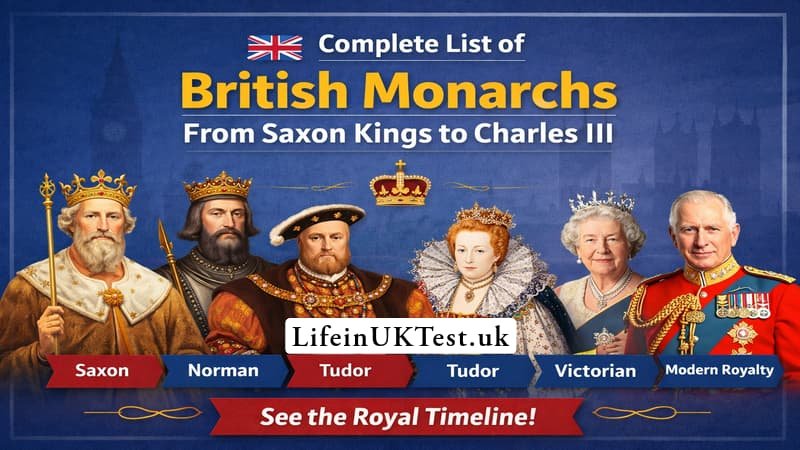
The complete list of British monarchs spans more than a thousand years of history, beginning with the early Saxon kings and continuing through Norman, Plantagenet, Tudor, Stuart, Hanoverian, and Windsor dynasties to King Charles III. Each monarch played a vital role in shaping Britain’s political system, culture, and global influence. This comprehensive guide to British monarchs presents a clear, chronological overview of kings and queens who ruled England and later the United Kingdom, making it an essential resource for students, history enthusiasts, and anyone seeking to understand the royal lineage of Britain.
Complete List of British Monarchs – From Saxon Kings to Charles III
Complete List of British Monarchs – You know what’s wild? The British monarchy has been around for over 1,200 years. I’m talking about a continuous thread of kings and queens stretching back to when most of Europe was still figuring out what a “country” even meant. And here we are in 2026, still talking about it.
Let me walk you through this properly, because honestly, understanding British monarchs isn’t just memorizing names and dates. It’s about seeing how these people – flawed, ambitious, sometimes brilliant, sometimes catastrophically terrible – shaped what Britain became.
The Beginning: When England Was Just an Idea
Before we had “England,” we had a bunch of Anglo-Saxon kingdoms constantly fighting each other. Wessex, Mercia, Northumbria—think of them like rival startups, except instead of competing for market share, they were competing with swords.
Æthelstan (927-939) is generally considered the first King of England proper. Not the first English king, mind you, but the first to actually unite all those squabbling kingdoms under one crown. His grandfather Alfred the Great did the groundwork, sure, but Æthelstan sealed the deal. He defeated the Vikings, conquered the last independent Anglo-Saxon kingdoms, and basically said “Right, we’re doing this.”
But here’s the thing about early medieval monarchy—it wasn’t stable. Not even close.
The House of Wessex and the Danish Interruption
After Æthelstan came a parade of rulers, some competent, some… less so. Then in 1013, something embarrassing happened: Sweyn Forkbeard, a Danish king, just conquered England. The Anglo-Saxon king Æthelred (literally nicknamed “the Unready,” which should tell you something) fled to Normandy.
Here’s how the early monarchs stacked up:
| Monarch | Reign | Notable For |
|---|---|---|
| Æthelstan | 927-939 | First true King of England, united the kingdoms |
| Edmund I | 939-946 | Æthelstan’s half-brother, fought Vikings |
| Eadred | 946-955 | Consolidated control over Northumbria |
| Eadwig | 955-959 | Young king who lost northern England briefly |
| Edgar | 959-975 | The Peaceful—reformed coinage, encouraged monasticism |
| Edward the Martyr | 975-978 | Murdered at 16, possibly by his stepmother |
| Æthelred the Unready | 978-1013, 1014-1016 | Paid Vikings to go away (it didn’t work) |
| Sweyn Forkbeard | 1013-1014 | Danish conquest, died after weeks |
| Edmund Ironside | 1016 | Fought Cnut, died mysteriously after months |
Sweyn died after only a few weeks, and his son Cnut (or Canute) took over in 1016. Now Cnut actually turned out to be a pretty decent king. He ruled England, Denmark, and Norway—a proper North Sea empire. There’s that famous story about him sitting by the sea trying to command the waves to stop, which people think was arrogance, but actually? It was the opposite. He was proving to his flattering courtiers that even kings can’t control nature. Honestly, we could use more leaders with that level of self-awareness.
| Danish Rulers | Reign | Key Achievement |
|---|---|---|
| Cnut | 1016-1035 | Built North Sea Empire, wise ruler |
| Harold Harefoot | 1035-1040 | Cnut’s son, contested succession |
| Harthacnut | 1040-1042 | Harsh taxer, died drinking at a wedding |
When Cnut’s line died out, the crown went back to Anglo-Saxon royalty with Edward the Confessor (1042-1066), a deeply religious guy more interested in building Westminster Abbey than having kids. Which created a massive succession problem.
1066: The Year Everything Changed
When Edward died childless in January 1066, three men claimed the throne: Harold Godwinson (an English earl), Harald Hardrada (a Norwegian king), and William of Normandy (Edward’s distant cousin from France).
Harold got crowned king immediately. Then he had to fight off a Norwegian invasion in the north, which he did brilliantly at Stamford Bridge in September. Three weeks later, exhausted and with a depleted army, he faced William at Hastings.
You know how that ended. An arrow supposedly hit Harold in the eye (though historians debate this), the Normans won, and on Christmas Day 1066, William the Conqueror became King of England.
Everything changed. The language changed—suddenly the ruling class spoke French. The culture changed. The architecture changed (hello, massive stone castles). The legal system changed. Modern English is essentially what you get when Norman French crashes into Old English and they have extremely complicated children together.
The Norman Dynasty: French Kings of England
| Norman Monarch | Reign | What They’re Remembered For |
|---|---|---|
| William I (the Conqueror) | 1066-1087 | Conquered England, Domesday Book, iron rule |
| William II (Rufus) | 1087-1100 | Red-haired, unpopular, died mysteriously hunting |
| Henry I | 1100-1135 | Seized throne from brother, lost heir in shipwreck |
| Stephen | 1135-1154 | Civil war with cousin Matilda, “The Anarchy” |
William I’s reign was brutal. He crushed rebellions viciously—the “Harrying of the North” in 1069-70 devastated northern England so thoroughly that entire villages disappeared. But he also commissioned the Domesday Book, a complete survey of England’s wealth. For tax purposes, naturally.
His son William Rufus died in a hunting “accident” that was almost certainly assassination. An arrow to the chest while hunting? Come on. His younger brother Henry just happened to be nearby and immediately rode to Winchester to secure the treasury. Suspicious doesn’t begin to cover it.
Henry I was capable but lost his legitimate son in the White Ship disaster of 1120—a drunken shipwreck that killed England’s heir and triggered decades of civil war. Henry tried to make his daughter Matilda his heir, but medieval England wasn’t ready for a queen regnant. When he died, his nephew Stephen seized the crown, Matilda fought back, and England descended into chaos called “The Anarchy.”
The Plantagenets: Empire Builders and Family Feuds
The compromise? Matilda’s son would inherit after Stephen. In 1154, Henry II became king, founding the Plantagenet dynasty that would rule for over 300 years.
The Early Plantagenets
| King | Reign | Major Events | Fatal Flaw |
|---|---|---|---|
| Henry II | 1154-1189 | Angevin Empire, legal reforms, Becket murder | Sons rebelled against him |
| Richard I (Lionheart) | 1189-1199 | Third Crusade, barely in England | Absent king, bankrupted realm |
| John | 1199-1216 | Lost French lands, Magna Carta | Paranoid, overtaxed everyone |
| Henry III | 1216-1272 | Long reign, rebuilt Westminster Abbey | Weak, dominated by others |
| Edward I | 1272-1307 | Conquered Wales, Model Parliament | Brutal to Scots and Jews |
| Edward II | 1307-1327 | Defeated at Bannockburn | Weak, probably murdered |
| Edward III | 1327-1377 | Started Hundred Years’ War, Black Death | War bankrupted England |
| Richard II | 1377-1399 | Artistic patron, faced Peasants’ Revolt | Tyrannical, deposed |
Henry II created an empire stretching from Scotland to the Pyrenees. Married Eleanor of Aquitaine (possibly the most powerful woman in medieval Europe). Then made the catastrophic mistake of wondering aloud whether someone would rid him of “this turbulent priest” Thomas Becket. Four knights took him literally, murdered the Archbishop of Canterbury, and Henry spent years doing penance.
His son Richard I, the famous “Lionheart,” barely spent any time in England—maybe six months total in a ten-year reign. He was too busy crusading in the Holy Land or being captured and ransomed. Spoke French primarily. But he’s remembered as this great English hero anyway, which tells you something about the power of mythology.
Then came John, Richard’s brother, one of England’s worst kings. Lost most of the French territories (earning him the nickname “Lackland”), fought with the Pope, overtaxed everyone, and eventually got forced by his barons to sign the Magna Carta in 1215. That document limited royal power and became the foundation for constitutional governance. Sometimes terrible kings do accidentally important things.
Edward I was effective but brutal—conquered Wales, nearly conquered Scotland, expelled all Jews from England in 1290 (a horrific decision that wasn’t reversed for over 350 years). His son Edward II was weak and got deposed and probably murdered with a red-hot poker. Medieval politics was not for the faint of heart.
Edward II’s son Edward III started the Hundred Years’ War with France by claiming the French throne. That went about as well as you’d expect—it lasted 116 years and England ultimately lost most of its French territories anyway.
The Wars of the Roses: Lancaster vs York
By the 1450s, the Plantagenet dynasty had split into two branches fighting for the crown. Picture a civil war, but make it a 30-year family feud with periodic bouts of extreme violence.
| House of Lancaster | Reign | House of York | Reign |
|---|---|---|---|
| Henry IV | 1399-1413 | Edward IV | 1461-1470, 1471-1483 |
| Henry V | 1413-1422 | Edward V | 1483 (86 days) |
| Henry VI | 1422-1461, 1470-1471 | Richard III | 1483-1485 |
Henry VI of Lancaster was pious but mentally unstable—he literally had a mental breakdown and became catatonic for over a year. Edward IV of York was tall, handsome, effective militarily, but made a secret marriage that caused political chaos. When he died suddenly in 1483, his brother Richard III took the crown and Edward’s two young sons—the “Princes in the Tower”—disappeared.
Yeah, Richard almost certainly had them murdered. For centuries, he was depicted as this evil hunchback, though recent evidence suggests he actually had scoliosis and wasn’t quite the monster Shakespeare portrayed. Still probably guilty of killing his nephews, though.
In 1485, a Welsh nobleman with a distant claim to the throne, Henry Tudor, landed in Wales with a small army, met Richard at Bosworth Field, and won. Richard died in battle (his skeleton was found under a parking lot in Leicester in 2012—seriously, look it up). Henry became Henry VII, married Elizabeth of York (Edward IV’s daughter), and united the two houses. The Tudor era began.
The Tudors: When England Went From Medieval to Modern
The Tudors gave us some of the most famous monarchs in history, and honestly, you couldn’t write fiction this good.
| Tudor Monarch | Reign | Religion | Died How |
|---|---|---|---|
| Henry VII | 1485-1509 | Catholic | Natural causes (55) |
| Henry VIII | 1509-1547 | Catholic → Protestant | Obesity-related illness (55) |
| Edward VI | 1547-1553 | Protestant | Tuberculosis (15) |
| Lady Jane Grey | 1553 (9 days) | Protestant | Executed (16) |
| Mary I | 1553-1558 | Catholic | Cancer or flu (42) |
| Elizabeth I | 1558-1603 | Protestant | Blood poisoning (69) |
Henry VII was cautious and financially shrewd, rebuilding royal authority after decades of war. His son Henry VIII? Completely different story.
You know Henry VIII for the six wives:
| Wife | Marriage | Outcome | Famous For |
|---|---|---|---|
| Catherine of Aragon | 1509-1533 | Divorced | Refused to accept annulment |
| Anne Boleyn | 1533-1536 | Beheaded | Mother of Elizabeth I |
| Jane Seymour | 1536-1537 | Died | Gave Henry his male heir |
| Anne of Cleves | 1540 | Divorced | “Flanders Mare” (Henry’s view) |
| Catherine Howard | 1540-1542 | Beheaded | Young cousin of Anne Boleyn |
| Catherine Parr | 1543-1547 | Survived | Nursed Henry in decline |
But the real story is the English Reformation. When the Pope refused to annul his marriage to Catherine of Aragon (because she hadn’t given him a male heir), Henry broke England away from the Catholic Church and made himself head of the Church of England. This wasn’t just about divorce. It was a power grab that dissolved monasteries, redistributed massive amounts of land and wealth, and fundamentally changed England’s relationship with Europe.
His children’s reigns showed the religious chaos this created:
Edward VI, his young son by Jane Seymour, was a committed Protestant who died at 15.
Mary I, daughter of Catherine of Aragon, was devoutly Catholic and tried to reverse the Reformation by force. She burned about 280 Protestant “heretics” at the stake, earning her the nickname “Bloody Mary.” Her five-year reign was characterized by religious persecution and an unpopular marriage to Philip II of Spain.
Then came Elizabeth I, daughter of Anne Boleyn, who I genuinely think was one of the most skilled politicians in English history. She navigated religious divisions by establishing a moderate Protestant church, defeated the Spanish Armada in 1588, never married (using the possibility as a diplomatic tool for decades), and presided over a cultural golden age—Shakespeare, Marlowe, the beginnings of English colonialism. When she died childless after 44 years, the Tudor line ended.
The Stuarts: Divine Right Meets Parliamentary Power
The crown passed to James VI of Scotland, who became James I of England, uniting the crowns (though not the governments) of Scotland and England.
| Stuart Monarch | Reign | Key Crisis | End Result |
|---|---|---|---|
| James I | 1603-1625 | Gunpowder Plot, Parliament conflicts | Died naturally |
| Charles I | 1625-1649 | Civil War | Executed |
| [Interregnum] | 1649-1660 | Commonwealth/Protectorate | Failed republic |
| Charles II | 1660-1685 | Restoration, religious tolerance | Died naturally |
| James II | 1685-1688 | Catholic revival attempts | Deposed, fled |
| William III & Mary II | 1689-1702 | Glorious Revolution | Constitutional monarchy |
| Anne | 1702-1714 | Act of Union with Scotland | Died childless |
James believed in the divine right of kings—that monarchs answered only to God. This went down poorly with Parliament.
His son Charles I believed this even more strongly. He kept dissolving Parliament when they disagreed with him, tried to rule without them for 11 years, attempted to impose Anglican practices on Presbyterian Scotland, and generally acted like an absolute monarch in a country that was moving toward constitutionalism.
This triggered a civil war. On one side: Royalists (Cavaliers) supporting the king. On the other: Parliamentarians (Roundheads) led by Oliver Cromwell, a military genius and religious zealot. Parliament won. And here’s where English history gets really radical: they put the king on trial for treason, found him guilty, and on January 30, 1649, they cut off his head in front of Whitehall.
England became a republic—the Commonwealth and then the Protectorate under Cromwell. But Cromwell died in 1658, and the whole republican experiment collapsed. In 1660, Parliament invited Charles I’s son back from exile. Charles II returned to massive celebration (the “Restoration”), and monarchy was restored. But things had changed fundamentally. No one could pretend anymore that kings ruled by divine right alone.
Charles II was charming, politically savvy, and fathered numerous illegitimate children—at least 12 acknowledged ones—but no legitimate heir. His brother James II was openly Catholic in a Protestant country and kept pushing Catholic policies and officials into positions of power. After three years, Parliament had enough. They invited his Protestant daughter Mary and her Dutch husband William of Orange to invade.
James fled to France without fighting. In what’s called the “Glorious Revolution” (1688), William III and Mary II became joint monarchs, accepting strict parliamentary limits on royal power through the Bill of Rights 1689. This is basically when Britain became a constitutional monarchy. The monarch reigned, but Parliament governed.
The Hanoverians: German Kings and Growing Empire
When Queen Anne died without surviving children (she’d been pregnant at least 17 times but all her children died young—absolutely tragic), the crown passed to a distant German cousin.
| Hanoverian Monarch | Reign | Age at Accession | Major Events |
|---|---|---|---|
| George I | 1714-1727 | 54 | Barely spoke English, first Prime Minister |
| George II | 1727-1760 | 43 | Last king to lead troops in battle |
| George III | 1760-1820 | 22 | American Revolution, went mad |
| George IV | 1820-1830 | 57 | Regency era, extravagant |
| William IV | 1830-1837 | 64 | Reform Act, abolished slavery in empire |
| Victoria | 1837-1901 | 18 | Longest reign until Elizabeth II |
George I barely spoke English and preferred Hanover to London. This began a period where monarchs had less and less actual political power as Prime Ministers and Parliament took over governance. Robert Walpole is often considered Britain’s first Prime Minister, serving George I and II.
George III is famous for two things: losing the American colonies and going mad (likely from porphyria, a metabolic disorder). His son ruled as Prince Regent from 1811 and then became George IV in 1820, remembered mainly for his extravagance, multiple mistresses, and disastrous marriage to Caroline of Brunswick.
Victoria became queen at 18 and reigned for 63 years, 7 months—until recently, the longest reign in British history. During her time, Britain became the world’s superpower with an empire covering a quarter of the globe. She mourned her husband Albert for 40 years after his death, rarely appearing in public for a decade, yet remained deeply popular. The Victorian era defined British culture, technology, and global influence in ways we’re still unpacking.
The House of Windsor: Modern Monarchy
Victoria’s son Edward VII waited 59 years to be king—longer than anyone before or since—and had a short but popular reign. His son George V reigned through World War I and wisely changed the family name from the German “Saxe-Coburg-Gotha” to “Windsor” in 1917. Smart PR move when fighting Germany.
| Windsor Monarch | Reign | Years | Key Events |
|---|---|---|---|
| George V | 1910-1936 | 26 | WWI, name change to Windsor, first Christmas broadcast |
| Edward VIII | 1936 | <1 | Abdicated for Wallis Simpson |
| George VI | 1936-1952 | 16 | WWII, Indian independence, never expected to be king |
| Elizabeth II | 1952-2022 | 70 | Longest reign, 15 Prime Ministers, end of empire |
| Charles III | 2022-present | 3+ | Oldest person to become king |
Edward VIII became king in January 1936 and abdicated in December to marry Wallis Simpson, an American divorcée. The establishment couldn’t stomach it—not just because she was divorced twice, but because of her questionable past and Edward’s Nazi sympathies (which only became fully clear later). His abdication was unprecedented and thrust his younger brother into the role.
George VI had a stammer, never expected to be king, but led Britain through World War II with quiet dignity alongside his wife Elizabeth (later the Queen Mother). The movie “The King’s Speech” tells this story beautifully. His eldest daughter became Elizabeth II in 1952 at age 25 while in Kenya, learning of her father’s death thousands of miles from home.
Elizabeth II: The Queen Who Defined Modern Monarchy
Let’s be real—Elizabeth II defined what modern monarchy meant. She reigned for 70 years and 214 days, through 15 Prime Ministers from Churchill to Truss.
| Era | Prime Ministers During Her Reign | Major Changes |
|---|---|---|
| 1950s | Churchill, Eden, Macmillan | End of empire begins |
| 1960s-70s | Wilson, Heath, Callaghan | Decolonization accelerates |
| 1980s-90s | Thatcher, Major, Blair | Falklands, Diana’s death, devolution |
| 2000s-10s | Brown, Cameron, May, Johnson | Iraq War, Brexit referendum |
| 2020s | Johnson, Truss | COVID-19, Harry/Meghan departure |
When she took the throne, Britain still had an empire and Winston Churchill was Prime Minister. When she died, Britain had left the European Union and smartphones existed. She witnessed the entire decolonization of the British Empire, the Cold War, the digital revolution, the rise and fall of British industry, and fundamental shifts in social values.
She never gave interviews about her personal views. Never voted (monarchs don’t). Maintained an image of steadfast duty. Through scandals—Charles and Diana’s divorce, Andrew’s controversies, Harry and Meghan’s departure—she remained a constant.
She died on September 8, 2022, at Balmoral Castle in Scotland at age 96. The outpouring of public grief was genuine and massive. Whatever you think about monarchy as an institution, she embodied it with remarkable consistency for an entire lifetime.
Charles III: The Long-Waiting Heir (2022-Present)
King Charles III became king at 73—the oldest person to assume the British throne. He’d waited longer than anyone in history to inherit. His coronation took place on May 6, 2023, at Westminster Abbey, a ceremony blending tradition with some modern touches (including representatives from multiple faiths participating, which was new).
Charles’s Challenges and Priorities (As of 2026)
| Area | Situation | Charles’s Approach |
|---|---|---|
| Public Image | Mixed approval ratings | Emphasizing environmental work, slimmed-down monarchy |
| Family Issues | Harry/Meghan rift, Andrew scandal | Reduced working royals, protecting William’s family |
| Commonwealth | Several nations moving toward republic status | More respectful of independence choices |
| Age | 77 years old in 2026 | Acknowledging transition will come sooner than Elizabeth’s |
| Modernization | Pressure to justify costs | Opening more properties, transparency on finances |
During his decades as heir apparent, Charles became known for environmental activism (he was talking about climate change before it was mainstream), architectural criticism, organic farming at Highgrove, and interfaith dialogue. He’s also dealt with intense scrutiny over his first marriage to Diana, her death in 1997, and his eventual marriage to Camilla.
As king, he’s signaled a desire for a “slimmed-down” monarchy—fewer working royals, reduced costs, greater efficiency. This is partly practical (the public is less deferential than in Elizabeth’s early years) and partly necessary (several royals have stepped back or been pushed out due to scandal).
His wife Camilla is Queen—officially “Queen Camilla” now, though initially there was discussion about her being called “Queen Consort” to avoid controversy. That’s largely faded. Public acceptance of her has grown significantly.
The Line of Succession (Current as of January 2026)
| Position | Name | Born | Relationship to Charles III |
|---|---|---|---|
| 1 | William, Prince of Wales | 1982 | Eldest son |
| 2 | Prince George | 2013 | Grandson (William’s eldest) |
| 3 | Princess Charlotte | 2015 | Granddaughter (William’s daughter) |
| 4 | Prince Louis | 2018 | Grandson (William’s youngest) |
| 5 | Prince Harry | 1984 | Second son |
| 6 | Prince Archie | 2019 | Grandson (Harry’s son) |
| 7 | Princess Lilibet | 2021 | Granddaughter (Harry’s daughter) |
| 8 | Prince Andrew | 1960 | Brother |
| 9 | Princess Beatrice | 1988 | Niece (Andrew’s daughter) |
| 10 | Sienna Mapelli Mozzi | 2021 | Great-niece (Beatrice’s daughter) |
| 11 | Princess Eugenie | 1990 | Niece (Andrew’s daughter) |
| 12 | August Brooksbank | 2021 | Great-nephew (Eugenie’s son) |
| 13 | Ernest Brooksbank | 2023 | Great-nephew (Eugenie’s son) |
| 14 | Prince Edward | 1964 | Brother |
| 15 | James, Earl of Wessex | 2007 | Nephew (Edward’s son) |
William is being groomed for kingship in a way Charles never really was—he’s been included in state affairs, given increasing responsibilities, and presents a more relatable image. His wife Catherine has become increasingly popular, especially for her work on early childhood development and mental health.
The drama? Harry and Meghan’s departure from royal duties in 2020, their explosive Oprah interview in 2021, Harry’s memoir “Spare” in 2023—all this has created a rift that hasn’t healed. Harry attended Charles’s coronation but didn’t stay for celebrations. Archie and Lilibet barely know their grandfather or cousins. It’s genuinely sad, whatever side you’re on.
Where Things Stand in 2026
As of January 2026, here’s the reality:
Charles is in his third year on the throne, 77 years old now. Health watch is a real thing—he’s relatively healthy, but he became monarch later in life than any predecessor. The succession is stable with William ready, but Charles waited so long for this role that his reign will inevitably be shorter than his mother’s historic tenure.
The monarchy faces genuine questions about relevance. Recent polling shows:
- Support for the institution remains around 60-65% in the UK
- But it’s notably weaker among people under 40 (closer to 40-50%)
- In Scotland, support is softer, around 45-55%
- Several Commonwealth realms are actively moving toward republic status
The Commonwealth realms are wrestling with whether to keep Charles as their head of state. Barbados became a republic in 2021. Jamaica has indicated strong interest in doing the same. Australia had a referendum in 1999 that failed narrowly, but there’s talk of another one. Canada’s less urgent about it, but Quebec has never been enthusiastic about the monarchy.
Prince Harry and Meghan remain in California with their children. They occasionally make headlines but are largely separate from royal duties. The relationship between Harry and William appears genuinely fractured—they barely speak, by most accounts. Prince Andrew remains in disgrace over his association with Jeffrey Epstein and Virginia Giuffre’s allegations. He’s no longer a working royal and rarely appears in public.
These absences, plus the deaths of Prince Philip (2021) and the Queen (2022), mean fewer senior royals doing public duties. Currently, the working royals are basically: Charles, Camilla, William, Catherine, Anne (Charles’s sister, who does more engagements than almost anyone), Edward and Sophie. That’s it. For an institution that used to have dozens of royals cutting ribbons and opening hospitals, it’s skeletal.
The Financial Question
The royal family’s finances come under regular scrutiny:
| Income Source | Amount (Approx) | Purpose |
|---|---|---|
| Sovereign Grant | £86 million (2023-24) | Official duties, property maintenance |
| Duchy of Lancaster | £24 million profit (2023) | Monarch’s private income |
| Duchy of Cornwall | £24 million profit (2023) | Prince of Wales’s private income |
The Sovereign Grant comes from 25% of the Crown Estate’s profits (recently increased from 15% to fund Buckingham Palace renovations). There’s ongoing debate about value for money, especially regarding property renovations and security costs. Charles has promised more transparency, but it’s still a touchy subject.
The Complete Royal Houses: A Quick Reference Guide
For those who want the full chronology without wading through all the stories:
House of Wessex (Anglo-Saxon Period)
| Monarch | Reign Years | Key Point |
|---|---|---|
| Æthelstan | 927-939 | First King of all England |
| Edmund I | 939-946 | Defended against Vikings |
| Eadred | 946-955 | Completed English unification |
| Eadwig | 955-959 | Brief, troubled reign |
| Edgar | 959-975 | “The Peaceful” |
| Edward the Martyr | 975-978 | Murdered, later sainted |
| Æthelred the Unready | 978-1016 | Paid Danegeld, disastrous reign |
| Edmund Ironside | 1016 | Fought Cnut, ruled briefly |
| Edward the Confessor | 1042-1066 | Founded Westminster Abbey |
| Harold II | 1066 | Last Anglo-Saxon king, died at Hastings |
Danish Dynasty
| Monarch | Reign | Achievement |
|---|---|---|
| Sweyn Forkbeard | 1013-1014 | Conquered England, died quickly |
| Cnut | 1016-1035 | North Sea Empire, wise ruler |
| Harold Harefoot | 1035-1040 | Contested succession |
| Harthacnut | 1040-1042 | Last Danish king of England |
Normans to Early Plantagenets
| Monarch | Reign | Dynasty | Defining Event |
|---|---|---|---|
| William I | 1066-1087 | Norman | Norman Conquest |
| William II | 1087-1100 | Norman | Mysterious death hunting |
| Henry I | 1100-1135 | Norman | White Ship disaster |
| Stephen | 1135-1154 | Norman | The Anarchy civil war |
| Henry II | 1154-1189 | Plantagenet | Becket murder |
| Richard I | 1189-1199 | Plantagenet | Third Crusade |
| John | 1199-1216 | Plantagenet | Magna Carta |
| Henry III | 1216-1272 | Plantagenet | Long but weak reign |
| Edward I | 1272-1307 | Plantagenet | Conquered Wales |
| Edward II | 1307-1327 | Plantagenet | Deposed and murdered |
| Edward III | 1327-1377 | Plantagenet | Hundred Years’ War began |
| Richard II | 1377-1399 | Plantagenet | Deposed by cousin |
Lancaster and York (Wars of the Roses)
| Lancaster | Reign | York | Reign |
|---|---|---|---|
| Henry IV | 1399-1413 | Edward IV | 1461-1470, 1471-1483 |
| Henry V | 1413-1422 | Edward V | 1483 (86 days) |
| Henry VI | 1422-1461, 1470-1471 | Richard III | 1483-1485 |
Complete Tudor Line
| Monarch | Reign | Religion | Spouse(s) | Legacy |
|---|---|---|---|---|
| Henry VII | 1485-1509 | Catholic | Elizabeth of York | Ended Wars of Roses |
| Henry VIII | 1509-1547 | Catholic→Anglican | 6 wives | English Reformation |
| Edward VI | 1547-1553 | Protestant | None | Died young |
| Jane Grey | July 1553 | Protestant | None | “Nine Days Queen” |
| Mary I | 1553-1558 | Catholic | Philip II of Spain | “Bloody Mary” |
| Elizabeth I | 1558-1603 | Protestant | None | Golden Age |
Stuart Dynasty
Stuart Dynasty table with all the details:
| Monarch | Reign | Major Crisis | Religion | Spouse(s) | Outcome |
|---|---|---|---|---|---|
| James I (James VI of Scotland) | 1603-1625 | Gunpowder Plot 1605, constant Parliament conflicts | Protestant (Anglican) | Anne of Denmark | Natural death at 58 |
| Charles I | 1625-1649 | English Civil War, 11 years ruling without Parliament | Protestant (Anglican, High Church) | Henrietta Maria of France (Catholic) | Executed by beheading, January 30, 1649 |
| [Interregnum] | 1649-1660 | Commonwealth (1649-1653), Protectorate under Oliver Cromwell (1653-1658), son Richard briefly (1658-1659) | Puritan rule | N/A | Republic collapsed after Cromwell’s death |
| Charles II | 1660-1685 | Restoration, Great Plague 1665, Great Fire of London 1666, religious tolerance attempts | Protestant (Anglican), Catholic sympathies | Catherine of Braganza (no surviving children) | Natural death, 12+ illegitimate children, no legitimate heir |
| James II (James VII of Scotland) | 1685-1688 | Attempted Catholic revival, Monmouth Rebellion, birth of Catholic heir | Catholic (openly) | (1) Anne Hyde (2) Mary of Modena | Deposed in Glorious Revolution, fled to France |
| William III & Mary II (Joint monarchs) | 1689-1702 (Mary died 1694) | Glorious Revolution, War of Spanish Succession, Battle of the Boyne 1690 | Protestant (both) | Each other (Mary was James II’s daughter) | Constitutional monarchy established, Bill of Rights 1689, William ruled alone after Mary’s death |
| Anne | 1702-1714 | War of Spanish Succession, Act of Union 1707 (created United Kingdom) | Protestant (Anglican) | Prince George of Denmark (17+ pregnancies, no surviving children) | Died childless at 49, ended Stuart line |
Key Points About the Stuart Dynasty:
Family Drama: The Stuarts had possibly the most dramatic family conflicts of any dynasty:
- James I’s son Charles I was executed by his own subjects
- Charles II was his son, invited back after republican experiment failed
- James II was Charles II’s brother who fled the country
- William III married his own first cousin Mary II (James II’s daughter) and invaded to depose his father-in-law
- Anne was Mary’s younger sister and also James II’s daughter
The Succession Problem: Anne had one of the most tragic reproductive histories of any monarch—at least 17 pregnancies, with only five children born alive, and none surviving past age 11. Her longest-surviving child, William, Duke of Gloucester, died at age 11 in 1700, devastating her.
Religious Whiplash:
- James I: Protestant, but soft on Catholics
- Charles I: Protestant, but married a Catholic
- Commonwealth: Hardcore Puritan
- Charles II: Officially Anglican, secretly Catholic (converted on deathbed)
- James II: Openly Catholic (fatal mistake)
- William & Mary: Firmly Protestant
- Anne: Protestant, moderate
This is why the crown passed to the German Hanoverians in 1714—Parliament wanted to ensure a Protestant succession and skipped over 50+ closer Catholic relatives to get to George I.
Hanoverians Through Victoria
| Monarch | Reign | Age Became King/Queen | Noteworthy |
|---|---|---|---|
| George I | 1714-1727 | 54 | German, barely spoke English |
| George II | 1727-1760 | 43 | Last to lead troops in battle |
| George III | 1760-1820 | 22 | Lost America, went mad |
| George IV | 1820-1830 | 57 | Regent from 1811, extravagant |
| William IV | 1830-1837 | 64 | “Sailor King” |
| Victoria | 1837-1901 | 18 | Empire’s peak, longest reign (until QEII) |
Modern Windsor Era
| Monarch | Reign | Length | Age at Death | Defining Characteristic |
|---|---|---|---|---|
| Edward VII | 1901-1910 | 9 years | 68 | Waited 59 years to be king |
| George V | 1910-1936 | 26 years | 70 | WWI, name change to Windsor |
| Edward VIII | 1936 | 326 days | 77 (1972) | Abdicated for love |
| George VI | 1936-1952 | 16 years | 56 | WWII king, reluctant monarch |
| Elizabeth II | 1952-2022 | 70 years | 96 | Longest reign, stability |
| Charles III | 2022-present | Ongoing | 77 (as of 2026) | Oldest accession, environmental focus |
Rules of Succession: How This Actually Works
The succession follows absolute primogeniture since 2013, meaning daughters have equal claim to sons. Before that, males took precedence regardless of birth order.
Key Requirements to Be Monarch
| Requirement | Details | Why It Matters |
|---|---|---|
| Protestant | Must be in communion with Church of England | Act of Settlement 1701 |
| Cannot marry Catholic | Marrying a Catholic removes you from succession | Same act, still in effect |
| Legitimate descent | Must descend from Sophia of Hanover through legitimate births | Established line |
| Parliamentary approval | Technically Parliament must approve | Constitutional monarchy |
The 2013 succession reform meant Princess Charlotte keeps her place ahead of Prince Louis, even though he’s male. Before 2013, Louis would have jumped ahead of her. This change also removed the disqualification for marrying a Catholic (you still can’t BE Catholic, but you can marry one).
Who’s Excluded and Why
| Person | Why They’re Out |
|---|---|
| Catholics | Act of Settlement 1701 explicitly bars them |
| Illegitimate children | Historical royals had many, but they can’t inherit |
| Those who renounce | Edward VIII’s descendants are technically in line but far down |
| Commoners who marry in | Catherine doesn’t have a claim; only her children do |
What Actually Makes Britain Different
Here’s my honest take, and I’m not trying to sell you on monarchy here: the British system is an anachronism. Hereditary power doesn’t align with democratic values. The wealth, the pageantry, the deference—it makes a lot of people uncomfortable, myself included sometimes.
But it’s also a living connection to over a millennium of history. Every coronation uses elements from William the Conqueror’s time. The Crown Jewels include the Coronation Spoon from the 12th century. Westminster Abbey has crowned monarchs since 1066. There’s something powerful about that continuity, even if you’re not a monarchist.
The monarchy now is essentially ceremonial—Charles can’t actually make laws, declare war, or override Parliament. He reigns but doesn’t rule. The Prime Minister governs. What the monarch provides is continuity, ritual, and (theoretically) political neutrality. They represent the nation in a way elected politicians, who are inherently partisan, can’t.
Royal Powers (Theory vs Practice)
| Royal Prerogative | Legal Right | Actual Practice |
|---|---|---|
| Appointing PM | Can choose anyone | Must choose leader of majority party |
| Dissolving Parliament | Can do so anytime | Only on PM’s advice |
| Refusing royal assent | Can refuse to sign laws | Last refused 1708, wouldn’t happen now |
| Declaring war | Technically monarch’s power | Actually government’s decision |
| Granting honors | Awards peerages, knighthoods | PM recommends virtually all |
Whether that’s worth the cost is a fair question. Some Commonwealth nations are ditching the monarchy. Within the UK, support varies—it’s stronger in England, weaker in Scotland, much weaker in Northern Ireland among nationalist communities.
Looking Forward: What Happens Next?
Charles III’s reign will likely be transitional. He’s already 77, and realistically, he might reign for 10-20 years at most. William will likely be king by his 50s or early 60s, whenever that comes.
The bigger question is what comes after William. By the time George might become king (potentially 2060s or beyond?), will the monarchy still exist in its current form? Will the Commonwealth realms still recognize British monarchs? Will the UK itself still exist in its current structure, or will Scotland be independent?
Scenarios for the Monarchy’s Future
| Scenario | Likelihood | What It Means |
|---|---|---|
| Status quo continues | Moderate | Monarchy survives in current form through George’s reign |
| Scandinavian model | High | Smaller, cheaper, more accessible monarchy |
| Commonwealth breakup | High | Most realms become republics, UK keeps monarchy |
| British republicanism | Low-Moderate | UK eventually votes to end monarchy |
| Scottish independence | Moderate | Scotland leaves UK, keeps or rejects monarchy separately |
These aren’t hypothetical questions. Support for monarchy among people under 30 is notably lower—some polls show it below 50%. The deference Elizabeth II commanded came from her personal qualities and longevity, not just the institution. Charles doesn’t have that same reservoir of goodwill, though he’s more popular now than during his marriage to Diana. Neither will William necessarily have it, despite being more popular than his father.
The institution that Charles III represents in 2026 is vastly different from what George I represented in 1714, which was different from what William I represented in 1066. That adaptability is probably why it’s survived this long. Whether it can keep adapting quickly enough for the 21st century? That’s the real question, and honestly, nobody knows the answer.
Disclaimer
For Informational and Educational Purposes Only
This article is intended for general informational and educational purposes as of January 2026. While every effort has been made to ensure accuracy, historical interpretations may vary among scholars, and contemporary information about living individuals is compiled from publicly available sources and may involve ongoing developments.
No Professional Advice: This content does not constitute legal, financial, or professional advice. Any opinions expressed are those of the author and do not represent official positions of any royal household, government, or institution.
Not Affiliated: This article is independent and not affiliated with, endorsed by, or connected to the British Royal Family or any official royal institution.
Verification Recommended: Readers are encouraged to independently verify information through multiple sources, official records, and reputable historical references, particularly regarding sensitive or contemporary topics.