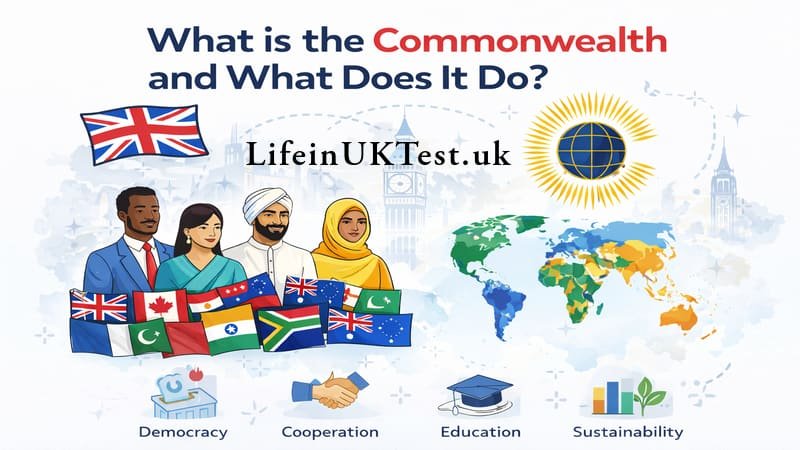
What is the Commonwealth and What Does It Do? – The Commonwealth, officially known as the Commonwealth of Nations, is a voluntary association of 56 countries with shared historical ties, values, and goals, many of which were once part of the British Empire. The Commonwealth works to promote democracy, human rights, peace, and sustainable development through cooperation in areas such as education, trade, climate action, and cultural exchange. It is an important topic covered in the Life in the UK Test, helping applicants understand the UK’s global relationships and international influence. Knowing what the Commonwealth is and what it does is essential for anyone studying UK history, international relations, or preparing for British citizenship.
What is the Commonwealth and What Does It Do?
You know that moment when you’re watching the Olympics or scrolling through news headlines and keep seeing references to “Commonwealth countries”? I used to gloss right over it, assuming it was just some dusty relic of British colonialism. Turns out, I was only half right—and the half I was missing is actually pretty fascinating.
The Commonwealth is this quirky international club of 56 countries that spans every continent except Antarctica. And here’s what surprised me most: it’s voluntary. Nobody’s being forced to stay. In fact, countries have left and come back (looking at you, Gambia and Maldives). So what’s keeping this thing alive in 2026?
The Basics: What Actually Is It?
Think of the Commonwealth as a network rather than a government. It’s not like the European Union with binding laws, or NATO with military obligations. Instead, it’s more like a professional association where member countries share values, help each other out, and coordinate on issues they care about.
The official pitch? It’s a “voluntary association of independent and equal sovereign states.” Translation: everyone’s there because they want to be, and in theory, tiny Tuvalu has the same standing as massive India.
King Charles III serves as the symbolic head—he inherited the role when Queen Elizabeth II died in 2022. But here’s the thing: he has zero political power over these countries. Most Commonwealth nations are republics with their own presidents. Only 15 still recognize him as their actual head of state (these are called Commonwealth realms).
What Does It Actually Do?
This is where it gets interesting. The Commonwealth operates through this web of programs and initiatives that touch everything from trade to human rights to climate action. Let me break down the main areas:
Democracy and Good Governance
The Commonwealth sends observer teams to monitor elections in member countries. When things go sideways—say, a military coup or democratic backsliding—they’re not afraid to suspend members. Pakistan’s been suspended. Fiji got suspended twice. Zimbabwe left before they could be kicked out, though they rejoined in 2024 after reforms.
They also run training programs for parliamentarians, judges, and civil servants. Sounds boring until you realize this has helped dozens of smaller nations build functioning democratic institutions from scratch.
Trade and Development
Here’s something I didn’t know: Commonwealth countries tend to trade with each other at lower costs. Studies suggest the “Commonwealth advantage” reduces trade costs by about 21% compared to trading with non-members. That’s huge for small island nations or landlocked countries trying to grow their economies.
The Commonwealth also champions small states—those countries with populations under 1.5 million that often get ignored in global forums. They’ve pushed for things like special financial provisions for small island developing states dealing with climate change.
Education and Youth
Nearly 60% of the Commonwealth’s population is under 30. That’s why youth programs are massive here. Commonwealth scholarships send thousands of students to universities across member countries each year. The Commonwealth Youth Programme runs leadership training and exchanges.
They also work on getting girls into school in regions where that’s still a challenge. It’s practical stuff—not just lofty declarations.
Sports and Culture
The Commonwealth Games happen every four years (most recently in 2022 in Birmingham, with the 2026 Games set for Victoria, Australia). It’s like the Olympics’ friendlier cousin—smaller, but with real passion and some unique sports you won’t see elsewhere.
There’s also the Commonwealth Writers’ Prize, initiatives to preserve indigenous languages, and cultural exchanges that keep connections alive beyond the governmental level.
Who’s Running This Show?
The Commonwealth Secretariat in London coordinates everything, led by the Secretary-General (currently Baroness Patricia Scotland from Dominica, serving since 2016). But real decision-making happens at the Commonwealth Heads of Government Meeting (CHOGM), where leaders gather every two years.
The last CHOGM was in Samoa in 2024—first time ever in a Pacific small island state. That meeting tackled climate change, ocean protection, and youth unemployment. The next one’s scheduled for India in 2026.
The Controversy Nobody Talks About Enough
Let’s be honest: the Commonwealth has baggage. It emerged from the British Empire, and that history casts a long shadow. Some members have pushed for Britain to formally apologize and pay reparations for colonialism and slavery. At the 2024 CHOGM, this became a major talking point—leaders from Caribbean nations and African countries didn’t hold back.
Britain’s response has been… diplomatic but noncommittal. They acknowledge the past but haven’t agreed to reparations. This tension isn’t going away.
There’s also the question of relevance. What does the Commonwealth offer that other international organizations don’t? The UN is bigger. Regional blocs like ASEAN or the African Union might be more focused. Some critics say the Commonwealth is just nostalgia dressed up as diplomacy.
But supporters argue it provides real value: a network of countries that share language (English is a common working language), legal traditions (many use common law systems), and institutional frameworks. That makes cooperation easier than starting from scratch.
The Member Countries: Who’s In the Club?
Here’s the complete list, including when each country joined. Fair warning—this table is longer than I expected when I started researching:
| Country | Year Joined | Region |
|---|---|---|
| Antigua and Barbuda | 1981 | Caribbean |
| Australia | 1931 | Pacific |
| The Bahamas | 1973 | Caribbean |
| Bangladesh | 1972 | Asia |
| Barbados | 1966 | Caribbean |
| Belize | 1981 | Caribbean |
| Botswana | 1966 | Africa |
| Brunei Darussalam | 1984 | Asia |
| Cameroon | 1995 | Africa |
| Canada | 1931 | Americas |
| Cyprus | 1961 | Europe |
| Dominica | 1978 | Caribbean |
| Eswatini | 1968 | Africa |
| Fiji | 1970 | Pacific |
| Gabon | 2022 | Africa |
| The Gambia | 1965 | Africa |
| Ghana | 1957 | Africa |
| Grenada | 1974 | Caribbean |
| Guyana | 1966 | South America |
| India | 1947 | Asia |
| Jamaica | 1962 | Caribbean |
| Kenya | 1963 | Africa |
| Kiribati | 1979 | Pacific |
| Lesotho | 1966 | Africa |
| Malawi | 1964 | Africa |
| Malaysia | 1957 | Asia |
| Maldives | 1982 | Asia |
| Malta | 1964 | Europe |
| Mauritius | 1968 | Africa |
| Mozambique | 1995 | Africa |
| Namibia | 1990 | Africa |
| Nauru | 1968 | Pacific |
| New Zealand | 1931 | Pacific |
| Nigeria | 1960 | Africa |
| Pakistan | 1947 | Asia |
| Papua New Guinea | 1975 | Pacific |
| Rwanda | 2009 | Africa |
| Saint Kitts and Nevis | 1983 | Caribbean |
| Saint Lucia | 1979 | Caribbean |
| Saint Vincent and the Grenadines | 1979 | Caribbean |
| Samoa | 1970 | Pacific |
| Seychelles | 1976 | Africa |
| Sierra Leone | 1961 | Africa |
| Singapore | 1965 | Asia |
| Solomon Islands | 1978 | Pacific |
| South Africa | 1931* | Africa |
| Sri Lanka | 1948 | Asia |
| Tanzania | 1961 | Africa |
| Togo | 2022 | Africa |
| Tonga | 1970 | Pacific |
| Trinidad and Tobago | 1962 | Caribbean |
| Tuvalu | 1978 | Pacific |
| Uganda | 1962 | Africa |
| United Kingdom | 1931 | Europe |
| Vanuatu | 1980 | Pacific |
| Zambia | 1964 | Africa |
| Country | Year Joined | Region |
*South Africa withdrew in 1961 and rejoined in 1994 after the end of apartheid.
Notice anything interesting? Rwanda joined in 2009 despite having zero historical connection to Britain. Mozambique joined in 1995—it was a Portuguese colony. These newer members see value in the network beyond colonial ties.
Newest additions—Gabon and Togo in 2022.
Does It Actually Matter in 2026?
Here’s my take after digging into this: the Commonwealth matters more in some contexts than others.
For small island nations facing climate catastrophe? It’s a lifeline—a platform where their voices get amplified alongside giants like India and Canada.
For trade between member countries? The advantages are real and measurable.
For young professionals seeking scholarships or training opportunities? It opens doors.
For global power politics? Eh, not so much. The Commonwealth isn’t reshaping world order or stopping wars.
The question for the future is whether it can evolve beyond its colonial origins while preserving what makes it useful. That 2024 CHOGM discussion about reparations might be a turning point—a chance to reckon with the past honestly rather than sweeping it under diplomatic carpets.
The Verdict
The Commonwealth is this weird, imperfect, surprisingly resilient organization that probably wouldn’t be invented today if it didn’t already exist. But it does exist, and it keeps chugging along because enough countries find enough value in it to show up.
It’s not going to solve all the world’s problems. It’s not even trying to. But for connecting 2.7 billion people across radically different countries, facilitating trade, supporting democracy, and giving small nations a bigger voice? It’s doing something right.
Whether it’s still doing that something right in another 20 years will depend on whether it can keep adapting. The jury’s still out.
For More Information:
- Official Commonwealth website: thecommonwealth.org
- Commonwealth Secretariat annual reports: thecommonwealth.org/reports
- Commonwealth Foundation (civil society arm): commonwealthfoundation.com