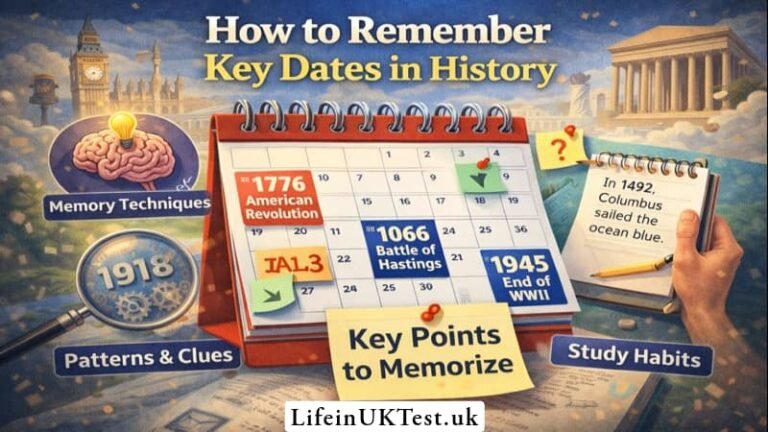
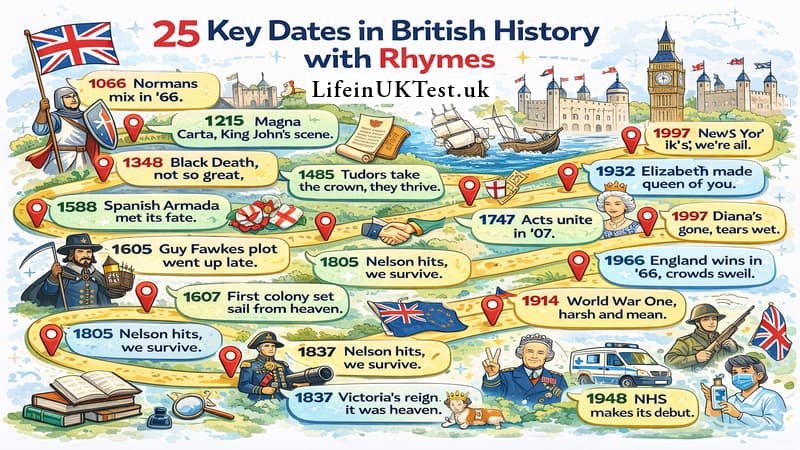
25 Key Dates in British History That You Must Memorize (With Rhymes) – Look, I get it. You’re preparing for the Life in the UK Test, and the thought of memorizing historical dates probably makes you want to close this tab right now. But here’s the thing—these aren’t just random numbers they’re throwing at you to make life difficult. These dates actually matter for the test, and I’ve seen too many people lose marks simply because they mixed up 1066 with 1606.
25 Key Dates in British History That You Must Memorize (With Rhymes)
I’ve helped dozens of people prepare for this test, and the single biggest complaint I hear? “I can’t remember all these dates!” So I’m going to do something different. For each crucial date, I’ll give you a simple rhyme. Yes, it might feel a bit silly at first, but trust me—these stick in your brain far better than mindlessly reading dates off a page.
Why These Specific 25 Dates?
The Life in the UK Test loves asking about pivotal moments that shaped Britain. I’ve gone beyond just the “essential ten” because, honestly, the test can be unpredictable. Some sessions lean heavily on medieval history, others focus on the Empire period or the 20th century. By knowing 25 dates solidly, you’re covering all your bases.
I’ve cross-referenced the official study materials updated through 2026, and these are the dates that keep appearing in test feedback from real candidates. Consider the first ten your absolute must-knows, and the remaining fifteen your insurance policy.
The Essential Ten (Your Non-Negotiables) – British history timeline
1. 1066 – The Norman Conquest
This is the big one. William the Conqueror defeated King Harold at the Battle of Hastings, and Britain was never the same. The Normans brought French influence, built castles everywhere, and completely restructured English society.
The rhyme: “Ten-sixty-six, Norman tricks—William won with his battle mix.”
Here’s what catches people out: they know the date but forget it was William who won. The test might ask who invaded in 1066, and if you blank on the name, you’ve lost an easy point. Also remember—this wasn’t just any William, it was William of Normandy, later called “the Conqueror.”
2. 1215 – Magna Carta
King John signed the Magna Carta at Runnymede, limiting royal power for the first time. This document is basically the grandfather of modern democracy and established that even the king wasn’t above the law.
The rhyme: “Twelve-fifteen, the king turned green—signed away his absolute scene.”
Common mistake? People remember “1200-something” but can’t pin down exactly when. 1215. Lock it in. Also know that it was King John specifically—the test loves asking which monarch signed it.
3. 1314 – Battle of Bannockburn
Robert the Bruce led Scotland to victory against the English under Edward II. This is crucial for understanding Scottish history within the UK and Scotland’s fight for independence.
The rhyme: “Thirteen-fourteen, Bruce was keen—Scotland’s victory on that scene.”
The test sometimes asks about significant Scottish battles. This is the one you need. Don’t confuse Robert the Bruce with William Wallace (who came earlier, around 1297).
4. 1588 – Spanish Armada Defeated
England (under Elizabeth I) defeated the Spanish fleet, establishing itself as a serious naval power. This victory is legendary—Spain was the superpower of the time, and England was the underdog.
The rhyme: “Fifteen-eighty-eight, Spain met its fate—England’s navy proved truly great.”
Watch out: some people confuse this with other Elizabethan events. The Armada was specifically 1588. Elizabeth I was queen, and Sir Francis Drake was one of the key commanders.
5. 1649 – Execution of Charles I
Charles I was executed after the English Civil War, and England briefly became a republic under Oliver Cromwell. This was revolutionary—literally beheading the king.
The rhyme: “Sixteen-forty-nine, crossed the line—Charles lost his head, end of the line.”
This date matters because it represents the only time Britain executed a reigning monarch. The Civil War ran from 1642-1651, but 1649 is when Charles actually lost his head.
6. 1688 – Glorious Revolution
William of Orange arrived from the Netherlands with his wife Mary, and James II fled to France. Parliament gained significant power without bloodshed—hence “Glorious.”
The rhyme: “Sixteen-eighty-eight, a bloodless slate—William came, James couldn’t wait.”
People mix this up with the Spanish Armada (both 1588 and 1688 end in 88). The Armada was 1588, Glorious Revolution was 1688—exactly 100 years later. Remember: William and Mary ruled together.
7. 1707 – Acts of Union
England and Scotland officially united to form Great Britain. One parliament, one kingdom. This wasn’t a conquest—it was a treaty creating a new political entity.
The rhyme: “Seventeen-oh-seven, union like heaven—England and Scotland, together eleven.”
Okay, “eleven” doesn’t make perfect sense there, but the rhythm helps. This isn’t just about England taking over Scotland—it was a formal union creating a new state. The Scottish Parliament was dissolved, and Scottish MPs joined Westminster.
8. 1801 – Union with Ireland
Ireland joined Great Britain to create the United Kingdom of Great Britain and Ireland. This is when the Union Flag (Union Jack) got its current design with St Patrick’s cross added.
The rhyme: “Eighteen-oh-one, the union’s done—Ireland joined, four became one.”
Remember: 1707 was Scotland, 1801 was Ireland. Don’t swap them. This union lasted until 1922 when most of Ireland became independent.
9. 1918 – Women Get the Vote (Partially)
Women over 30 who met property requirements could vote. Full equality came later (1928), but 1918 was the breakthrough after years of suffragette campaigning.
The rhyme: “Nineteen-eighteen, suffragettes seen—women could vote, though not yet all clean.”
The test might ask specifically about when women first got the vote. That’s 1918, not 1928. Key names: Emmeline Pankhurst and her daughters led the suffragette movement.
10. 1945 – End of World War II
VE Day (Victory in Europe) was May 8, 1945. This marks Britain’s role in defeating Nazi Germany. Winston Churchill was Prime Minister.
The rhyme: “Nineteen-forty-five, glad to be alive—victory in Europe, freedom did thrive.”
Be aware: 1945 is when WWII ended in Europe. WWI ended in 1918 (same year women got the vote, which helps you remember both). VJ Day (Victory over Japan) came in August 1945.
The Insurance Fifteen (Extra Protection)
11. 1348 – The Black Death Arrives
The bubonic plague reached Britain, killing about a third of the population. This completely reshaped medieval society and the economy.
The rhyme: “Thirteen-forty-eight, met a terrible fate—Black Death arrived, through the gate.”
This isn’t asked as often as 1066, but when the test covers medieval history, it comes up. The plague had massive social consequences—labor became valuable, serfdom began to decline.
12. 1415 – Battle of Agincourt
Henry V defeated the French in this famous battle during the Hundred Years’ War. Shakespeare made it legendary with his play Henry V.
The rhyme: “Fourteen-fifteen, Henry’s scene—beat the French, incredibly keen.”
Remember the king was Henry V, not Henry VIII. The English longbow was crucial to this victory.
13. 1534 – Break with Rome
Henry VIII broke from the Catholic Church and established the Church of England because the Pope wouldn’t annul his marriage to Catherine of Aragon.
The rhyme: “Fifteen-thirty-four, Henry wanted more—split from Rome, closed that door.”
This is hugely important for understanding British religion and politics. Henry VIII became Supreme Head of the Church of England. Don’t confuse this with his actual marriages—he had six wives, but the break with Rome was specifically about Catherine of Aragon.
14. 1605 – Gunpowder Plot
Guy Fawkes and conspirators tried to blow up Parliament and King James I. They were caught, and we still celebrate Bonfire Night on November 5th.
The rhyme: “Sixteen-oh-five, plot didn’t thrive—Guy Fawkes tried, but caught alive.”
“Remember, remember the 5th of November”—this helps you remember 1605. This was a Catholic conspiracy against the Protestant establishment.
15. 1642 – English Civil War Begins
The war between King Charles I and Parliament began. This eventually led to Charles’s execution in 1649.
The rhyme: “Sixteen-forty-two, war broke through—King and Parliament, conflict grew.”
The war actually had multiple phases running until 1651, but 1642 is the official start. Royalists (Cavaliers) vs Parliamentarians (Roundheads).
16. 1660 – Restoration of the Monarchy
Charles II returned from exile, and the monarchy was restored after Cromwell’s death. The experiment with republicanism was over.
The rhyme: “Sixteen-sixty, monarchy’s back, nifty—Charles the Second, filled the gap swiftly.”
This ended the Commonwealth period. Charles II was the son of the executed Charles I. Known as the “Merry Monarch” for his lifestyle.
17. 1805 – Battle of Trafalgar
Admiral Nelson defeated the French and Spanish navies, securing British naval supremacy. Nelson died in the battle but became a national hero.
The rhyme: “Eighteen-oh-five, Nelson’s drive—won at Trafalgar, didn’t survive.”
This happened during the Napoleonic Wars. Nelson’s Column in Trafalgar Square commemorates this victory. His famous signal was “England expects that every man will do his duty.”
18. 1833 – Slavery Abolished in British Empire
The Abolition of Slavery Act ended slavery throughout most of the British Empire. William Wilberforce had campaigned for this for decades.
The rhyme: “Eighteen-thirty-three, set them free—slavery abolished, finally.”
Note: The slave trade was abolished earlier in 1807, but actual slavery continued until 1833. This is a common confusion point.
19. 1846 – Repeal of the Corn Laws
These laws had kept grain prices high. Their repeal marked a shift toward free trade and helped the working class afford food.
The rhyme: “Eighteen-forty-six, free trade tricks—Corn Laws repealed, no more fix.”
This might seem obscure, but it represents a major economic shift in Victorian Britain. Robert Peel was the Prime Minister who pushed this through.
20. 1851 – The Great Exhibition
Prince Albert organized this showcase of industrial achievement in the Crystal Palace. It demonstrated Britain’s industrial dominance and imperial reach.
The rhyme: “Eighteen-fifty-one, Albert’s fun—Crystal Palace, exhibitions begun.”
This was the first World’s Fair. The profits helped fund museums in South Kensington including the V&A and Natural History Museum.
21. 1914 – World War I Begins
Britain entered the “Great War” after Germany invaded Belgium. This war would reshape Europe and the British Empire.
The rhyme: “Nineteen-fourteen, war machine—World War One, brutal scene.”
The war ended in 1918 (same year as women’s suffrage). Nearly a million British soldiers died. The Treaty of Versailles was signed in 1919.
22. 1928 – Equal Voting Rights for Women
The Equal Franchise Act gave women the vote on the same terms as men (age 21 and over). This completed what started in 1918.
The rhyme: “Nineteen-twenty-eight, equality’s date—women vote equal, finally great.”
Remember: 1918 was partial (women over 30), 1928 was equal rights. This is a common test question distinguishing between the two dates.
23. 1939 – World War II Begins
Britain declared war on Germany after Hitler invaded Poland. This six-year conflict defined a generation.
The rhyme: “Nineteen-thirty-nine, drawn the line—World War Two, Britain’s time.”
Prime Minister Neville Chamberlain declared war on September 3, 1939. Winston Churchill became PM in 1940. The war in Europe ended in 1945.
24. 1948 – National Health Service Founded
The NHS was created, providing free healthcare for all. Aneurin Bevan was the Labour minister who championed it.
The rhyme: “Nineteen-forty-eight, healthcare’s fate—NHS founded, truly great.”
This is one of the most important post-war achievements. It was part of the welfare state created by the Labour government after 1945.
25. 1973 – Britain Joins the European Community
Britain joined what was then called the European Economic Community (EEC), later becoming the EU. Edward Heath was Prime Minister.
The rhyme: “Nineteen-seventy-three, joined the EC—Europe together, across the sea.”
Britain had tried to join earlier but was blocked by France. This membership lasted until Brexit in 2020. Note: The test materials through 2026 still reference this as an important historical moment in Britain’s relationship with Europe.
The Complete Timeline at a Glance
| Year | Event | Key Figure/Detail |
|---|---|---|
| 1066 | Norman Conquest | William the Conqueror |
| 1215 | Magna Carta | King John |
| 1314 | Battle of Bannockburn | Robert the Bruce |
| 1348 | Black Death Arrives | Killed 1/3 of population |
| 1415 | Battle of Agincourt | Henry V vs France |
| 1534 | Break with Rome | Henry VIII |
| 1588 | Spanish Armada Defeated | Elizabeth I |
| 1605 | Gunpowder Plot | Guy Fawkes |
| 1642 | English Civil War Begins | Charles I vs Parliament |
| 1649 | Charles I Executed | Only monarch executed |
| 1660 | Restoration of Monarchy | Charles II returns |
| 1688 | Glorious Revolution | William & Mary |
| 1707 | Acts of Union | England + Scotland |
| 1801 | Union with Ireland | Creates United Kingdom |
| 1805 | Battle of Trafalgar | Admiral Nelson |
| 1833 | Slavery Abolished | Throughout Empire |
| 1846 | Corn Laws Repealed | Free trade begins |
| 1851 | Great Exhibition | Prince Albert, Crystal Palace |
| 1914 | WWI Begins | The Great War |
| 1918 | Women Get Vote (Partial) | Over 30, property owners |
| 1928 | Equal Voting Rights | Women equal to men |
| 1939 | WWII Begins | September 3 |
| 1945 | WWII Ends | VE Day, May 8 |
| 1948 | NHS Founded | Aneurin Bevan |
| 1973 | Joins European Community | Edward Heath PM |
How to Actually Memorize 25 Dates (Without Losing Your Mind)
Let me be straight with you—25 dates is a lot. If you try to learn them all at once, you’ll remember approximately none of them. Here’s the strategy that actually works:
Week One: Master the Essential Ten
Focus exclusively on dates 1-10. Write the rhymes, test yourself, sleep on it. Don’t even look at the other fifteen yet. By the end of week one, you should be able to recite these ten in random order without hesitation.
Week Two: Add Five More
Once the first ten are solid, add dates 11-15. Now you’re at fifteen total. Continue reviewing the first ten daily while adding the new five.
Week Three: Complete the Set
Add dates 16-20. You’re now at twenty. The pattern you’ll notice: dates start clustering. The 1800s have several important dates, as do the 1900s. This actually helps—once you’re in a century, it’s easier to remember multiple dates.
Week Four: Final Five and Polish
Add dates 21-25. Spend this week doing random quizzes, mixing up the order, and identifying your weak spots.
The Century Clustering Trick
Here’s something I noticed helping people: dates naturally group by century. Once you remember “okay, this is 1800s,” you’ve narrowed it down significantly. Let me show you:
- 1000s (Medieval): 1066
- 1200s: 1215
- 1300s: 1314, 1348
- 1400s: 1415
- 1500s: 1534, 1588
- 1600s: 1605, 1642, 1649, 1660, 1688
- 1700s: 1707
- 1800s: 1801, 1805, 1833, 1846, 1851
- 1900s: 1914, 1918, 1928, 1939, 1945, 1948, 1973
Notice how the 1600s and 1800s are packed? That’s because these were periods of massive change in Britain. Once you know “this is a 1600s question,” you’re choosing from seven options, not twenty-five.
Memory Hacks That Actually Work
Create a Memory Palace
This sounds fancy, but it’s simple. Visualize walking through your house. At the front door, picture William the Conqueror (1066). In the hallway, King John signing the Magna Carta (1215). In the kitchen, Robert the Bruce with his sword (1314). And so on.
I know someone who uses their commute to work—each landmark represents a different date. The weird part? It works brilliantly.
Connect Dates with Similar Numbers
- 1588 and 1688 both end in 88 (Spanish Armada and Glorious Revolution)
- 1918 and 1928 are both women’s suffrage dates (10 years apart)
- 1914 and 1939 are both World Wars starting (25 years apart)
- 1945 and 1948 are both post-WWII rebuilding (NHS came 3 years after war ended)
These connections create a web in your memory instead of isolated facts.
The “Before and After” Game
Test yourself not just on dates, but on sequences. What happened before 1707? What came after 1649? This builds understanding, not just memorization.
For example: The English Civil War (1642) led to Charles I’s execution (1649), which led to Cromwell’s Commonwealth, which eventually led to the Restoration (1660). That’s three dates connected by cause and effect.
Common Traps and How to Avoid Them
After watching countless people prepare for this test, here are the mistakes that keep appearing:
Trap 1: Mixing Up the Henrys
Henry V won at Agincourt (1415). Henry VIII broke with Rome (1534). Different Henrys, different centuries, different achievements. Write this down: “Henry V = Victory, Henry VIII = VIII wives (and Church split).”
Trap 2: The Two Women’s Suffrage Dates
I cannot stress this enough: 1918 is partial voting (women over 30), 1928 is equal voting. The test loves asking which date was which. Get this wrong and you’ve wasted all that memorization.
Trap 3: Confusing the World Wars
WWI began 1914, ended 1918. WWII began 1939, ended 1945. Both wars lasted about 4-5 years, but they’re a generation apart. Also remember: women got the vote (partially) the same year WWI ended—1918.
Trap 4: The Unions
1707 = Scotland joins England = Great Britain created 1801 = Ireland joins = United Kingdom created
Not the same event, not interchangeable. Write it as a timeline: “First Scotland, then Ireland.”
Trap 5: Slavery Dates
1807 = Slave trade abolished (couldn’t bring new slaves into the Empire) 1833 = Slavery itself abolished (freed existing slaves)
The test sometimes asks about the difference. That’s a 26-year gap.
Trap 6: The 1688 Confusion
1588 = Spanish Armada (Elizabeth I, external threat) 1688 = Glorious Revolution (William & Mary, internal change)
Both end in 88. Both are crucial. One’s about foreign invasion, one’s about changing monarchs. Don’t mix them up.
The Week Before Your Test
Here’s your final week strategy:
Daily Random Testing: Use a random number generator or have someone quiz you completely out of order. If you can only remember dates in sequence, you’re not ready.
Focus on Your Weak Spots: By now, you know which dates keep slipping. For me when I was learning this, it was always 1846 (Corn Laws). I finally remembered it by thinking “1846 sounds like ‘eighteen-forty-sick’ and the working class was sick of expensive bread.”
Make up whatever ridiculous connection works for you.
Practice the Details: Knowing the date is half the battle. Make sure you know:
- Who was involved (which king, which general, which politician)
- What actually happened (not just “something with Scotland” but “Robert the Bruce won at Bannockburn”)
- Why it mattered (how did this change Britain?)
Don’t Cram the Night Before: Your brain needs sleep to consolidate memories. Review once in the evening, then go to bed early. Seriously.
A Reality Check About the Test
Here’s something they don’t tell you in the official materials: the Life in the UK Test won’t necessarily ask about all these dates. You might get a test heavy on medieval history, or one focused on the 20th century. That’s why knowing 25 dates matters—you’re covering all possible angles.
I’ve spoken to people who said, “I memorized ten dates and none of them appeared on my test.” That’s the risk of minimal preparation. The ones who studied 20-25 dates? They always had the answer.
Why Rhymes Actually Work (The Science Bit)
You might feel silly using rhymes, but there’s solid neuroscience behind this. Your brain remembers patterns, rhythms, and sounds better than abstract numbers. That’s why you can remember song lyrics from twenty years ago but not what you had for lunch last Tuesday.
The rhymes create what memory experts call “elaborative encoding”—you’re not just memorizing “1588” as random digits, you’re attaching it to rhythm, meaning, and multiple sensory inputs. This creates multiple pathways to the same memory, so even if one pathway fails under test pressure, another gets you there.
Also, rhymes force you to engage actively with the material. You can’t passively read a rhyme and absorb it—you have to process it, maybe say it aloud, definitely think about whether it makes sense. That active engagement is what moves information from short-term to long-term memory.
Creating Your Own Memory System
If my rhymes don’t work for you, make your own. Seriously. The act of creating a memory device is even more powerful than using someone else’s.
Maybe you’re visual—draw a timeline with little pictures. Maybe you’re musical—turn the dates into a song. I knew someone who rapped the dates. Did it sound good? No. Did she pass the test? Yes.
The goal isn’t to use my system perfectly. The goal is to use whatever system makes these 25 dates stick in your brain.
Practice Questions to Test Yourself
Don’t just memorize in isolation. Here are the kinds of questions the test actually asks:
- When did women first get the vote in the UK?
- Which battle did Robert the Bruce win, and when?
- When was the United Kingdom formed?
- Who won the Battle of Hastings, and in what year?
- When did Britain join the European Community?
- In what year was the NHS established?
- When was the Magna Carta signed?
- Which king was executed, and when?
Notice how the test combines dates with details? You need both.
The Night Before: Your Final Checklist
□ Can you recite all 25 dates in random order? □ Do you know the key people involved for each date? □ Can you explain what actually happened (not just memorize the rhyme)? □ Have you identified patterns and connections between dates? □ Do you know which dates are commonly confused and how to keep them straight? □ Have you had a good night’s sleep? (This matters more than last-minute cramming)
If you’ve ticked all these boxes, you’re ready.
Key Takeaway
The Life in the UK Test demands historical knowledge, and dates are non-negotiable. Master the essential ten first (1066, 1215, 1314, 1588, 1649, 1688, 1707, 1801, 1918, 1945), then build up to all 25 for comprehensive coverage. Use the rhymes actively—write them out, test yourself randomly, and create connections between similar dates. Watch out for common traps: mixing up the Henrys (V vs VIII), confusing women’s suffrage dates (1918 partial, 1928 equal), and swapping the unions (1707 Scotland, 1801 Ireland). Don’t memorize dates in isolation—know who was involved and why it mattered. The test won’t ask about all 25, but knowing them all means you’re prepared for any question they throw at you. Learn in clusters by century, test yourself out of sequence, and focus on your weak spots in the final week. The rhymes might feel silly, but they create memory pathways that work under pressure—and passing this test is what matters.
Now start with those first ten dates. Write the rhymes tonight. Test yourself tomorrow. You’ve got this.