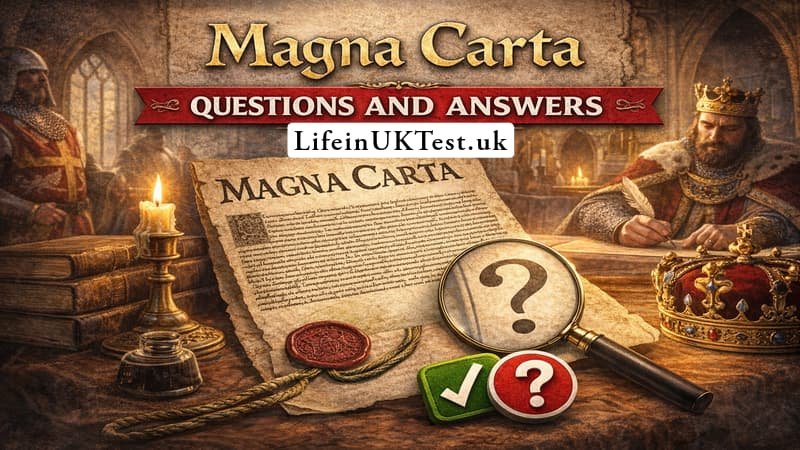
Magna Carta Questions and Answers – The Magna Carta is one of the most important documents in British history and a key topic in the Life in the UK Test, often appearing in exam questions. Many candidates find Magna Carta questions challenging due to dates, historical context, and the rights it established. In this article on “Magna Carta Questions and Answers,” we explain the most commonly asked exam-style questions in clear, simple language, helping you understand why the Magna Carta matters and how it shaped modern democracy in the UK. This guide is ideal for anyone preparing for the Life in the UK Test who wants accurate answers, quick revision, and better confidence on test day.
Magna Carta Questions and Answers: What You Actually Need to Know for the Life in the UK Test
Look, I’ll be straight with you – the Magna Carta comes up in the Life in the UK test, and it trips people up more than you’d think. Not because it’s complicated, but because test-takers either overthink it or remember the wrong details. Let me walk you through everything that matters.
Magna Carta – What’s the Real Story Here?
The Magna Carta isn’t some dusty old document that only historians care about. It’s the foundation of how we think about rights and the law in the UK today. King John signed it in 1215 – that’s over 800 years ago – at a place called Runnymede. The barons had basically had enough of his heavy-handed rule and forced him to agree to limits on royal power.
Here’s what’s brilliant about it: for the first time, it established that even the king had to follow the law. Revolutionary stuff for 1215.
The document guaranteed rights and liberties, and while most of its original clauses don’t apply anymore, a few fundamental principles stuck. Things like the right to a fair trial and protection from unlawful imprisonment. You can still see its influence in legal systems across the world, including the United States Constitution.
Magna Carta Questions You’ll Actually Face
Right, let’s get to what the test asks. I’ve put together the most common questions based on the current test format (and yes, this is updated for 2026).
Question 1: When was the Magna Carta agreed?
Answer: 1215
Don’t overcomplicate this one. Just remember 1215. I’ve seen people write 1205 or 1225 because they second-guess themselves. Trust your memory.
Question 2: Where was the Magna Carta signed?
Answer: Runnymede
It’s a meadow by the River Thames. Some people mix this up with other historical locations, but Runnymede is the one you need.
Question 3: Which king was forced to sign the Magna Carta?
Answer: King John
Not King Henry, not King Richard. King John. He wasn’t exactly thrilled about it either.
Question 4: Who forced King John to sign the Magna Carta?
Answer: The barons (or noblemen)
These were powerful landowners who’d grown tired of John’s arbitrary taxation and abuse of power. They demanded guarantees.
Question 5: What was the main principle established by the Magna Carta?
Answer: That the king is subject to the law (or that everyone, including the king, must obey the law)
This is crucial. The test might phrase it differently, but the core idea is the same – nobody’s above the law, not even royalty.
Question 6: What important right did the Magna Carta establish?
Answer: The right to a fair trial (or protection from unlawful imprisonment)
Specifically, it said that no free man could be imprisoned or punished without lawful judgment. Pretty groundbreaking for medieval times.
Question 7: Is the Magna Carta still important today?
Answer: Yes – its principles form the basis of constitutional law and human rights
Only a few clauses remain on the statute books, but its influence is massive. Modern legal systems worldwide draw from its ideas.
Question 8: How many original clauses of the Magna Carta are still in force today?
Answer: Three (or four, depending on how you count)
The test usually accepts “three” as the answer. These relate to the freedom of the Church, the privileges of the City of London, and the right to due process.
Question 9: What language was the Magna Carta originally written in?
Answer: Latin
Medieval documents of this importance were written in Latin, the language of the Church and educated classes. It was called “Magna Carta Libertatum.”
Question 10: True or False: The Magna Carta was a peace treaty between England and France.
Answer: False
This is a trick question that sometimes appears. The Magna Carta was an internal English document about limiting royal power, nothing to do with France.
Question 11: Which of these is NOT associated with the Magna Carta?
A) Rule of law
B) Trial by jury
C) Universal suffrage
D) Limits on taxation without consent
Answer: C) Universal suffrage
The Magna Carta dealt with legal rights and limiting royal power. Voting rights for all citizens came much, much later – we’re talking centuries.
Question 12: What did the Magna Carta limit?
Answer: The power of the king (or monarchy)
Before this, monarchs could pretty much do whatever they wanted. The Magna Carta said, “Actually, no, there are rules you need to follow too.”
Question 13: What does “Magna Carta” mean in English?
Answer: Great Charter
“Magna” means great or large, and “Carta” means charter or document. Simple as that.
Question 14: Which river is Runnymede located near?
Answer: The River Thames
This helps you visualize the location – it’s in Surrey, between Windsor and Staines. Not essential for the test, but it helps the facts stick.
Question 15: True or False: King John willingly created the Magna Carta.
Answer: False
He was forced into it by rebellious barons. Given half a chance, he’d have torn it up – which he actually tried to do shortly after signing it.
Question 16: What principle about taxation did the Magna Carta establish?
Answer: No taxation without representation (or the king couldn’t impose taxes without consent)
This became massive later on. The idea that rulers can’t just take your money without agreement? Revolutionary then, obvious now.
Question 17: How many original copies of the Magna Carta survive today?
Answer: Four
Two are held in the British Library, one in Lincoln Cathedral, and one in Salisbury Cathedral. You won’t be tested on this specific detail, but it’s fascinating.
Question 18: In what century was the Magna Carta signed?
Answer: 13th century (1200s)
If you blank on 1215, at least remembering “13th century” might help you eliminate wrong answers in a multiple-choice question.
Question 19: Which of the following did the Magna Carta protect?
A) The rights of women to vote
B) The freedom of the Church
C) Workers’ rights to fair wages
D) The right to own property abroad
Answer: B) The freedom of the Church
Clause 1 of the Magna Carta, which is still in force, protects the English Church’s freedom from royal interference.
Question 20: True or False: The Magna Carta gave rights to all people in England equally.
Answer: False
Initially, it protected “free men” – basically barons, knights, and freemen. Serfs and peasants weren’t included. It wasn’t a document of universal human rights, though its principles eventually expanded.
Question 21: What did the Magna Carta say about imprisonment?
Answer: No free man could be imprisoned without lawful judgment of his peers or by the law of the land
This is the foundation of habeas corpus – you can’t just lock people up on a whim. There has to be a legal process.
Question 22: Which English county is Runnymede in?
Answer: Surrey
Geography again. It’s west of London, a reasonable distance from where King John would have been based.
Question 23: True or False: The Magna Carta is considered one of the most important legal documents in history.
Answer: True
It influenced constitutional development worldwide, including the US Constitution and Bill of Rights. Its impact went far beyond England.
Question 24: What was King John’s main problem that led to the Magna Carta?
Answer: He abused his power, imposed heavy taxes, and ruled unfairly
He’d lost territory in France (earning him the nickname “John Lackland”), needed money for wars, and squeezed his barons dry. They’d had enough.
Question 25: Which of these rights does the Magna Carta NOT establish?
A) Right to a fair trial
B) Protection from unlawful imprisonment
C) Freedom of speech
D) Limits on royal power
Answer: C) Freedom of speech
Freedom of speech came much later. The Magna Carta focused on legal processes, taxation, and limiting arbitrary royal power.
Question 26: How many clauses were in the original 1215 Magna Carta?
Answer: 63 clauses
Most dealt with specific medieval grievances – things about fish weirs in the Thames or the behaviour of royal officials. Only a handful have lasting significance.
Question 27: True or False: The Pope annulled the Magna Carta shortly after it was signed.
Answer: True
Pope Innocent III declared it null and void within months, saying John had been forced to sign it. But the genie was out of the bottle – the principles survived.
Question 28: What concept did the Magna Carta help establish about law?
Answer: The rule of law (that law applies to everyone, including rulers)
This is the big one. Before this, kings were essentially above the law. The Magna Carta said otherwise, and that idea never went away.
Question 29: Which later document was influenced by the Magna Carta?
A) The Treaty of Versailles
B) The US Constitution
C) The Geneva Convention
D) The Treaty of Rome
Answer: B) The US Constitution
The American founding fathers looked back to the Magna Carta when creating their own system of government. Ideas about due process and limiting government power came directly from it.
Question 30: True or False: The Magna Carta established democracy in England.
Answer: False
It didn’t create democracy or give common people the vote. It limited royal power and protected certain rights, but England remained a monarchy with power concentrated among the nobility. Democracy came gradually over the following centuries.
Why This Matters for Your Test
I’ve tutored dozens of people preparing for the Life in the UK test, and here’s what I’ve noticed: people who fail the Magna Carta questions usually do so because they confuse dates or mix up which king was involved. Some think it was Henry VIII (he came 300 years later). Others remember “King” and “1200s” but fumble the specifics.
Here’s my advice – create a simple mental image: King John (think of Robin Hood’s era – same John) in the year 1215, standing by a river at Runnymede, grudgingly putting his seal on a document that says he’s not above the law. That story sticks better than isolated facts.
Common Mistakes People Make
Mistake 1: Saying it gave everyone equal rights immediately. It didn’t. Initially, it protected barons and freemen, not peasants or serfs.
Mistake 2: Thinking all 63 original clauses still apply. They don’t. Most have been repealed over the centuries.
Mistake 3: Confusing Runnymede with other historical sites like Westminster or Canterbury. Geography matters here.
Mistake 4: Mixing up King John with King Henry VIII, who’s more famous for other reasons (six wives, breaking from Rome, etc.).
Mistake 5: Believing it established democracy or voting rights. The Magna Carta was about limiting royal tyranny, not creating representative government. That evolution took centuries.
Mistake 6: Thinking it was written in English. Remember: Latin was the language of official documents in 1215.
Pattern Recognition for the Test
After looking at these 30 questions, you’ll notice the test circles around a few key themes:
- The basics: 1215, King John, Runnymede, barons
- The principles: Rule of law, fair trial, limits on power
- The impact: Constitutional influence, still relevant today
- What it wasn’t: Not democracy, not universal rights, not for everyone
If you’ve got those four areas covered, you’re in excellent shape. The test doesn’t try to catch you on obscure medieval history. It wants to know you understand why the Magna Carta matters in British constitutional development.
How to Study These Effectively
Don’t just read through the questions once and think you’re done. I’ve seen that approach fail more times than I can count.
Try this instead: cover the answers and test yourself. Write down what you remember. The questions you get wrong? Those are the ones to focus on.
Make flashcards if that’s your thing. Or better yet, explain the Magna Carta to someone else – your partner, your friend, even your cat. If you can tell the story coherently, you understand it.
Group similar questions together. All the “True or False” ones, for instance. Then all the ones about what the Magna Carta did versus what it didn’t do. Patterns emerge, and that makes remembering easier.
What the Test Won’t Ask (But You Might Wonder)
The test doesn’t dive into the nitty-gritty details of individual clauses or the political intricacies of 13th-century England. You won’t need to know about the First Barons’ War that followed or the papal annulment details beyond the basic fact it happened.
You also won’t be asked about modern celebrations, specific clause numbers, or the precise wording of any clause in Latin or English.
What you do need is the essential narrative: who, what, when, where, and why it matters today.
The Bigger Picture
Here’s something that might help it all click: the Magna Carta wasn’t really about the specific complaints of 1215. It was about establishing a precedent. Once you say “the king must follow the law,” you’ve opened a door that can never be fully closed again.
Every subsequent struggle for rights in British history – from Parliament’s battles with Charles I to the slow extension of voting rights – traces back to this principle. The Magna Carta didn’t create modern democracy or universal human rights, but it planted a seed that grew into those things over time.
When you’re revising, don’t just memorize – understand the story. Why would barons force a king to sign something? Because power without limits leads to abuse. That’s a human story, not just a historical footnote. Once you grasp why it happened, the details become easier to remember.
Final Tips Before Your Test
The night before, don’t cram. Instead, run through the key facts one more time: 1215, King John, Runnymede, barons, rule of law, fair trial. If you know those cold, you can work out most other answers through logic.
During the test, if you see a Magna Carta question and panic, take a breath. Think about what makes sense historically. A question about voting rights? Probably not the Magna Carta – that’s centuries later. Something about limiting royal power? Definitely the Magna Carta.
You’ve got this. The Magna Carta section isn’t meant to catch you out – it’s actually one of the more straightforward topics if you know the basics. These 30 questions cover more than you’ll likely see on the actual test. Master these, and you’re sorted.
Good luck with your test!