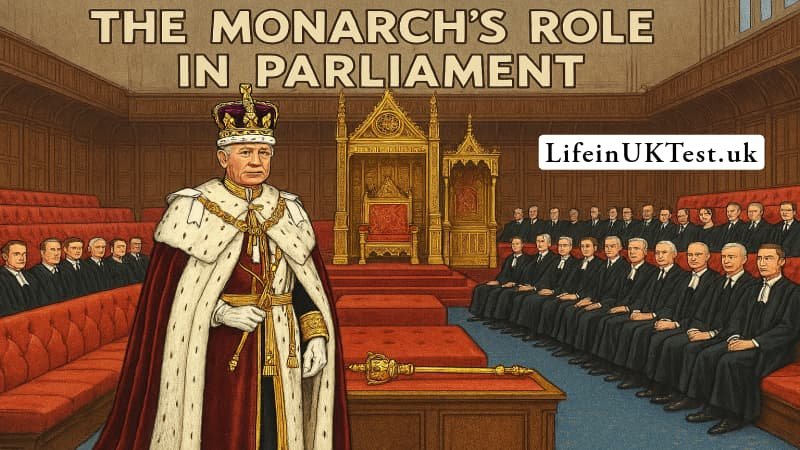
The Monarch’s role in Parliament is a cornerstone of the United Kingdom’s constitutional framework, blending centuries-old tradition with modern democratic practice. While the UK is a constitutional monarchy, the sovereign retains important ceremonial and formal powers, including the opening of Parliament, granting Royal Assent to legislation, and formally appointing the Prime Minister. This article explores the Monarch’s role in Parliament, explaining how royal duties interact with the legislative process, influence government, and uphold centuries of political tradition in the UK.
The Monarch’s Role in Parliament: What You Actually Need to Know
When I first started preparing for the Life in the UK Test, I’ll be honest—the whole monarchy and parliament relationship confused me. You’ve got a Queen (well, now a King), but the Prime Minister runs things? Parliament makes laws, but the monarch has to approve them? It felt backwards.
Here’s what clicked for me: the UK has a constitutional monarchy. That means King Charles III is the head of state, but he doesn’t actually make political decisions. Parliament does the real work.
What Does the Monarch Actually Do?
Think of the King as someone who keeps the machinery running smoothly without steering the car. His role is mostly ceremonial and symbolic, but it matters for keeping the system legitimate.
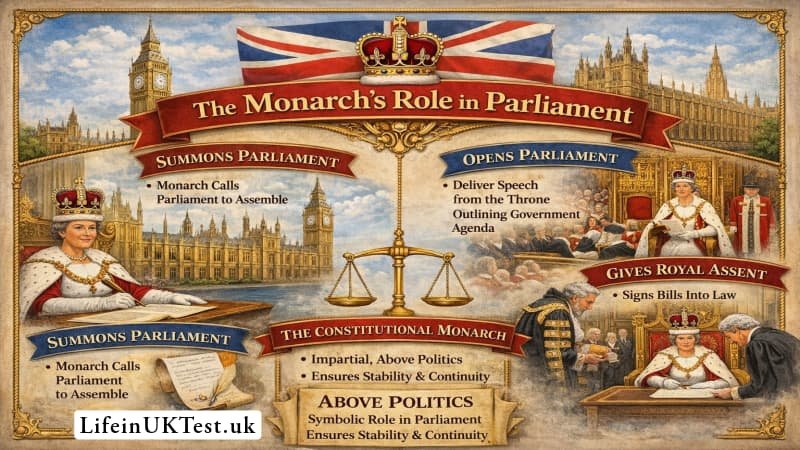
Opening Parliament is probably the biggest visible job. The King arrives at the Palace of Westminster to deliver the King’s Speech (previously the Queen’s Speech when Queen Elizabeth II reigned). This ceremony is called the State Opening of Parliament and traditionally happens each year, though in 2025 there was no King’s Speech because the current parliamentary session was extended until 2026. But here’s the thing—he doesn’t write it. The government writes every word. He’s basically reading their script about what laws they plan to introduce that year.
The State Opening of Parliament is full of traditions. Black Rod gets sent to summon MPs from the House of Commons, and they literally slam the door in his face to show their independence from the Crown. Then they all walk over to the House of Lords to hear the speech. Honestly, it looks dramatic, but it’s theatre with a purpose—reminding everyone that Parliament, not the monarch, holds the power.
Royal Assent is another crucial function. Every bill that passes through Parliament needs the monarch’s approval to become law. But let me be clear: the King can’t actually refuse. The last time a monarch said no was in 1708. If King Charles tried to block a law today, we’d probably have a constitutional crisis on our hands. So yes, it’s required, but no, it’s not a real veto.
The monarch also appoints the Prime Minister, but again, there’s no choice involved. After a general election, the King asks the leader of the party with the most MPs to form a government. That’s it. He can’t pick his favourite person or someone he thinks would do a better job.
The Real Power Sits in Parliament
Parliament is where actual decisions happen. It’s split into two houses: the House of Commons and the House of Lords.
House of Commons
The House of Commons is the big one. These are the 650 MPs (Members of Parliament) elected by us, the public. They debate laws, scrutinize the government, and represent their constituencies. The Prime Minister comes from this group—whoever leads the party with the majority of seats.
House of Lords
The House of Lords is more complicated. Lords aren’t elected. Some inherited their titles (though this is being phased out), some are appointed for life because of their expertise, and some are bishops from the Church of England. They review and suggest changes to laws, but they can’t block legislation from the Commons indefinitely. The Commons always wins eventually.
Together, these two houses make up Parliament. The monarch is technically part of Parliament too—it’s called “the Crown-in-Parliament”—but only in the ceremonial sense.
What About Political Power?
None. Zero. The monarch stays completely neutral on political issues.
King Charles can meet with the Prime Minister every week for private conversations, and he does. These meetings are confidential, and he can offer advice based on his decades of experience. But he can’t tell the PM what to do, and he definitely can’t share his political opinions publicly.
You won’t catch the King endorsing a political party, commenting on Brexit, or weighing in on tax policy. That’s not his job. If he did, it would undermine the whole constitutional monarchy setup.
Why Does the UK Still Have a Monarchy?
Fair question. Some people love the tradition and stability. Others think it’s outdated and expensive. The monarch represents continuity—governments change every few years, but the Crown remains. It’s also a tourist draw, though that’s debatable as a justification.
What matters for your test is understanding that the monarchy isn’t about power anymore. It’s about ceremony, tradition, and representing the nation symbolically.
Quick Facts You’ll Want to Remember
| Role | Details |
|---|---|
| Current Monarch | King Charles III (became King in September 2022) |
| Head of State | The monarch, but ceremonial only |
| Head of Government | The Prime Minister (currently Sir Keir Starmer, Labour, since July 2024) |
| Parliament Structure | House of Commons (650 elected MPs) and House of Lords (appointed members) |
| King’s Speech | Written by the government, delivered by the King at State Opening of Parliament |
| Royal Assent | Required for all bills to become law, but cannot be refused in practice (last refused in 1708) |
| Political Neutrality | The monarch must stay completely neutral on all political matters |
| Weekly Meetings | The King meets the Prime Minister privately each week to discuss government matters |
| Appointing PM | The King appoints the leader of the party with majority in Commons as Prime Minister |
Common Mistakes People Make
One big confusion: thinking the King can overrule Parliament. He can’t. Another one: assuming the House of Lords is more powerful than the House of Commons. Wrong way round—the Commons has the final say.
Also, don’t mix up “head of state” with “head of government.” The King is head of state (ceremonial leader of the country). The Prime Minister is head of government (actually runs things day-to-day).
What This Means in Practice
Let’s say Parliament passes a controversial law—something half the country hates. The King still gives Royal Assent. He doesn’t tweet about it. He doesn’t give interviews saying whether he agrees. He stays silent and lets democracy work.
Or imagine a general election produces a hung parliament where no party has a clear majority. The King doesn’t pick who becomes Prime Minister. He waits for the politicians to sort it out, then formally appoints whoever emerges as the agreed leader.
The system works because everyone sticks to their lane. The monarch provides stability and symbolism. Parliament provides democracy and lawmaking. The Prime Minister provides leadership and policy. When one tries to do another’s job, that’s when problems start.
For Your Life in the UK Test
You need to know the basics: who the current monarch is, what Royal Assent means, what happens at the State Opening of Parliament, and why the monarch doesn’t get involved in politics. You should understand the difference between the two houses of Parliament and who actually runs the country (hint: not the King).
The test loves asking about traditions and roles, so remember that the monarchy is constitutional and ceremonial. Real power belongs to elected representatives in Parliament.
Look, the British constitution is weird. It’s not written down in one document like in the US. It’s based on laws, conventions, and traditions built up over centuries. The monarchy is part of that tradition—respected, maintained, but kept carefully separate from actual political power.
That separation is what makes it work.
References and Further Reading
This article is based on information from authoritative sources about the UK constitutional monarchy and parliamentary system:
- The Royal Family Official Website – The Role of the Monarchy
- UK Parliament Official Website – Parliament and Crown
- Institute for Government – The Monarch, Royal Family and Parliament
- UK Parliament – State Opening of Parliament
- House of Commons Library – Royal Assent
- UCL Constitution Unit – What is Constitutional Monarchy?
For Life in the UK Test preparation, refer to the official handbook “Life in the UK: A Guide for New Residents” published by the Home Office.
Key Takeaway
The UK monarch is the ceremonial head of state with no real political power. King Charles III performs traditional duties like opening Parliament and granting Royal Assent to laws, but he cannot refuse legislation or interfere in politics. Real power sits with Parliament—the elected House of Commons and the appointed House of Lords—and the Prime Minister leads the government. The system works because everyone respects these boundaries, maintaining a constitutional monarchy where tradition meets democracy.