[top]
Top 100 Life in the UK test most common questions and answers (2026) – Look, I get it. You’re sitting there staring at the official handbook, wondering how you’ll possibly remember everything about British history from the Stone Age to the modern era. Here’s the thing though – you don’t need to memorize the entire book word-for-word.
Top 100 Life in the UK test most common questions and answers (2026)
After analyzing thousands of test reports from people who’ve actually sat the exam, certain questions pop up again and again. Think of this as your shortcut to passing. Not cheating, just smart preparation.
Why These Questions Matter
The Life in the UK test isn’t designed to trick you. It’s 24 multiple-choice questions, 45 minutes on the clock, and you need 18 correct answers to pass (that’s 75%). Most folks finish in under 10 minutes. The real challenge? Knowing what to focus on.
Based on feedback from test-takers throughout 2025 and early 2026, these 100 questions represent what you’re most likely to face. Practice these until you can answer them without thinking twice.
British Values & Principles
1. What are the fundamental principles of British life?
- Tolerance of those with different faiths and beliefs
- Rule of law
- Democracy
- Individual liberty
- Participation in community life
Honestly, this one comes up a lot. It’s testing whether you understand what makes Britain, well, Britain.
2. What does the UK offer to its residents or citizens?
- Freedom of belief and religion
- Freedom of speech
- Freedom from unfair discrimination
- Right to a fair trial
- Right to join in the election of a government
3. What are your responsibilities as a British citizen or permanent resident?
- Look after yourself and your family
- Look after the area in which you live and the environment
- Respect and obey the law
- Respect the rights of others, including their right to their own opinions
- Treat others with fairness
4. Which of these is NOT part of the citizenship pledge? Answer: “Long live our noble King!” (This is from the National Anthem, not the citizenship pledge)
Geography & Governance
5. What are the Crown dependencies? Answer: Channel Islands and Isle of Man
These are closely linked to the UK but not actually part of it. They have their own governments.
6. Where is the UK parliament located? Answer: Westminster (in London)
7. Which countries make up Great Britain? Answer: England, Scotland, and Wales
(Northern Ireland is part of the United Kingdom but not Great Britain – tricky distinction!)
8. What are some British overseas territories? Answer: St Helena and the Falkland Islands
9. How many members are in the Scottish Parliament? Answer: 129 MSPs (Members of Scottish Parliament)
They’re elected by proportional representation, if you’re wondering.
10. How many members are there in the Welsh Assembly (Senedd)? Answer: 60 members
They’re elected by a form of proportional representation.
British History – Medieval Period
11. What were the Wars of the Roses? Answer: A civil war (1455) between the House of Lancaster (red rose) and House of York (white rose) to decide who should be king of England
12. Who was Boudicca? Answer: A queen of the Iceni tribe who led an uprising against the Romans
She’s a proper British legend. Her statue stands near Westminster Bridge.
13. When did the first farmers arrive in Britain? Answer: 6,000 years ago
14. What was the Reformation? Answer: A movement against the authority of the Pope during Henry VIII’s reign
This changed Britain’s religious landscape forever.
15. Under which Act was Wales formally united with England? Answer: The Act for the Government of Wales (during Henry VIII’s reign)
16. What are jesters? Answer: People who told jokes and made fun of people at medieval royal courts
Medieval kings and nobles employed them for entertainment.
17. Where has been the coronation church since 1066? Answer: Westminster Abbey
It’s also the final resting place of 17 monarchs.
Tudor & Stuart Period
18. Who is the Elizabethan period known for? Answer: William Shakespeare (for the richness of poetry and drama)
19. What happened in 1588? Answer: The English defeated the Spanish Armada
20. Who was given the title of Lord Protector? Answer: Oliver Cromwell (ruled until his death in 1658)
21. When was the Act of Union that created the United Kingdom of Great Britain and Ireland? Answer: 1801 (Act of Union of 1800)
Victorian Era & Industrial Revolution
22. Who defeated Napoleon at the Battle of Waterloo in 1815? Answer: The Duke of Wellington
This ended the French Wars for good.
23. What did Isambard Kingdom Brunel build? Answer: Tunnels, bridges, railway lines, and ships (including the Great Western Railway)
He was an engineering genius from Portsmouth.
24. What was the Great Fire of London? Answer: A massive fire in 1666 that destroyed much of the city
This comes up surprisingly often in the test.
25. What did the Reform Act of 1832 do? Answer: Abolished pocket and rotten boroughs and gave more parliamentary seats to towns and cities
It also increased the number of people who could vote.
20th Century & Modern Britain
26. Who was the Labour Prime Minister who nationalized major industries? Answer: Clement Attlee
His government created the NHS and implemented stronger welfare state plans.
27. Who introduced the Scottish Parliament and Welsh Assembly? Answer: Tony Blair (Labour Party leader elected in 1997)
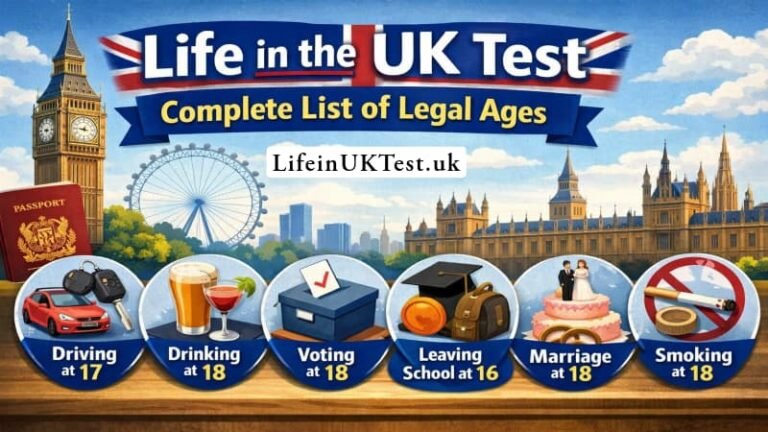
28. When was the voting age reduced to 18? Answer: 1969 (for both men and women)
29. When did women get the right to vote at age 21? Answer: 1928 (same age as men)
Before this, women over 30 could vote (since 1918), but younger women couldn’t.
British Inventions & Innovators
30. Who invented the World Wide Web? Answer: Sir Tim Berners-Lee (born 1955)
Information was first successfully transferred via the web on 25 December 1990. British innovation at its finest.
31. What did Sir Isaac Newton discover? Answer: How gravity applies to the whole universe; also discovered that white light is made up of rainbow colors
His major work was “Philosophiae Naturalis Principia Mathematica.”
32. Who discovered the structure of DNA? Answer: Francis Crick (along with others at British universities in London and Cambridge in 1953)
33. What is a famous British invention of the 20th century? Answer: The Harrier jump jet (aircraft capable of vertical takeoff)
34. Who invented the television? Answer: John Logie Baird
He was a Scottish inventor who first demonstrated television in the 1920s.
35. Who discovered penicillin? Answer: Sir Alexander Fleming
This Scottish scientist discovered it in 1928. It became the first antibiotic and saved millions of lives.
36. Who developed radar? Answer: Sir Robert Watson-Watt (Scottish)
Radar was developed in the 1930s and proved crucial during World War II.
37. Who developed the jet engine? Answer: Sir Frank Whittle
He was a Royal Air Force engineer who developed it in the 1930s.
38. Who pioneered the use of statistics in medicine? Answer: Florence Nightingale
She’s known as the founder of modern nursing and used statistics to improve hospital hygiene.
39. Who developed the smallpox vaccine? Answer: Edward Jenner
In 1796, he pioneered vaccination, which eventually led to smallpox being eradicated worldwide.
40. Who improved the steam engine? Answer: James Watt (Scottish)
His improvements in the 1760s made steam engines much more efficient and helped power the Industrial Revolution.
41. Who pioneered the use of antiseptics in surgery? Answer: Joseph Lister
His work in the 1860s dramatically reduced infections and deaths from surgery.
British Literature & Writers
42. Who wrote Pride and Prejudice? Answer: Jane Austen
She wrote about the landed gentry and promoted the idea that women should marry for love, not just financial security.
43. Who wrote 1984 and Animal Farm? Answer: George Orwell (real name: Eric Arthur Blair)
Both books deal with totalitarianism and political oppression. Terms like “Big Brother” and “Orwellian” come from his work.
44. Who is considered the greatest writer in the English language? Answer: William Shakespeare
He wrote plays including Hamlet, Macbeth, Romeo and Juliet, and A Midsummer Night’s Dream.
45. Who wrote the novel Oliver Twist? Answer: Charles Dickens
He wrote about social problems in Victorian England. His other famous works include A Christmas Carol and Great Expectations.
46. Who wrote the Harry Potter series? Answer: J.K. Rowling
The books became a global phenomenon and were made into highly successful films. She’s one of the most commercially successful authors ever.
47. Who wrote The Lord of the Rings? Answer: J.R.R. Tolkien
He was a professor at Oxford and also wrote The Hobbit. The books were adapted into massively successful films.
48. Who wrote Sherlock Holmes stories? Answer: Sir Arthur Conan Doyle
Holmes is one of the most famous fictional detectives. Conan Doyle was originally trained as a doctor.
49. What did Robert Burns write? Answer: Poems and songs in Scottish dialect, including Auld Lang Syne
He’s Scotland’s most famous poet. Auld Lang Syne is traditionally sung at New Year.
50. Who wrote Middlemarch? Answer: George Eliot (real name: Mary Ann Evans)
She used a male pen name to be taken seriously as a writer in the Victorian era.
51. What is The Canterbury Tales? Answer: A collection of 24 stories written by Geoffrey Chaucer around 1400
It’s written in Middle English and tells stories of pilgrims traveling to Canterbury.
Culture & Traditions
52. What is The Mousetrap? Answer: A murder-mystery play by Dame Agatha Christie that has been running in the West End since 1952 (longest initial run in history)
53. What movies is Nick Park famous for? Answer: Animation films, including Wallace and Gromit (won four Oscars)
Britain’s really strong in special effects and animation.
54. When is April Fool’s Day? Answer: 1st of April
55. What did Thomas Gainsborough paint? Answer: Portraits of people in country or garden settings
He lived from 1727-88 and was one of Britain’s greatest portrait painters.
56. When is Halloween celebrated? Answer: 31st October
It has ancient roots in pagan festivals. Children dress up and play “trick or treat.”
57. What is Bonfire Night? Answer: 5th November – celebrates the failure of the Gunpowder Plot in 1605
Guy Fawkes tried to blow up the Houses of Parliament. People celebrate with fireworks and bonfires.
58. What is Hogmanay? Answer: The Scottish celebration of New Year’s Eve (31st December)
Scotland has special traditions for New Year that aren’t as widely celebrated elsewhere in the UK.
59. What is Diwali? Answer: The Festival of Lights, celebrated by Hindus and Sikhs
It usually falls in October or November and lasts five days. There’s a famous celebration in Leicester.
60. What happens on Remembrance Day? Answer: People remember those who died in wars (held on 11th November or the Sunday nearest to it)
People wear poppies and observe two minutes of silence at 11am.
61. What is the Turner Prize? Answer: An annual prize for contemporary art, established in 1984
It’s named after painter J.M.W. Turner. Four works are shortlisted and shown at Tate Britain.
National Symbols & Patron Saints
62. Which flag has a red cross on a white ground? Answer: The flag of St George (England’s patron saint)
63. Which flag has a diagonal red cross on a white ground? Answer: St Patrick’s Cross (associated with Ireland)
64. What flower is associated with England? Answer: The rose
- Scotland: thistle
- Wales: daffodil
- Northern Ireland: shamrock
65. Who is the patron saint of Scotland? Answer: St Andrew
66. When is St David’s Day? Answer: 1st March (patron saint of Wales)
67. When is St Patrick’s Day? Answer: 17th March (patron saint of Ireland and Northern Ireland)
68. When is St Andrew’s Day? Answer: 30th November (patron saint of Scotland)
69. When is St George’s Day? Answer: 23rd April (patron saint of England)
Government & Law
70. Who chairs debates in the House of Commons? Answer: The Speaker
The Speaker keeps order and makes sure rules are followed, including giving the opposition guaranteed time to debate.
71. How does the UK electoral system work? Answer: “First past the post” – the candidate with the most votes in each constituency is elected
72. Who can stand for public office in the UK? Answer: Most citizens of the UK, Ireland, or Commonwealth aged 18 or over
Exceptions: Members of armed forces, civil servants, people guilty of certain criminal offences.
73. What happens if no political party wins a majority? Answer: Two parties may join together to govern (coalition government)
74. What is the pass mark required to pass the Life in the UK test? Answer: 75% (at least 18 out of 24 questions correct)
75. What is Prime Minister’s Questions? Answer: A weekly session where MPs can question the Prime Minister
It takes place every Wednesday when Parliament is sitting.
76. What is a constituency? Answer: A geographical area represented by one MP in Parliament
There are 650 constituencies in the UK.
77. At what age can you stand for public office? Answer: 18 or over
Most UK, Irish, or Commonwealth citizens can stand (with some exceptions like members of armed forces and civil servants).
78. What is a by-election? Answer: An election held when an MP dies or resigns between general elections
It fills the vacant seat in Parliament.
79. Who appoints “Life Peers”? Answer: The monarch, on the advice of the Prime Minister
Life Peers sit in the House of Lords but the title isn’t hereditary.
80. What is the cabinet? Answer: A group of senior MPs chosen by the Prime Minister to lead government departments
They make key government decisions together.
Courts & Legal System
81. Which court deals with the most serious cases in Scotland (like murder)? Answer: The High Court (with a judge and jury)
Sheriff Courts handle serious cases but the High Court takes the most serious ones.
82. What age range can serve on a jury? Answer: 18 to 70 years old (must be on the electoral register)
83. What do County Courts deal with? Answer: Civil disputes including money owed, personal injury, family matters, breaches of contract, and divorce
In Scotland, most of these are handled by the Sheriff Court.
84. Can you complain about the police? Answer: Yes – by writing to the Chief Constable of the police force involved
Sports & Leisure
85. Who captained England’s football team when they won the 1966 World Cup? Answer: Bobby Moore
This is British sporting history 101.
86. What is Wimbledon? Answer: The oldest tennis tournament in the world, held at the All England Lawn Tennis and Croquet Club; the only Grand Slam event played on grass
87. How many events make up the heptathlon? Answer: 7 different track and field events
Jessica Ennis-Hill won Olympic gold in this event in 2012.
88. Which British cyclist won the Tour de France in 2012? Answer: Bradley Wiggins
He was the first Briton ever to win the Tour de France. He also won multiple Olympic gold medals.
89. Who was the first man to run a mile in under four minutes? Answer: Sir Roger Bannister (in 1954)
This was a massive achievement in athletics history.
90. Which sport did Sir Chris Hoy compete in? Answer: Cycling
He won six Olympic gold medals and one silver – one of Britain’s most successful Olympians.
91. What is the Ashes? Answer: A cricket series between England and Australia
It’s one of the most famous cricket competitions in the world.
92. Where is the Grand National horse race held? Answer: Aintree, near Liverpool
It’s one of the most famous horse races in the world, held annually.
93. Which tennis player won Olympic gold for Britain in 2012? Answer: Andy Murray
He won gold in the men’s singles and also won the US Open the same year. In 2013, he became the first British man to win Wimbledon singles since 1936.
94. Who won gold medals for Britain in the 5,000 and 10,000 metres at the 2012 Olympics? Answer: Mo Farah
He was the first Briton to win Olympic gold in the 10,000 metres.
95. Can cricket matches last up to five days? Answer: Yes, and they can still end in a draw
This is one of the unique features of Test cricket.
96. What sport do you associate with the name Ellie Simmonds? Answer: Paralympic swimming
She won gold medals in 2008 and 2012 and was the youngest member of the British team in 2008.
Miscellaneous Important Facts
97. What is the Lake District? Answer: England’s largest national park
It’s an area of protected countryside in northwest England with mountains and lakes.
98. In which country is the Battle of the Boyne celebrated as a bank holiday? Answer: Northern Ireland (in July)
This commemorates the battle in 1690.
99. What is Balmoral Castle? Answer: One of the residences of the British Royal Family (in Scotland)
It’s a private residence where the Royal Family traditionally spends summer holidays.
100. What happened on 25 December 1990? Answer: Information was first successfully transferred via the World Wide Web
Tim Berners-Lee achieved this historic technological breakthrough.
Quick Reference Tables
Important Dates You Should Know
| Year | Event |
|---|---|
| 1455 | Wars of the Roses began |
| 1588 | Defeat of Spanish Armada |
| 1666 | Great Fire of London |
| 1796 | Edward Jenner developed smallpox vaccine |
| 1801 | Act of Union (created UK of Great Britain and Ireland) |
| 1815 | Battle of Waterloo |
| 1832 | Reform Act |
| 1928 | Women got vote at age 21 |
| 1952 | The Mousetrap opened |
| 1953 | DNA structure discovered |
| 1954 | Roger Bannister ran mile under 4 minutes |
| 1966 | England won World Cup |
| 1969 | Voting age reduced to 18 |
| 1990 | First successful web transfer (25 December) |
| 1997 | Tony Blair elected; Scottish Parliament & Welsh Assembly introduced |
National Flowers & Patron Saints
| Country | Flower | Patron Saint | Saint’s Day | Flag |
|---|---|---|---|---|
| England | Rose | St George | 23rd April | Red cross on white |
| Scotland | Thistle | St Andrew | 30th November | White diagonal cross on blue |
| Wales | Daffodil | St David | 1st March | – |
| Northern Ireland | Shamrock | St Patrick | 17th March | Red diagonal cross on white |
British Writers at a Glance
| Writer | Famous For | Time Period |
|---|---|---|
| William Shakespeare | Plays (Hamlet, Macbeth, Romeo & Juliet) | Late 16th/early 17th century |
| Jane Austen | Pride and Prejudice, Emma | Early 19th century |
| Charles Dickens | Oliver Twist, A Christmas Carol | Victorian era (19th century) |
| George Eliot | Middlemarch | Victorian era |
| Robert Burns | Scottish poems, Auld Lang Syne | Late 18th century |
| Geoffrey Chaucer | The Canterbury Tales | Medieval (around 1400) |
| George Orwell | 1984, Animal Farm | 20th century |
| J.K. Rowling | Harry Potter series | Contemporary (1990s-2000s) |
| J.R.R. Tolkien | The Lord of the Rings, The Hobbit | 20th century |
| Sir Arthur Conan Doyle | Sherlock Holmes stories | Late 19th/early 20th century |
Scientists & Inventors Reference
| Inventor/Scientist | Achievement | When |
|---|---|---|
| Tim Berners-Lee | World Wide Web | 1990 |
| John Logie Baird | Television | 1920s |
| Alexander Fleming | Penicillin (antibiotic) | 1928 |
| Frank Whittle | Jet engine | 1930s |
| Robert Watson-Watt | Radar | 1930s |
| Edward Jenner | Smallpox vaccine | 1796 |
| James Watt | Improved steam engine | 1760s |
| Joseph Lister | Antiseptics in surgery | 1860s |
| Florence Nightingale | Modern nursing, medical statistics | 1850s |
| Isaac Newton | Gravity, light spectrum | 17th century |
| Francis Crick | DNA structure | 1953 |
Smart Study Tips That Actually Work
Let me share what worked for people who passed first time:
Focus on practice tests 1-17 first. Multiple test-takers report that most questions come from these practice exams. Master these before moving on.
Don’t just memorize – understand the story. British history makes more sense when you see how events connect. The Tudors led to the Reformation, which influenced later politics, which shaped modern Britain.
Use the process of elimination. If you’re stuck, cross out obviously wrong answers. Often you can narrow it down to two choices, improving your odds.
Practice under timed conditions. You’ve got 45 minutes for 24 questions – that’s nearly 2 minutes per question. Most people finish in 5-10 minutes, but practicing with a timer stops panic on test day.
Read questions twice. Seriously. The test isn’t trying to trick you, but reading carefully prevents silly mistakes.
Pattern recognition matters. Notice that certain topics come up repeatedly:
- Wars and battles (Waterloo, Spanish Armada, Wars of the Roses)
- Government structure (Speaker, constituencies, electoral system)
- Sports achievements (1966 World Cup, Olympic medalists)
- Scientific breakthroughs (DNA, penicillin, radar)
Group similar information together. Don’t learn patron saints as isolated facts – learn all four together in one go. Same with national flowers, dates of important events, or famous writers.
Use mnemonics for tricky dates. For example, “Spanish Armada: 1588” could be “15 ate eight” if that helps you remember.
Focus on “firsts.” The test loves asking about firsts – first person to run a mile under four minutes, first Briton to win Tour de France, first professional football clubs, etc.
Watch for exceptions. The test sometimes asks trick questions. Great Britain vs United Kingdom. Crown dependencies vs overseas territories. Test cricket lasting five days but still drawing.
Common Mistakes to Avoid
Mixing up Great Britain and the United Kingdom. Great Britain = England, Scotland, Wales. United Kingdom = Great Britain + Northern Ireland.
Confusing Crown dependencies with overseas territories. Channel Islands and Isle of Man are Crown dependencies (not part of UK). St Helena and Falklands are overseas territories (also not part of UK, but different status).
Getting patron saints mixed up. St George (England), St Andrew (Scotland), St David (Wales), St Patrick (Ireland/Northern Ireland).
Forgetting when women got the vote. Women over 30 got the vote in 1918. All women at age 21 (same as men) got it in 1928. The voting age for everyone reduced to 18 in 1969.
Confusing similar inventions. Television (Baird), jet engine (Whittle), radar (Watson-Watt), World Wide Web (Berners-Lee) – these get mixed up frequently.
Rushing through questions. You have plenty of time. Use it.
What If You See Something You Don’t Know?
You will. Everyone does. Here’s how to handle it:
Stay calm. You can get 6 questions wrong and still pass.
Read the question twice. Sometimes the answer is obvious once you slow down.
Eliminate obviously wrong answers. If a question asks about Scottish geography and one option mentions Wales, you can cross that off immediately.
Make an educated guess. Don’t leave it blank. You have a 25% chance (or 50% if it’s true/false) even if you’re completely guessing.
Move on. Don’t let one difficult question derail your confidence. The next question might be something you know perfectly.
Test Day Reality Check
The actual test costs £50 and you’ll book it through the official government website: https://www.gov.uk/life-in-the-uk-test
Don’t use third-party booking sites – they’ll overcharge you.
You’ll sit at a computer. Questions are random. Every test center uses the same software, so there’s no “easier” location.
Arrive 30 minutes early. Bring proper ID that exactly matches your booking name.
You’ll get a 4-question practice test before the real one to get familiar with the software.
Results come immediately. If you pass, you’ll receive your Unique Reference Number (URN) at the test center – don’t leave before getting it! You’ll need this for your citizenship or settlement application.
If you fail (and 36% of people do), you can retake it after 7 days. Learn from what you got wrong and try again.
Final Preparation Checklist
One week before:
- Review these 100 questions daily
- Take at least 3 full practice tests
- Focus extra time on any topic where you’re still shaky
Day before:
- Do one final practice test
- Review the quick reference tables
- Get a good night’s sleep (seriously – being well-rested helps more than cramming)
Test day:
- Arrive 30 minutes early
- Bring correct ID (matching your booking exactly)
- Remember: most questions are straightforward if you’ve prepared
- Read each question carefully before selecting your answer
- Use the full 45 minutes if you need it
Additional Resources Worth Checking
Official Handbook: “Life in the United Kingdom: A Guide for New Residents, 3rd Edition” – read this at least once
Government Booking Site: https://www.gov.uk/life-in-the-uk-test
Free Practice Tests: Available at lifeintheuktestweb.co.uk, lifeintheuktest.com, and britizen.uk
Key Takeaway
You now have 100 of the most commonly asked Life in the UK test questions. Master these, understand the underlying concepts, take several practice tests, and you’re extremely well-positioned to pass. The test isn’t trying to fail you – it’s checking you understand the basics of British life, values, history, and culture. Focus on high-probability questions, use the reference tables for quick revision, and trust your preparation. Study smart, not just hard. The 64% pass rate means if you prepare properly using resources like this, you’re likely joining the majority who pass first time. You’ve got this.
Remember: the difference between passing and failing often comes down to focused preparation. These 100 questions represent the core knowledge that appears most frequently on the actual test. Combined with 3-5 practice tests from official materials, you’re in excellent shape to pass and move forward with your citizenship or settlement application.
Good luck!