20th Century History: Key Events of WWI & WWII for Exams – So you’re preparing for the Life in the UK Test, and you’ve hit the history section. Let’s be real—trying to memorize dates and events from two world wars can feel overwhelming. But here’s the thing: you don’t need to know every single battle. You just need the key moments that shaped Britain and the world.
20th Century History: Key Events of WWI & WWII for Exams
I’ve worked with dozens of test-takers who stumbled on this section simply because they overthought it. They tried cramming every detail when what they actually needed was a clear roadmap. That’s what we’re building here.
Why These Wars Matter for Your Test
The Life in the UK Test isn’t asking you to become a military historian. What it wants is simple: do you understand the major events that defined Britain in the 20th century? Both world wars fundamentally changed British society, politics, and daily life. Women entered the workforce in massive numbers. The empire began its decline. The NHS was born from wartime solidarity.
When you understand the “why” behind these events, the dates stick better. Trust me on this.
World War I: The Great War (1914-1918)
How It All Started
Picture Europe in 1914—a powder keg waiting to explode. You had major powers forming alliances like kids picking teams on a playground, except with actual armies. When Archduke Franz Ferdinand of Austria-Hungary was assassinated in Sarajevo on June 28, 1914, those alliance systems kicked in like dominoes.
Britain entered the war on August 4, 1914, after Germany invaded Belgium. Britain had guaranteed Belgian neutrality, so there wasn’t really a choice. Within weeks, what everyone thought would be a quick adventure turned into a nightmare.
The Western Front Reality
Here’s what catches people off guard: the trench warfare. Soldiers dug into trenches stretching from the English Channel to Switzerland. They lived in mud, fought for yards of ground, and died in numbers we can barely comprehend today.
The Battle of the Somme (July-November 1916) killed or wounded over a million men. On the first day alone—July 1, 1916—nearly 20,000 British soldiers died. That’s not a typo. It remains the bloodiest day in British military history.
Passchendaele in 1917 was another horrific battle fought in Belgian mud. Soldiers literally drowned in shell craters filled with water.
Britain’s Home Front
While men fought abroad, women kept Britain running. They worked in munitions factories (often called “canary girls” because the chemicals turned their skin yellow), drove ambulances, and took over jobs previously reserved for men.
The government introduced rationing and took control of key industries. DORA—the Defence of the Realm Act—gave the government sweeping powers. Honestly, it changed how British people viewed their government’s role in daily life.
The War Ends
Germany signed the Armistice on November 11, 1918, at 11 a.m. That’s why we observe a two-minute silence at 11 a.m. on Remembrance Day each year.
The Treaty of Versailles in 1919 officially ended the war, but it planted seeds for future conflict. Germany was forced to accept blame and pay massive reparations. Many historians argue this harsh treatment helped Hitler rise to power two decades later.
Timeline: World War I
| Date | Event |
|---|---|
| June 28, 1914 | Assassination of Archduke Franz Ferdinand in Sarajevo |
| August 4, 1914 | Britain declares war on Germany after invasion of Belgium |
| 1914-1918 | Trench warfare dominates the Western Front |
| July 1-November 18, 1916 | Battle of the Somme—over 1 million casualties |
| 1917 | Battle of Passchendaele; U.S. enters the war |
| November 11, 1918 | Armistice signed—fighting ends at 11 a.m. |
| June 28, 1919 | Treaty of Versailles signed |
World War II: Britain’s Finest Hour (1939-1945)
Hitler’s Rise and War’s Beginning
After WWI, Germany struggled under the Treaty of Versailles. Economic hardship and national humiliation created perfect conditions for Adolf Hitler and the Nazi Party. By the mid-1930s, Hitler was rearming Germany and expanding territory.
Britain initially tried appeasement—basically giving Hitler what he wanted to avoid another war. Prime Minister Neville Chamberlain famously returned from Munich in 1938 claiming he’d secured “peace for our time.” He hadn’t.
When Germany invaded Poland on September 1, 1939, Britain had enough. Two days later, on September 3, 1939, Britain and France declared war.
The Early Dark Days
What happened next shocked everyone. Using “Blitzkrieg” (lightning war) tactics, Germany conquered most of Western Europe in months. France fell in June 1940. Britain suddenly stood alone against Nazi Germany.
Between May 26 and June 4, 1940, over 338,000 Allied troops were evacuated from Dunkirk, France. Regular British citizens sailed personal boats across the Channel to rescue soldiers. It was a military defeat but a moral victory that showed British resilience.
Churchill Takes Charge
Winston Churchill became Prime Minister in May 1940, right when Britain needed someone defiant. His speeches rallied the nation. “We shall fight on the beaches… we shall never surrender” wasn’t just rhetoric—it became Britain’s attitude.
The Battle of Britain
From July to October 1940, the German Luftwaffe tried to destroy the Royal Air Force (RAF) to prepare for invasion. Young RAF pilots fought desperate battles in the skies over southern England.
Churchill famously said of these pilots: “Never in the field of human conflict was so much owed by so many to so few.” The RAF won. Germany postponed, then cancelled, its invasion plans.
The Blitz
Since Germany couldn’t invade, they tried to bomb Britain into submission. The Blitz ran from September 1940 to May 1941. London was bombed for 57 consecutive nights. Other cities—Coventry, Birmingham, Liverpool—suffered terribly too.
Families slept in Anderson shelters in their gardens or in Underground stations. Children were evacuated from cities to countryside homes. The blackout meant cities went dark at night to make bombing harder.
Here’s a test tip students often miss: remember that British civilian morale largely held firm during the Blitz. This “Blitz spirit” of carrying on despite hardship became a defining characteristic of wartime Britain.
Turning Points
The war was global, but for Britain, several moments mattered:
Pearl Harbor (December 7, 1941): Japan’s attack brought America into the war, giving Britain a powerful ally.
El Alamein (October-November 1942): British forces under Montgomery defeated Rommel in North Africa. Churchill said: “Before Alamein we never had a victory. After Alamein we never had a defeat.”
D-Day (June 6, 1944): Allied forces invaded Normandy, France. This was the beginning of the end for Nazi Germany.
Victory in Europe and Japan
Germany surrendered on May 8, 1945—VE Day (Victory in Europe Day). People danced in the streets.
Japan fought on until August 1945, finally surrendering after atomic bombs destroyed Hiroshima and Nagasaki. VJ Day (Victory over Japan Day) on August 15, 1945, marked the war’s true end.
What the War Cost Britain
Over 450,000 British people died. Cities lay in ruins. The economy was shattered. Britain had borrowed heavily from America and was essentially broke.
But something else happened too. The shared sacrifice of the war years created support for massive social change. In 1945, Churchill lost the election to Labour’s Clement Attlee. People wanted change. This led to the creation of the welfare state and the NHS in 1948.
Timeline: World War II
| Date | Event |
|---|---|
| September 1, 1939 | Germany invades Poland |
| September 3, 1939 | Britain and France declare war on Germany |
| May 10, 1940 | Winston Churchill becomes Prime Minister |
| May 26-June 4, 1940 | Dunkirk evacuation—over 338,000 troops rescued |
| June 1940 | France falls to Germany |
| July-October 1940 | Battle of Britain—RAF defeats Luftwaffe |
| September 1940-May 1941 | The Blitz—German bombing campaign against British cities |
| December 7, 1941 | Japan attacks Pearl Harbor; U.S. enters the war |
| October-November 1942 | Battle of El Alamein—British victory in North Africa |
| June 6, 1944 | D-Day—Allied invasion of Normandy |
| May 8, 1945 | VE Day—Germany surrenders |
| August 6 & 9, 1945 | Atomic bombs dropped on Hiroshima and Nagasaki |
| August 15, 1945 | VJ Day—Japan surrenders; WWII ends |
What the Test Actually Asks
Let me save you some stress. The Life in the UK Test typically asks about:
- When Britain entered both wars and why
- Key leaders (especially Churchill)
- Major battles and events (Somme, Dunkirk, Battle of Britain, D-Day)
- The home front experience (rationing, women’s roles, the Blitz)
- How the wars changed British society
They won’t ask you for detailed military strategies or obscure battles. They want to know if you grasp the big picture.
Common Mistakes Test-Takers Make
Mixing up dates: People confuse WWI and WWII dates constantly. Remember WWI was 1914-1918 (roughly the teens) and WWII was 1939-1945 (late thirties to mid-forties).
Forgetting the home front: The test loves questions about civilian life. Don’t just study battles—understand rationing, evacuation, women’s contributions.
Ignoring the aftermath: Both wars fundamentally changed Britain. WWI led to women getting the vote (1918 for women over 30 who met property qualifications, 1928 for all women over 21). WWII led to the welfare state.
Overlooking Commonwealth contributions: Millions from the British Empire and Commonwealth fought for Britain. This isn’t just a footnote—it’s important context for understanding modern Britain.
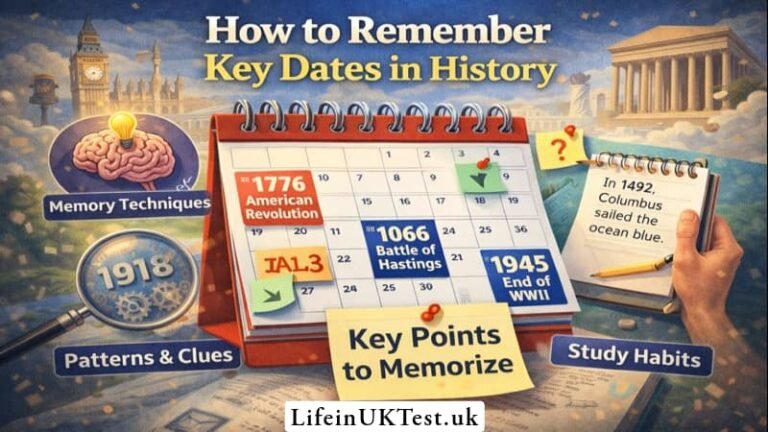
How to Actually Remember This Stuff
Create mental anchors. When you think of WWI, picture trenches and poppies (the flower symbol of Remembrance Day). For WWII, picture Churchill’s bulldog determination and RAF Spitfires.
Connect events to consequences. Dunkirk wasn’t just an evacuation—it showed British determination. The Blitz wasn’t just bombing—it created the “Blitz spirit” that still gets referenced in British culture today.
Use the timelines above. Honestly, just reading through them a few times will help more than you think.
The Bigger Picture
These wars transformed Britain from a global empire to a welfare state. They changed who could vote, what jobs women could hold, and how British people viewed their government’s responsibilities.
When you’re sitting in that test center, remember: you’re not just memorizing facts. You’re understanding the events that made modern Britain what it is today. That’s actually pretty meaningful.
Key Takeaway
For WWI, remember: Started 1914 when Germany invaded Belgium, trench warfare on the Western Front, battles like the Somme killed millions, ended November 11, 1918.
For WWII, remember: Britain declared war September 3, 1939, after Poland invasion. Churchill became PM in May 1940. Dunkirk evacuation, Battle of Britain, and the Blitz happened in 1940. D-Day 1944, victory in 1945. The war created the conditions for the NHS and welfare state.
The test focuses on these major events, key dates (especially when wars started and ended), Churchill’s leadership, and how the wars affected civilian life. Get those down, and you’re in good shape.
You’ve got this. Thousands of people pass this test every year, and there’s no reason you can’t be one of them.