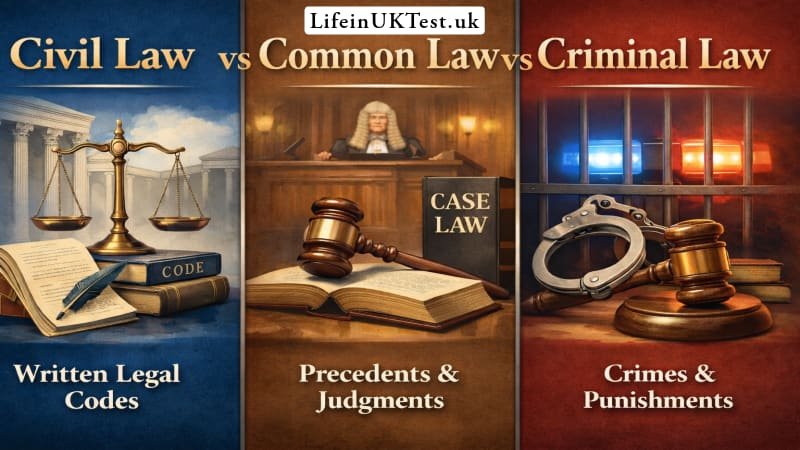
Civil Law vs Common Law vs Criminal Law – Understanding the difference between civil law, common law, and criminal law is an important part of learning how the UK legal system works, especially for those preparing for the Life in the UK Test.
The United Kingdom primarily follows the common law system, which is based on judicial decisions and precedents, while civil law deals with disputes between individuals or organisations and criminal law focuses on offences against the state and public order. Knowing how these three branches of law differ helps applicants better understand their rights, responsibilities, and the principles that underpin British justice, governance, and everyday life in the UK.
Civil Law vs Common Law vs Criminal Law – Examples, Differences, and What You Need to Know
Right, let’s talk about something that trips up almost everyone preparing for the Life in the UK Test: the different types of law. I know it sounds complicated, but honestly? Once you understand the basics, it clicks into place.
Here’s the thing most people don’t realize—when we say “law” in the UK, we’re actually talking about completely different systems that work in totally different ways. You’ve got criminal law (the obvious one), civil law (not what you think), and then there’s this whole concept called common law that’s… well, it’s uniquely British.
What’s Criminal Law? (The Easy One)
Let’s start with the straightforward bit. Criminal law is what you see on TV. Someone commits a crime, the police get involved, and if there’s enough evidence, the Crown Prosecution Service takes them to court.
The key thing here? It’s always the state versus the person. Even if someone mugs you, the case isn’t “You vs The Mugger”—it’s “The Crown vs The Mugger.” You’re a witness, not the person bringing the case.
Real Criminal Law Examples
| Type of Crime | What It Means | Typical Outcome |
|---|---|---|
| Theft | Taking someone’s property without permission | Fine, community service, or prison |
| Assault | Physically attacking someone | Varies from fine to prison depending on severity |
| Fraud | Deceiving someone for financial gain | Usually prison for serious cases |
| Burglary | Breaking into a building to steal | Prison sentence |
| Driving offences | Speeding, drink-driving, dangerous driving | Points on license, fines, possible prison |
The punishment comes from the state. Fines go to the government, not the victim. Prison sentences are decided by judges. That’s criminal law in a nutshell.
Civil Law: When It’s Not a Crime
Now, civil law is where it gets interesting. This is about disputes between people or organizations. Nobody’s going to prison here (well, not usually). Instead, it’s about compensation, rights, and settling disagreements.
Let me give you a scenario. Your neighbor builds a massive fence that blocks all your sunlight. That’s not a crime—the police won’t care. But it might break property laws, so you could take them to civil court. See the difference?
Common Civil Law Situations
| Area of Civil Law | What It Covers | Who Can Bring a Case |
|---|---|---|
| Contract disputes | Broken agreements, unpaid bills | Anyone in the contract |
| Property issues | Boundary disputes, landlord problems | Property owners, tenants |
| Family law | Divorce, child custody, inheritance | Family members |
| Employment disputes | Unfair dismissal, discrimination | Employees, employers |
| Personal injury | Accidents, medical negligence | The injured person |
In civil cases, the person bringing the case is called the “claimant,” and they’re suing the “defendant.” If you win, you usually get money (called “damages”) or the court orders someone to do something (or stop doing something).
The standard of proof is lower too. In criminal cases, guilt must be proven “beyond reasonable doubt.” In civil cases, it’s “on the balance of probabilities”—basically, is it more likely than not that this happened?
Common Law: The British Special
Here’s where it gets properly British. Common law isn’t a type of case—it’s a whole legal system. And honestly, it’s one of the UK’s biggest exports.
Think of it this way: most countries have written legal codes that spell out every law. France does this. Germany does this. They look up the law in a book, apply it, done.
Britain? We do things differently. We look at what judges decided in previous similar cases. Those decisions become law themselves. It’s called “precedent.”
How Common Law Actually Works
Imagine there’s no specific law about whether you can be sued for your dog barking all night. A judge hears a case, decides yes, you can be sued, and awards the neighbor £500. That decision becomes law. The next time someone’s dog won’t shut up, lawyers point to that case and say, “See? Previous court said this is wrong.”
This is why British lawyers spend so much time reading old cases. They’re not just looking at laws passed by Parliament—they’re looking at what judges have said over centuries.
Countries Using Common Law Today:
- United Kingdom
- United States
- Canada
- Australia
- India
- New Zealand
- Ireland
- Most former British colonies
It’s pretty wild when you think about it. A legal principle from a 1850s British case might still apply in a Canadian court today.
The Big Comparison: All Three Side by Side
Let’s lay it all out properly. This is the table you want to screenshot for revision:
| Feature | Criminal Law | Civil Law | Common Law |
|---|---|---|---|
| What is it? | Laws against crimes that harm society | Laws governing disputes between people/organizations | Legal system based on judge-made precedents |
| Who brings the case? | The state (Crown Prosecution Service) | Individual person or organization (claimant) | Not applicable—it’s a system, not a type of case |
| Purpose | Punish wrongdoing and protect society | Resolve disputes and provide compensation | Create consistent legal principles through court decisions |
| Examples | Murder, theft, assault, fraud, drug offences | Contract disputes, divorce, personal injury, property issues | System used in UK, USA, Australia, Canada |
| Possible outcomes | Prison, fines, community service, criminal record | Compensation (damages), injunctions, court orders | Precedents that become law for future cases |
| Standard of proof | Beyond reasonable doubt (very high) | Balance of probabilities (more likely than not) | Varies depending on whether criminal or civil |
| Who decides? | Judge and/or jury | Usually just a judge | Previous judges’ decisions guide current judges |
| Can you go to prison? | Yes | Rarely (only for contempt of court) | Depends if it’s a criminal or civil case |
| Cost to bring case | Free (state prosecutes) | You pay legal costs | Not applicable |
Why This Matters for Life in the UK Test
The test loves asking about these differences. You might get questions like:
“What type of law deals with theft?” (Criminal)
“In civil cases, who brings the case to court?” (The individual person—the claimant)
“Which countries use the common law system?” (UK, USA, Canada, Australia, etc.)
One thing that catches people out: they mix up “civil law” as a type of case with “civil law” as a legal system (like in France). When the test talks about civil law in the UK, it means disputes between people, not the whole legal system. The UK uses common law as its system.
Quick Real-World Examples to Remember
Criminal: Someone punches you in a pub. The police arrest them. The Crown prosecutes them for assault. They might go to prison.
Civil: That same person damaged your glasses when they punched you. You sue them in civil court for £200 to replace your glasses. They pay you compensation.
Common law: The judge who decides the assault case looks at what previous judges did in similar pub fight cases. Those old decisions help determine the sentence.
All three working together. That’s how the British legal system functions.
What About Scotland and Northern Ireland?
Quick note because this confuses people: England and Wales share the same legal system. Scotland has its own distinct system (it mixes common law with some civil law traditions). Northern Ireland is closer to England and Wales but has some differences.
For the Life in the UK Test, focus on England and Wales unless the question specifically mentions Scotland or Northern Ireland.
Key Takeaway
Criminal law is the state punishing people who break society’s rules—think crimes, police, prison. Civil law is individuals sorting out their disputes through courts—think compensation, not jail time. Common law is the British legal system where judges’ past decisions become law themselves, and it’s used across much of the world thanks to the British Empire.
The test wants you to know the differences, recognize examples, and understand that the UK uses common law as its fundamental legal system. Get these basics sorted, and you’ll handle any law questions they throw at you.
And honestly? Understanding this stuff isn’t just useful for the test. Once you’re living in the UK, knowing whether something is a criminal matter (call the police) or civil matter (talk to a solicitor) can save you a lot of confusion and stress.
Good luck with your test preparation. You’ve got this.