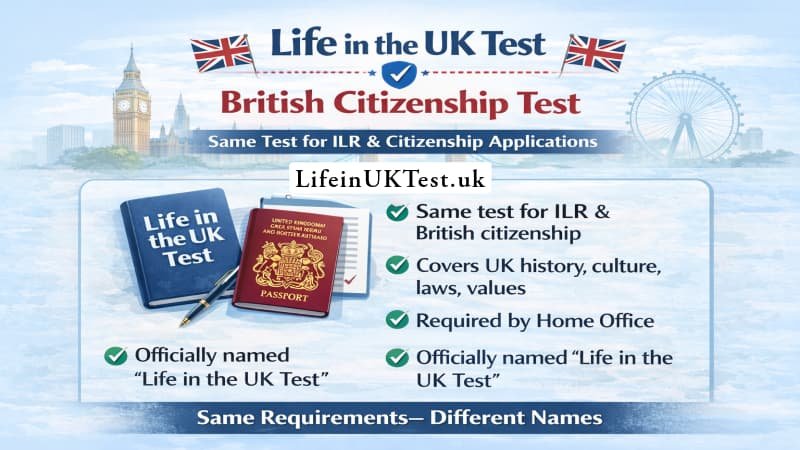
Life in the UK Test vs British Citizenship Test – Many applicants preparing for UK settlement or citizenship often wonder whether the Life in the UK Test and the British Citizenship Test are different or the same. Understanding the difference between the Life in the UK Test vs British Citizenship Test is essential to avoid confusion and ensure you meet the correct Home Office requirements. In this article, we clearly explain how both tests compare, who needs to take them, what topics they cover, and why passing the Life in the UK Test is mandatory for British citizenship and Indefinite Leave to Remain (ILR).
Life in the UK Test vs British Citizenship Test: What’s the Real Difference?
Life in the UK Test vs British Citizenship Test – Here’s something that trips up almost everyone applying for British citizenship: people keep searching for the “British Citizenship Test” when what they actually need is the Life in the UK Test. Honestly, it’s confusing at first, but let’s clear this up right now.
They’re Actually the Same Thing
The Life in the UK Test and the British Citizenship Test are the exact same exam. There’s no separate citizenship test you need to worry about. The official name is “Life in the United Kingdom Test,” but everyone calls it different things—the citizenship test, the UK residency test, the British test. It’s all referring to that one 45-minute computer-based exam you’ll take at a test center.
When you’re applying for indefinite leave to remain (ILR) or naturalization as a British citizen, this test is what the Home Office requires. There aren’t two different versions floating around.
What You’re Actually Getting Tested On
The test covers British history, traditions, values, and everyday life. We’re talking about everything from the Magna Carta to how the NHS works. The 2026 version of the test pulls questions from the official handbook, which gets updated periodically to keep things current.
You’ll face 24 multiple-choice questions. You need 18 correct answers to pass—that’s 75%. The questions are randomly selected from a massive question bank, so your test will look different from your friend’s test, even if you take it on the same day.
Here’s what actually shows up:
British values and principles – Democracy, rule of law, individual liberty, tolerance. These aren’t just abstract concepts; you’ll get specific questions about how they work in practice.
UK history – Medieval times through to modern Britain. Yes, you’ll need to know about things like the Battle of Hastings, the Industrial Revolution, and both World Wars. The handbook goes deeper than you’d expect.
Modern British culture – Sports, literature, music, film. Think Shakespeare, Roald Dahl, The Beatles, and why everyone loses their minds over Wimbledon.
Government and law – How Parliament works, what devolution means for Scotland, Wales, and Northern Ireland, your rights and responsibilities as a UK resident.
Everyday life – The NHS, schools, housing, employment rights, how to register a birth or get married. Practical stuff you’ll actually use.
Who Needs to Take This Test?
Let’s be real: not everyone does. If you’re between 18 and 65 and applying for settlement or citizenship, you’re taking this test. No exceptions unless you qualify for an exemption.
You might skip it if you have a long-term physical or mental condition that prevents you from taking it, or if you’ve already passed it before for a previous application. Once you pass, that result is valid forever—you won’t need to retake it.
People under 18 or over 65 get a free pass. So do those applying on the basis of being a victim of domestic violence or as a refugee.
How the Actual Test Works
You’ll book your slot online through an official test center. There are centers all across the UK, and you can usually find one within reasonable traveling distance. The test costs £50 as of 2026, and you pay when you book.
On test day, bring your proof of ID—passport or travel document, biometric residence permit, EU Settlement Scheme ID card. They’re strict about this. Show up at least 15 minutes early because they won’t let you in if you’re late.
The test happens on a computer. You don’t need to be a tech genius; it’s literally just clicking answers. You’ll sit in a room with other test-takers, each at your own station. The questions appear one at a time on the screen.
After you finish, you get your result immediately. Pass or fail, you’ll know within seconds. If you pass, they’ll print you a certificate right there—keep this safe because you’ll need it for your citizenship or settlement application.
Here’s What People Don’t Tell You
The questions are weirdly specific. You can’t just skim the handbook and hope for the best. They’ll ask you exact dates, specific numbers, precise details. “When was the Battle of Bosworth?” “How many members are in the Northern Ireland Assembly?” That level of detail.
Random means random. Your mate might get easy questions about sports and festivals. You might get hammered with constitutional history and medieval monarchs. It’s genuinely luck of the draw, which is why you need to know the entire handbook.
The 2026 handbook matters. Don’t study from old versions. The content changes. What was in the 2023 handbook might not match what’s tested now. Always use the current official handbook.
Practice tests are your friend. Free practice tests online show you the question format and help you identify weak spots. Take loads of them. When you’re consistently scoring 90% or higher on practice tests, you’re probably ready.
Common Mistakes That Cost People
Showing up without proper ID is number one. You’ll be turned away, lose your £50, and have to rebook. Double-check what ID you need before test day.
Underestimating how much detail you need to know. This isn’t a citizenship quiz where you guess at answers. The questions are specific and sometimes intentionally tricky.
Not reading questions carefully. They’ll throw in questions like “Which of these is NOT true about…” and people select the true statement out of habit. Slow down and read properly.
Booking too early before you’re ready. You can fail and retake, but why waste money? Study properly first, then book.
Study Strategy That Actually Works
Get the official handbook—the “Life in the United Kingdom: A Guide for New Residents” book. This is your bible. Everything on the test comes from here.
Read it cover to cover once just to get familiar. Then go back and read it again, this time taking notes on dates, numbers, specific facts. Make flashcards for things you struggle to remember.
After each chapter, take practice tests on that section. When you mess up a question, go back to the handbook and reread that part. Don’t just memorize answers; understand the context.
Give yourself at least 2-3 weeks of proper study time. Some people need more, some less, depending on how much you already know about British culture and history.
The Settlement and Citizenship Connection
Passing this test is just one requirement for your citizenship application. You’ll also need to prove your English language ability (unless exempt), meet the residence requirements, show good character, and have qualifying immigration status.
For settlement (indefinite leave to remain), you need the test plus English language proof and five years of continuous residence in most cases.
The test result never expires. Once you pass, that’s it—you can use it for settlement and later for citizenship without retaking it.
What Happens If You Fail?
You can retake it as many times as needed. There’s no limit. But you’ll pay £50 each time, and you’ll need to book a new slot, which might be days or weeks away depending on availability.
About 25-30% of test-takers fail on their first attempt. It’s not easy, and there’s no shame in needing a second go. The people who fail usually either underestimated the test or tried to wing it without proper preparation.
When you fail, you don’t get detailed feedback on which questions you missed. You just get a fail notice. So you can’t really pinpoint your weak areas unless you’re honest with yourself about what you didn’t know during the test.
Resources You’ll Actually Use
| Resource | What It Is | Link |
|---|---|---|
| Official Handbook | The source material for all test questions | https://www.gov.uk/life-in-the-uk-test |
| Practice Tests | Sample questions in test format | https://lifeinUKtest.uk |
| Test Center Booking | Where to schedule your test | https://www.gov.uk/life-in-the-uk-test |
| Home Office Guidance | Official immigration information | https://www.gov.uk/british-citizenship |
The Bottom Line
The Life in the UK Test and British Citizenship Test are identical. One exam, different names. You take it once, use the pass certificate for your citizenship or settlement application, and you’re done with this requirement forever.
Don’t let the test intimidate you, but don’t treat it lightly either. Proper preparation makes the difference between passing first time and burning through retake fees. Get the handbook, study properly, practice extensively, and you’ll be fine.
This test is basically the Home Office’s way of ensuring you know enough about the UK to integrate into society. Whether that’s fair or effective is debatable, but it’s mandatory, so here we are.
Key Takeaway
The Life in the UK Test and British Citizenship Test are the same exam—just different names for one requirement. You need 18 out of 24 questions correct (75%) to pass, and the test covers British history, culture, values, and everyday life from the official handbook. Study the current 2026 handbook thoroughly, take practice tests until you’re consistently scoring 90%+, and bring proper ID on test day. Your pass certificate never expires and covers both settlement and citizenship applications. Don’t underestimate how detailed the questions get—this isn’t general knowledge, it’s specific facts and dates from the handbook.