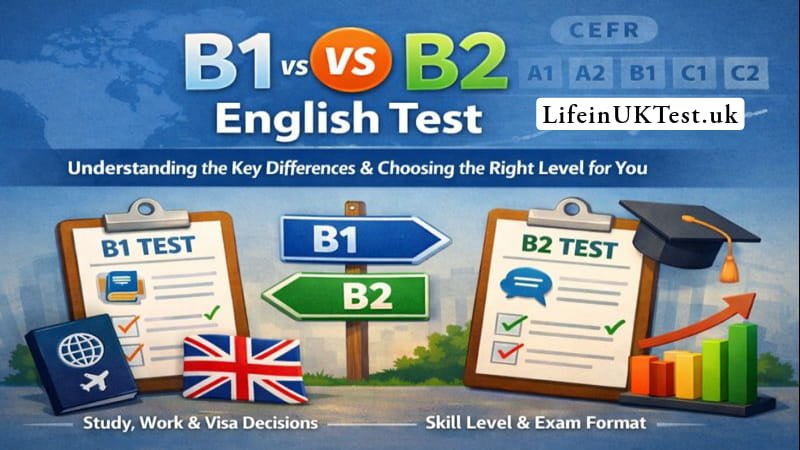
B1 vs B2 English Test – Choosing the right English proficiency level can be confusing—especially when you’re deciding between the B1 vs B2 English test. Both exams are part of the CEFR (Common European Framework of Reference for Languages) and are widely accepted for study, work, and visa purposes, but they measure very different levels of language ability. In this article, we’ll break down the key differences between B1 and B2 English tests, including skill level, exam format, difficulty, and which one you should take based on your goals—so you can make a smart, confident decision.
B1 vs B2 English Test: What’s the Real Difference for Your UK Visa in 2026?
So you’re planning your UK visa application and suddenly everyone’s talking about B1 and B2 English tests. If you’re feeling confused, you’re not alone. January 8, 2026 brought some major changes, and honestly? The whole thing has left a lot of people scratching their heads.
Here’s what you need to know, straight up—no bureaucratic nonsense.
The Big Change That Caught Everyone Off Guard
Remember when B1 was enough for most UK work visas? Well, those days are gone for some routes. Starting January 8, 2026, if you’re applying for a Skilled Worker visa for the first time, you now need B2-level English. Same goes for Scale-up and High Potential Individual (HPI) routes.
But—and this is crucial—the date you submitted your application matters more than when they process it. Applied before January 8? You’re still under the old B1 rule. Already in the UK on one of these visas and just extending? B1 still works for you. This B2 requirement is specifically targeting brand-new applications submitted on or after that date.
The government says it’s about better workplace integration. For you, it means one more hurdle to clear before landing that UK job.
What Do B1 and B2 Actually Mean?
Let’s cut through the jargon. Both B1 and B2 are part of something called the CEFR scale—that’s the Common European Framework of Reference for Languages. Think of it as Europe’s standardized way of measuring how well you speak a language.
The UK government has started comparing these levels to familiar British qualifications:
- B1 is roughly equivalent to GCSE-level English (what most British kids achieve around age 16)
- B2 is more like A-Level standard (the qualification British students take at age 18 before university)
That gap? It’s bigger than it sounds.
B1 English Level: The Basics
At B1, you’re what they call an “independent user.” Here’s what that looks like in real life:
You can:
- Handle most everyday situations when traveling in English-speaking countries
- Understand the main points when people discuss work, school, or leisure—as long as they speak clearly
- Write simple texts about familiar topics
- Describe your experiences, dreams, and plans (though you might stumble a bit)
- Deal with that awkward moment at the hotel reception or order food without too much stress
But you’ll struggle with:
- Technical discussions at work
- Complex news articles
- Fast-paced conversations with native speakers
- Writing professional documents
- Anything outside your comfort zone
Think of B1 as “getting by” English. You can survive, but you’re not thriving.
B2 English Level: The Real Deal
B2 is where things get interesting. At this level, you’re entering what people call the “fluency zone.”
You can:
- Understand complex texts on both concrete and abstract topics
- Follow technical discussions in your professional field
- Interact with native speakers with enough fluency that neither of you feels strained
- Write clear, detailed texts on a wide range of subjects
- Explain your viewpoint on current issues and weigh up pros and cons
- Participate properly in workplace meetings (not just sit there nodding)
The difference? At B1, your goal is to make yourself understood. At B2, you can communicate precisely and with sophistication. You’re not just surviving conversations—you’re contributing to them.
The Real Skills Gap Between B1 and B2
Here’s where it gets practical. Let me break down what moving from B1 to B2 actually means for each skill:
Speaking
B1: You can chat about familiar topics with some hesitation. “Um, well, I think maybe we should…” is your friend.
B2: You can discuss complex ideas fluently. You build structured arguments, use evidence, and sound professional. The “ums” are mostly gone.
Listening
B1: You catch the main ideas if people speak clearly and slowly about familiar topics.
B2: You understand the main ideas of complex speech, including technical stuff in your field. Normal-speed native speakers? No problem.
Reading
B1: Simple reports on familiar topics are fine. That dense legal document? Not so much.
B2: Complex texts on abstract topics are manageable. You can handle professional documents, detailed articles, even literature.
Writing
B1: You can write simple emails and descriptions about things you know well.
B2: You can produce clear, detailed texts on diverse subjects. Professional reports, persuasive arguments, nuanced explanations—you’ve got this.
Vocabulary
B1: Around 2,500-3,000 words (and you can recall about half quickly)
B2: Significantly larger vocabulary with better recall and more precise word choice
Difference between B1 and B2 English test
| Aspect | B1 (Intermediate) | B2 (Upper Intermediate) |
|---|---|---|
| UK School Equivalent | GCSE standard | A-Level standard |
| Study Hours Needed | ~400 hours | ~600 hours |
| Vocabulary Size | 2,500-3,000 words | 3,500-4,500 words |
| IELTS Score Required | 4.0 in all four components | 5.5 in all four components |
| Workplace Capability | Can execute tasks as part of a team | Can design strategies and lead discussions |
| Main Communication Goal | Make yourself understood | Communicate precisely and professionally |
| Conversation with Natives | Possible but may strain both parties | Fluent without strain |
| Professional Documents | Simple emails and reports | Complex reports and presentations |
| Current UK Visa Use (2026) | Settlement, citizenship, visa extensions | NEW Skilled Worker, Scale-up, HPI applications |
Which English Test Do You Actually Need?
Not all English tests are created equal. For UK visa purposes, you must take a Secure English Language Test (SELT) from an approved provider. Taking the wrong test is treated exactly the same as not meeting the requirement at all—yes, even if your English is brilliant.
Approved Tests for UK Visas in 2026:
For B1 Level:
- IELTS Life Skills B1 (speaking and listening only)
- IELTS for UKVI (minimum 4.0 in each of the four components)
- Trinity College London GESE or ISE
- LanguageCert International ESOL SELT
- Pearson PTE Academic UKVI
For B2 Level:
- IELTS for UKVI (minimum 5.5 in each of the four components)
- Trinity College London ISE II
- LanguageCert International ESOL SELT B2
- Pearson PTE Academic UKVI (typically minimum score of 59)
Critical point: You must score the minimum in every single component. Getting 6.5 in speaking but 5.0 in writing? That’s a fail for B2.
Who Needs What in 2026?
Let’s clear this up once and for all:
You Need B2 English If:
- You’re making a first-time application for Skilled Worker visa (submitted on or after January 8, 2026)
- You’re applying for Scale-up visa for the first time (on or after January 8, 2026)
- You’re applying for High Potential Individual visa for the first time (on or after January 8, 2026)
- This includes switching into these routes from another visa category
You Still Only Need B1 English If:
- You’re extending an existing Skilled Worker, Scale-up, or HPI visa (you already had permission before January 8, 2026)
- You’re applying for settlement (Indefinite Leave to Remain)
- You’re applying for British citizenship
- You’re on a Spouse/Partner visa (A1 for first application, A2 for extension, B1 for settlement)
- You’re on most temporary worker routes (Creative Worker, Religious Worker, etc.)
- Your application was submitted before January 8, 2026 (even if it’s still being processed)
Can You Skip the Test Altogether?
Sometimes, yes. You might be exempt if:
1. You’re from a majority English-speaking country:
- Antigua and Barbuda, Australia, The Bahamas, Barbados, Belize, Canada, Dominica, Grenada, Guyana, Jamaica, Malta, New Zealand, St Kitts and Nevis, St Lucia, St Vincent and the Grenadines, Trinidad and Tobago, USA
2. You have a degree taught in English:
- A UK degree taught in English usually works
- An overseas degree requires proof from UK ENIC (formerly UK NARIC) confirming it’s equivalent to a UK qualification AND was taught in English
- Just having a degree from an English-speaking country isn’t automatically enough—you need that formal confirmation
3. You previously passed a SELT at the required level:
- If you passed B1 for an earlier visa and now only need B1, you can reuse it
- BUT if you now need B2, your old B1 test doesn’t count—you need to retake at B2
- The test must be from a provider that’s still approved
Common Mistakes That’ll Get Your Application Refused
I’ve seen these trip people up time and again:
1. Taking a non-UKVI test Regular IELTS Academic or General won’t cut it. You need IELTS for UKVI specifically. The test center must be approved for UK visa purposes.
2. Taking the test at the wrong level Passed IELTS Life Skills B1 but need B2? That doesn’t partially count. It’s treated as not meeting the requirement at all.
3. Missing the date cutoff Applied on January 7, 2026? B1 is fine. Applied on January 8? You need B2. One day makes all the difference.
4. Assuming your degree automatically exempts you Even if your degree is from Australia or the US, if it’s not clearly documented as taught in English, you might still need that UK ENIC confirmation.
5. Thinking “close enough” works Scored 5.0 in one component when you needed 5.5? That’s a refusal. Every component must meet the minimum.
How Long Does It Take to Go from B1 to B2?
Here’s the honest answer: it depends on you.
Rough estimates:
- If you’re already solid at B1: expect 3-6 months of focused study
- Total study hours from scratch: around 200 extra hours beyond B1
- For someone starting from zero: about 600 cumulative hours to reach B2
My advice? Don’t rush it. Give yourself at least 8 weeks to prepare properly:
Week 1: Take a diagnostic test, book your official test
Weeks 2-5: Skill development (focus on your weak areas)
Week 6: Full mock tests under exam conditions
Week 7: Final revision and admin checks
Week 8: Sit the test and submit your visa application
Always allow extra time for retakes or document processing. A rushed application is a rejected application.
Tips from People Who’ve Been There
“Practice all four skills equally.”
Don’t just focus on speaking because it feels most important. You need that 5.5 in writing and reading too.
“Immerse yourself daily.”
Change your phone to English. Watch British TV shows with subtitles. Read BBC News over breakfast. Living in the language helps way more than just studying it.
“Take practice tests seriously.”
Free practice tests are everywhere. Use them under real exam conditions—no pausing, no dictionary, time yourself properly.
“Don’t underestimate the writing section.”
It’s where loads of people drop points. Practice writing essays and formal letters regularly.
“Book your test early.”
Test centers fill up fast, especially in major cities. Book at least 4-6 weeks ahead.
What Happens If You Fail?
First off, don’t panic. People retake these tests all the time.
You can:
- Retake the test as many times as you need (though it costs money each time)
- Use a different test provider if one isn’t working for you
- Take more time to prepare before your next attempt
But remember:
- Each test costs £150-£200
- Results typically take 5-13 days
- Your visa deadline doesn’t change just because you failed
This is why building in buffer time is so important.
The Bottom Line: What You Actually Need to Know
The jump from B1 to B2 is significant—more significant than most people realize. It’s not just about learning a few more words. It’s about moving from “getting by” to genuinely functioning in a professional English-speaking environment.
If you’re applying for a Skilled Worker, Scale-up, or HPI visa for the first time after January 8, 2026, buckle up for that B2 requirement. It’s real, it’s enforced, and there’s no wiggle room.
If you’re extending an existing visa or applying for settlement? B1 is still your friend.
Either way, take an approved SELT, score the minimum in every component, and keep your test certificate somewhere safe—you’ll need it for future applications too.
Key Takeaway
The difference between B1 and B2 English tests comes down to this: B1 gets you understood in everyday situations (think GCSE-level), while B2 lets you communicate professionally and precisely (think A-Level standard). From January 8, 2026, first-time Skilled Worker, Scale-up, and HPI visa applicants need B2 instead of B1, meaning you’ll need IELTS scores of 5.5 (not 4.0) in all four components. The jump requires roughly 200 extra study hours and takes most people 3-6 months. Extensions, settlement applications, and citizenship still only need B1. Always use an approved SELT provider, score the minimum in every component, and allow 8+ weeks for preparation and testing. Your application date—not processing date—determines which requirement applies.
Useful Resources
Official UK Government Info:
- GOV.UK English Language Requirements: https://www.gov.uk/english-language
- Approved SELT Providers List: https://www.gov.uk/guidance/prove-your-english-language-abilities-with-a-secure-english-language-test-selt
Test Providers:
- IELTS for UKVI: https://ielts.org/take-a-test/test-types/ielts-tests-for-uk-visas-and-immigration
- Trinity College London: https://www.trinitycollege.com/qualifications/SELT
- LanguageCert: https://www.languagecert.org/en/selt
- Pearson PTE: https://www.pearsonpte.com/organizations/uk-visas-immigration
Degree Confirmation:
- UK ENIC (degree equivalency): https://www.enic.org.uk/
Got questions? The Home Office guidance changes regularly, so always double-check the official requirements before booking your test or submitting your application. When in doubt, take the higher-level test—better safe than sorry.