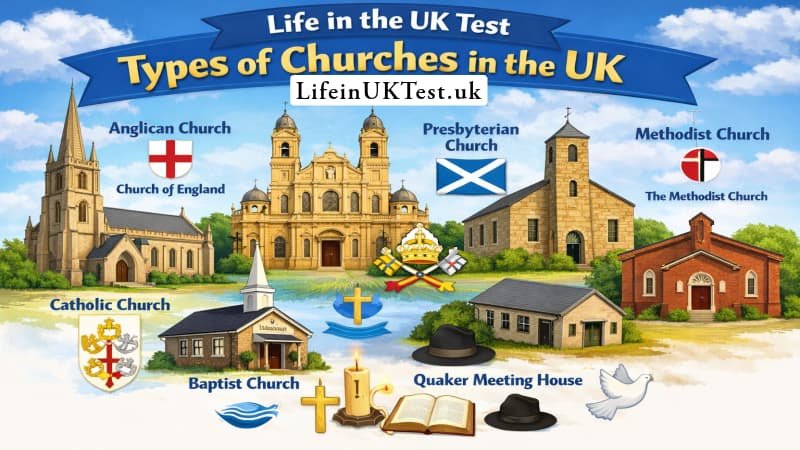
If you’re preparing for the Life in the UK Test, understanding the different types of churches in the UK is an important part of learning about British history, culture, and traditions. Christianity has played a major role in shaping the UK, and today you’ll find several Christian denominations, each with its own beliefs, practices, and place in society. From the Church of England, which is the established church, to other well-known groups such as the Catholic Church, Presbyterian Church, Methodist Church, Baptist Church, and Quakers, these churches reflect the country’s religious diversity. In this guide, we’ll clearly explain the main types of churches in the UK in a simple, exam-focused way to help you feel confident and well prepared for the Life in the UK Test.
Types of Churches in the UK: Simple Guide for Life in the UK Test
Look, when I first started preparing for the Life in the UK test, the whole church thing confused me. The UK has so many different types of churches, and honestly, it’s easy to mix them up. But here’s the thing – you don’t need to memorize everything. You just need to understand the basics.
What You Actually Need to Know
The UK is historically a Christian country, but let’s be real – not everyone goes to church these days. Still, for your test, you need to know about the main church types because they’re part of British history and culture.
The Church of England (Anglican Church)
This is the big one. The Church of England is the official church in England. Here’s what matters:
Who’s in charge? The monarch (currently King Charles III) is the head of the Church of England. Not the Pope, not a priest – the King himself. This happened back when Henry VIII broke away from the Catholic Church in the 1500s because he wanted to divorce his wife.
What’s special about it? It’s called the “established” church in England. That means it’s the official state church. Bishops from this church sit in the House of Lords. Pretty powerful, right?
Quick tip for the test: Remember – Church of England = England only. Scotland has its own thing going on.
The Presbyterian Church (Church of Scotland)
Scotland marches to its own beat. The Church of Scotland is Presbyterian, not Anglican.
Key differences:
- No bishops here – they have a different structure
- The monarch isn’t the head (though they’re a member)
- It’s the national church of Scotland
- They call their church buildings “kirk” sometimes
I’ve seen people mess this up on practice tests. Don’t say the Church of England runs Scotland – it doesn’t.
The Catholic Church (Roman Catholic)
The Catholic Church in the UK is separate from the Church of England. After the Reformation, Catholics faced discrimination for centuries.
What you should know:
- The Pope is the head, not the British monarch
- Catholics couldn’t hold public office for a long time (that changed)
- Still a significant community in the UK today
- Has its own schools and institutions
Other Important Churches
Methodist Church – Started by John Wesley in the 18th century. They wanted to reform the Church of England and make it more personal and emotional.
Baptist Church – Believe in adult baptism (when you’re old enough to choose), not baby baptism.
Quakers (Society of Friends) – Very peaceful group. They don’t have priests or formal services. Famous for being against war.
Key Takeaway
For the Life in the UK test, remember this simple formula:
- England = Church of England (Anglican) with the monarch as head
- Scotland = Church of Scotland (Presbyterian)
- Both are “established” or national churches
- Catholics follow the Pope, not the monarch
- Other churches exist but aren’t state churches
Most Asked Questions (The Confusing Bits)
Question: Is the Church of England the same as the Church of Scotland?
No! This trips people up all the time. Church of England is for England. Church of Scotland is for Scotland. Different structures, different leadership. The monarch is head of the Church of England but NOT head of the Church of Scotland.
Question: Can a Catholic become King or Queen?
This is tricky. Until 2013, the rules said no. The law changed, but here’s the catch – the monarch must be “in communion” with the Church of England because they’re its head. So technically, a Catholic still couldn’t be monarch in practice. For the test, just know the monarch must be the head of the Church of England.
Question: What about Wales and Northern Ireland?
Good question! Wales used to have the Church of England, but it was “disestablished” in 1920 – meaning it’s no longer the official church. The Church in Wales exists but isn’t a state church.
Northern Ireland is complicated (isn’t it always?). No established church there. You’ve got Protestants and Catholics, with historical tensions. For the test, you don’t need deep detail on Northern Ireland’s churches.
Question: What does “established church” mean?
It means “official state church.” Only England and Scotland have them. The government has some say in church matters, and the church has some influence in government (like bishops in the House of Lords).
Question: What’s the difference between Catholic and Protestant?
Big question! Catholics follow the Pope and give lots of weight to church tradition. Protestants don’t follow the Pope and focus mainly on the Bible. The Church of England is Protestant (even though it kept some Catholic-style traditions like bishops).
Question: Is Presbyterian the same as Protestant?
Yes and no. Presbyterian IS Protestant (they both rejected the Pope), but Presbyterian is a specific TYPE of Protestant church. All Presbyterians are Protestant, but not all Protestants are Presbyterian. Think of it like this: all squares are rectangles, but not all rectangles are squares.
Question: Why does this matter for the test?
The test wants you to know that:
- Church of Scotland = Presbyterian = Protestant (but organized differently)
- Church of England = Anglican = Protestant (but with bishops)
- Both are different from Catholic Church (which follows the Pope)
- Orthodox barely comes up – just know it exists
Question: What about Orthodox churches?
Orthodox churches split from Catholics way back in 1054. They’re big in Greece, Russia, and Eastern Europe. In the UK? Very small communities, mostly in cities. For the Life in the UK test, you probably won’t get questions about Orthodox churches. Just know they exist.
Question: Do I need to know dates?
Not really. Know that Henry VIII broke from Rome in the 1500s. Know that the Reformation happened. But you don’t need exact years for most things.
Common Test Mistakes to Avoid
Mistake 1: Saying the Pope is head of the Church of England. Nope – it’s the monarch.
Mistake 2: Thinking the Church of England covers the whole UK. It doesn’t. Scotland has its own church.
Mistake 3: Forgetting that the Church of Scotland is Presbyterian, not Anglican.
Mistake 4: Not knowing that bishops from the Church of England sit in the House of Lords.
Mistake 5: Confusing Presbyterian with Catholic. Presbyterian is Protestant! It’s just a specific type.
Mistake 6: Thinking all Protestant churches are the same. They’re not – Presbyterian, Methodist, Baptist are all different types of Protestant churches.
Mistake 7: Saying Orthodox churches are common in the UK. They’re not – very small communities, mostly in cities.
What Do These Terms Actually Mean? (No More Confusion)
Let me break this down the way I wish someone had explained it to me:
Catholic = Roman Catholic Church
- Head: Pope
- For the test: Know it’s NOT the established church in the UK
- The monarch is NOT the head
- Separate from Church of England
Protestant = Anyone who “protested” against the Catholic Church
- This is an UMBRELLA term
- Includes: Church of England, Presbyterians, Methodists, Baptists, and more
- Main difference from Catholic: No Pope, Bible is main authority
- For the test: Church of England is Protestant (specifically Anglican)
Presbyterian = A TYPE of Protestant
- Main feature: No bishops, uses elders instead
- More democratic structure
- For the test: This is what the Church of Scotland is
- Don’t mix it up with Anglican
Orthodox = Eastern Christian tradition
- Split from Catholics in 1054
- Very traditional, lots of icons and ceremony
- For the test: Barely mentioned. Small presence in UK
- Just know it exists but isn’t a major UK church
Types of Churches in the UK – How They Relate (Visual Guide)
Christianity in the UK
│
├── Catholic (Pope as head)
│   └── Not established in UK
│
├── Orthodox (Patriarchs as heads)
│   └── Small communities, not established
│
└── Protestant (No Pope)
    │
    ├── Anglican (Church of England)
    │   └── ESTABLISHED in England
    │   └── Monarch is head
    │   └── Has bishops
    │
    ├── Presbyterian (Church of Scotland)
    │   └── ESTABLISHED in Scotland
    │   └── No bishops, uses elders
    │
    ├── Methodist
    │   └── Not established
    │
    └── Baptist
        └── Not established
Understanding the Main Christian Traditions: What’s the Difference?
Before we get to the churches in the UK specifically, let’s clear up the confusion between Catholic, Protestant, Presbyterian, and Orthodox. These terms get thrown around, and honestly, it’s easy to mix them up.
The Big Split: A Super Simple History
Catholic Church – The original western Christian church. Been around since the early days of Christianity.
Orthodox Church – Split from Catholics in 1054 (called the “Great Schism”). They’re big in Eastern Europe, Greece, Russia. Not many Orthodox churches in the Life in the UK test, but good to know they exist.
Protestant Churches – Broke away from the Catholic Church during the Reformation (1500s). This includes Church of England, Lutherans, Methodists, Baptists, and yes, Presbyterians.
Presbyterian – A TYPE of Protestant church. It’s Protestant, but with its own special structure (no bishops, uses elders instead).
Major Differences Explained (The Table Everyone Needs)
| Feature | Catholic | Protestant (General) | Presbyterian | Orthodox |
|---|---|---|---|---|
| Leader | The Pope in Rome | Varies (no single leader) | No single earthly head; governed by elders | Patriarch (different ones for different regions) |
| Where’s the Authority? | Pope + Church tradition | The Bible alone (mostly) | The Bible + church councils | Church tradition + Bible |
| Church Structure | Hierarchical (Pope → Cardinals → Bishops → Priests) | Varies widely | Elders and assemblies (no bishops) | Hierarchical (Patriarch → Bishops → Priests) |
| Priests Can Marry? | No (celibacy required) | Yes (most Protestant churches) | Yes | Yes (before ordination) |
| Saints and Mary | Very important; pray to saints | Less emphasis; no praying to saints | Minimal emphasis | Very important; venerate saints and icons |
| Baptism | Infant baptism | Varies (some infant, some adult) | Infant baptism usually | Infant baptism |
| Church Services Style | Formal liturgy, Latin/vernacular | Ranges from formal to casual | Simpler, less ritualistic | Very formal, lots of tradition |
| Main Countries | Italy, Spain, Ireland, Poland, South America | USA, Germany, Scandinavia, UK | Scotland mainly | Greece, Russia, Eastern Europe |
| UK Presence | Strong (especially in Northern Ireland, parts of Scotland) | Dominant (Church of England, Methodist, Baptist) | Scotland (Church of Scotland) | Small communities |
Breaking It Down Even Simpler
Catholic = Pope is boss. Very traditional. Lots of ceremony.
Protestant = No Pope. Bible is the main authority. Church of England is Protestant (even though it kept bishops and some traditions).
Presbyterian = Protestant but organized differently. Scotland’s thing. Uses elders, not bishops. More democratic in church decisions.
Orthodox = Like Catholic in being very traditional, but split off centuries ago. Different leader (Patriarch, not Pope). Not big in the UK, so barely mentioned in the test.
Types of Churches in the UK – Quick Reference Table
| Church Type | Where | Head | Type | Established? |
|---|---|---|---|---|
| Church of England | England | The Monarch | Anglican/Protestant | Yes |
| Church of Scotland | Scotland | Jesus Christ (no earthly head) | Presbyterian/Protestant | Yes |
| Church in Wales | Wales | Archbishop of Wales | Anglican/Protestant | No (since 1920) |
| Roman Catholic | Across UK | The Pope | Catholic | No |
| Methodist | Across UK | Conference | Protestant | No |
| Baptist | Across UK | Congregational | Protestant | No |
| Orthodox | Mainly cities | Various Patriarchs | Orthodox | No |
Real Talk: Why This Matters for Your Test
The test loves asking about:
- Who heads the Church of England (answer: the monarch)
- What type of church is in Scotland (answer: Presbyterian)
- Whether bishops sit in the House of Lords (answer: yes, from Church of England)
- The difference between established and non-established churches
You might see questions like:
- “True or False: The monarch is head of the Church of Scotland” (FALSE)
- “Which church has bishops in the House of Lords?” (Church of England)
- “What type of church is the Church of Scotland?” (Presbyterian)
Simple Memory Tricks
For Church of England: Think “England’s King/Queen runs England’s Church”
For Church of Scotland: Think “Presbyterian = Scotland’s preference”
For established churches: Only TWO – England and Scotland. That’s it.
For Catholic vs Protestant: Catholic = Pope. Protestant = not Pope. Church of England = Protestant but with bishops (a middle ground).
What the Test WON’T Ask
Don’t waste time learning:
- Detailed theology or religious practices
- Names of current bishops or archbishops (except maybe the Archbishop of Canterbury as head of the Church of England)
- Specific prayers or ceremonies
- Dates of every single church event in history
Resources and Useful Links
If you want to learn more (not required for the test, but helpful for understanding UK culture):
| Resource | What It’s For | Link |
|---|---|---|
| Church of England Official Site | Understanding the state church | www.churchofengland.org |
| Church of Scotland Official Site | Learning about Presbyterian structure | www.churchofscotland.org.uk |
| Life in the UK Test Handbook | Official test preparation | Available at bookstores and online |
Final Tips from Someone Who Passed
Focus on the big picture. You’re not training to be a priest. You just need to know which church is which and who’s in charge.
Practice questions are your friend. Do loads of practice tests. You’ll start seeing the same patterns.
Don’t overthink it. If a question asks about the Church of England, it’s probably asking about the monarch being head or bishops in the House of Lords.
Remember the monarch matters. So many questions link back to the monarch’s role in the Church of England.
The churches section isn’t the hardest part of the test, honestly. Get these basics down, and you’ll be fine. The test is more about showing you understand UK culture and history, not making you a religious expert.
Good luck! You’ve got this.
Quick Quiz (Test Yourself)
1. Who is the head of the Church of England? Answer: The monarch (King Charles III currently)
2. What type of church is the Church of Scotland? Answer: Presbyterian
3. Do Catholic Church leaders sit in the House of Lords? Answer: No, only Church of England bishops
4. Is the Church in Wales an established church? Answer: No, it was disestablished in 1920
5. What’s the main difference between Church of England and Catholic Church regarding leadership? Answer: Church of England is headed by the monarch; Catholic Church is headed by the Pope
Remember: This article is for Life in the UK test preparation. The actual religious landscape of the UK is diverse and includes many faiths beyond Christianity, including Islam, Hinduism, Sikhism, Judaism, and others, plus a growing number of people with no religion.