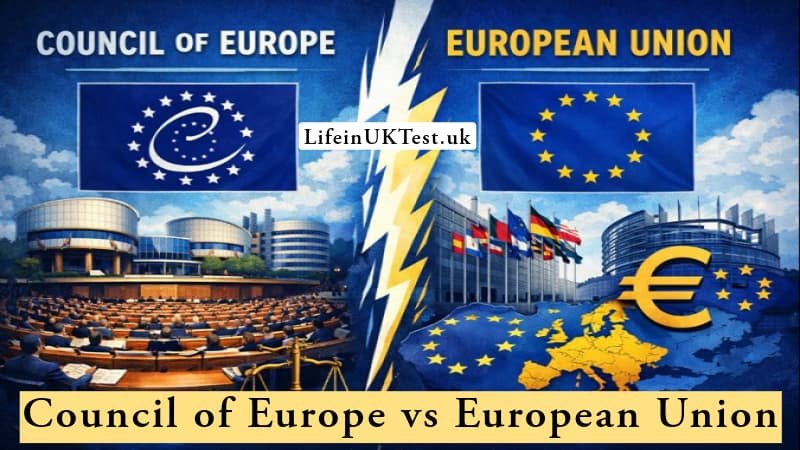
Council of Europe vs European Union – So there I was, three days before my Life in the UK Test, staring at my notes thinking “Wait, which one did the UK leave again?”
If you’ve ever had that moment of panic—you know, where Council of Europe and European Union blur into one confusing mess—you’re not alone. My mate Ahmed failed his first attempt because he mixed these up. One question. That’s all it took.
Council of Europe vs European Union
Council of Europe vs European Union: Stop Confusing Them (Trust Me, It’s Easier Than You Think) – The annoying part? Once you understand the difference, it’s actually dead simple. The names are similar, sure, but these organisations are about as different as tea and coffee. Both European, both important, but completely different things.
The Quick Answer (Before We Get Into Details)
Here’s what you need burned into your brain:
| Feature | Council of Europe | European Union |
|---|---|---|
| UK Still a Member? | YES ✓ | NO ✗ (left 2020) |
| Founded | 1949 | 1957 (as EEC) |
| Total Members | 46 countries | 27 countries |
| Main Focus | Human rights & democracy | Economy & trade |
| The Court | European Court of Human Rights (Strasbourg) | Court of Justice (Luxembourg) |
| UK Joined | 1949 (founding member) | 1973 |
Stick that table on your fridge. Seriously. Those six rows contain about 80% of what the test will ask you.
Why You Actually Need To Know This
Right, so why does the UK government care if you know the difference between these two?
Because Brexit happened. And loads of people—even British citizens—still think “leaving Europe” meant leaving everything European. It didn’t. The UK walked away from the EU but stayed put in the Council of Europe, NATO, the UN, and dozens of other international groups.
Plus, your rights as a resident come from the Council of Europe’s work. When someone talks about “human rights” in the UK, they’re usually talking about protections that came from the Council of Europe’s European Convention on Human Rights. That’s still active. That’s still protecting you. The test wants to know you understand that.
The Council of Europe: The Older, Quieter One
Picture this: it’s 1949. World War II just ended four years ago. Europe’s in ruins. Countries are terrified of another war happening.
So ten countries (including the UK) sat down and said “Never again.” They created the Council of Europe with one job—make sure democracy and human rights become non-negotiable across the continent.
This isn’t the organisation you hear about on the news. It doesn’t make trade deals. It doesn’t set tariffs. It just quietly makes sure countries treat their citizens properly.
What They Actually Do
The Council wrote the European Convention on Human Rights in 1950. Think of it as Europe’s promise to its people: you have rights, and we’ll protect them.
These rights include stuff like:
- Fair trial if you’re accused of a crime
- Freedom to say what you think (within reason)
- No torture or inhuman treatment
- Right to privacy
- Freedom of religion
When British courts talk about “human rights,” they’re usually referring to this convention. The UK actually incorporated it into British law through the Human Rights Act 1998. So it’s not just some foreign document—it’s part of our legal system.
That Court in Strasbourg
The European Court of Human Rights sits in Strasbourg, France. If you’ve exhausted every appeal in British courts and still think your rights were violated, you can take your case there.
Important: This is NOT an EU court. It belongs to the Council of Europe. The UK can’t just ignore it because of Brexit—we’re still members of the Council.
Real example: In 2005, the court ruled that the UK’s blanket ban on prisoners voting violated human rights. Controversial? Absolutely. But it shows the court still has power over UK policy.
Membership Numbers That Matter for Your Test
46 member countries. That’s everyone from tiny Andorra to massive Russia (though Russia got suspended in 2022 for invading Ukraine).
Here’s the thing: the Council of Europe includes loads of countries that aren’t in the EU and never were. Turkey? Member since 1950. Switzerland? Joined in 1963. Ukraine? Been a member since 1995.
The UK helped create this organisation in 1949 and never left. Remember that—it’s test gold.
The European Union: The Money-Focused Younger Sibling
Fast forward to 1957. Europe’s rebuilding nicely, but six countries have a brilliant idea: “What if we made our economies so interconnected that going to war would be economic suicide?”
France, West Germany, Italy, Belgium, Netherlands, and Luxembourg formed the European Economic Community. Notice the keyword? Economic. This was always about money, trade, and prosperity.
The UK didn’t join at first. We were being typically British about it—”Oh, we don’t need a trading club, we’ve got the Commonwealth.” Then in the 1960s, we realized we’d made a massive mistake and finally joined in 1973.
What Makes the EU Different from the Council
The EU is like joining a club with serious membership requirements. You don’t just show up—you agree to follow club rules, pay membership fees, and give up some independence in exchange for economic benefits.
The Four Freedoms (this might come up on the test):
- Free movement of goods—no customs checks between members
- Free movement of services—a French plumber can work in Spain
- Free movement of capital—money flows freely across borders
- Free movement of people—any EU citizen can live/work in any member country
That last one became a huge Brexit issue. “Free movement” meant a Polish worker had the same right to live in London as a British person. Some loved it. Others… not so much.
EU Institutions You Might See on the Test
The EU has its own mini-government structure:
- European Commission (Brussels) – Proposes laws, like a government
- European Parliament (Brussels/Strasbourg) – Elected representatives
- Court of Justice of the European Union (Luxembourg) – Settles legal disputes about EU law
See that? Luxembourg, not Strasbourg. Different court, different city, different organisation from the Council of Europe.
The Euro Situation
Not every EU country uses the euro. The UK never did—we kept our lovely pounds. Denmark, Sweden, Poland, and others also kept their own currencies even though they’re EU members (or were, in the UK’s case).
The euro’s complicated. Some see it as the ultimate symbol of European unity. Others see it as giving up too much control. The UK decided it wasn’t for us, even before Brexit was a thing.
Current Membership: 27 Countries
After the UK left in 2020, the EU has 27 members. That number’s important for test questions.
Here’s a useful way to remember it:
| Organisation | Members | UK Status |
|---|---|---|
| Council of Europe | 46 | Still in |
| European Union | 27 | Left |
46 is bigger than 27. The Council of Europe is older and larger but less talked about. The EU is smaller but was everywhere in the news because of Brexit.
Brexit: The Big Breakup
Right, you can’t talk about the UK and the EU without mentioning Brexit. Even if you weren’t here when it happened, you need to understand it for the test.
23 June 2016: Referendum day. Should the UK stay in the EU or leave?
- 52% voted Leave
- 48% voted Remain
It was close. It was bitter. Families argued. Friendships ended. I’m not exaggerating—this was the most divisive political event in modern British history.
Why did people vote Leave?
- Immigration concerns (that free movement thing)
- “Taking back control” of British laws
- Membership fees (£350 million a week, they claimed—economists disputed this)
- Sovereignty issues
Why did people vote Remain?
- Economic benefits of the single market
- Ease of travel and work in Europe
- Cooperation on climate change, security, research
- “Better together” mentality
I’m not here to tell you who was right. For the test, you just need to know it happened and when.
31 January 2020 – The UK officially left the European Union. Write that date down. Tattoo it on your brain. It WILL be on the test.
There was then a transition period until 31 December 2020 where everything stayed mostly the same while the UK and EU negotiated their future relationship. But the official leaving date is 31 January 2020.
What Brexit Actually Changed
| Before Brexit (in EU) | After Brexit (out of EU) |
|---|---|
| Free movement to EU countries | Need visa for stays over 90 days in 180 |
| EU citizens could live/work in UK freely | EU citizens now need permission |
| Followed EU laws automatically | UK makes its own laws |
| Paid into EU budget | No more contributions |
| Part of single market | Separate trade deals needed |
| Blue EU passport | Burgundy British passport (now blue again) |
What Brexit did NOT change:
- UK membership in Council of Europe
- UK membership in NATO
- UK membership in the United Nations
- European Convention on Human Rights still applies
- UK still cooperates with Europe on loads of stuff
This is where people get confused. Brexit wasn’t “leaving Europe” in every sense. It was specifically leaving the EU’s political and economic union.
The Side-by-Side Breakdown (Screenshot This)
Alright, let’s put them next to each other so you can actually see the differences:
| Aspect | Council of Europe | European Union |
|---|---|---|
| Birth Year | 1949 | 1957 (as EEC), 1993 (as EU) |
| UK Joined | 1949 (founding member!) | 1973 |
| UK Status Now | Full member ✓ | Left 31 Jan 2020 ✗ |
| Members | 46 countries | 27 countries |
| Main Goal | Protect human rights & democracy | Economic cooperation & integration |
| Famous Document | European Convention on Human Rights | Treaty of Rome, Lisbon Treaty |
| The Court | European Court of Human Rights | Court of Justice of the EU |
| Court Location | Strasbourg, France | Luxembourg |
| Shared Currency | None | Euro (but not all members use it) |
| Free Movement | No | Yes (when you’re a member) |
| Makes Laws | No (makes recommendations) | Yes (creates binding legislation) |
The “Which One?” Test
Quick self-check questions to see if you’ve got this:
Which one did Brexit involve? Answer: European Union. The UK left the EU, not the Council of Europe.
Which one is older? Answer: Council of Europe (1949 vs 1957)
Which one has more members? Answer: Council of Europe (46 vs 27)
Which one focuses on human rights? Answer: Council of Europe (though the EU cares about rights too)
Which one did the UK help create? Answer: Council of Europe (founding member in 1949)
Which one’s court is in Strasbourg? Answer: Council of Europe’s European Court of Human Rights
Which one created the euro? Answer: European Union
Which one can the UK still take legal cases to? Answer: Council of Europe (the European Court of Human Rights)
Where People Mess Up (Learn From Their Mistakes)
I’ve helped five friends study for this test. Here are the exact mistakes they made:
Mistake #1: “The UK left Europe”
What they meant: The UK left the European Union What it sounds like: Britain physically drifted into the Atlantic
The UK is still geographically in Europe (obviously). We’re still in European organisations like the Council of Europe, NATO, Eurovision Song Contest (for what that’s worth), and loads of others. Brexit just meant leaving the EU specifically.
Mistake #2: “All those European courts are the same thing”
There are THREE different courts people mix up:
| Court Name | Belongs To | Location | UK Status |
|---|---|---|---|
| European Court of Human Rights | Council of Europe | Strasbourg | Still bound by it |
| Court of Justice of the European Union | European Union | Luxembourg | Not anymore (post-Brexit) |
| International Court of Justice | United Nations | The Hague | Still bound by it |
My mate Sarah got a question wrong because she said the European Court of Human Rights was in Brussels. It’s not. It’s in Strasbourg. Brussels has the EU Commission and Parliament, but the EU’s court is in Luxembourg.
Confusing? Yes. Worth memorizing? Absolutely.
Mistake #3: “Brexit means we don’t have human rights anymore”
Wrong wrong wrong. The European Convention on Human Rights came from the Council of Europe, which the UK is STILL IN.
The UK also has its own Human Rights Act 1998, which put those Convention rights into British law. Even if the UK ever left the Council of Europe (it won’t, but hypothetically), those rights are still in British law unless Parliament specifically removes them.
Mistake #4: “European Council = Council of Europe”
Oh, this is sneaky. They did this on purpose, I swear.
Council of Europe: The organisation we’ve been talking about (1949, human rights, 46 members)
European Council: An EU institution where EU leaders meet for summits (like when you see those photos of world leaders around a big table)
Completely. Different. Things.
The test probably won’t ask about the European Council specifically, but if you see it in a question, don’t confuse it with the Council of Europe.
Mistake #5: “The UK was a founding member of the EU”
Nope. The UK joined 16 years late.
Founding members of the EU (or EEC as it was): France, West Germany, Italy, Belgium, Netherlands, Luxembourg. That’s it. Six countries in 1957.
When the UK joined: 1973, after Charles de Gaulle stopped vetoing our application.
UK was a founding member of: The Council of Europe in 1949. We helped create it.
Don’t mix these up. The test loves asking which organisations the UK founded vs which ones we joined later.
Mistake #6: “Strasbourg is in Germany”
It’s in France. Eastern France, right on the German border, which is why people get confused.
If a question asks where the European Court of Human Rights is located, the answer is Strasbourg, France. Not Germany. Not Brussels. Not Luxembourg.
Mistake #7: “The EU and Council of Europe merged at some point”
They never merged. They’ve always been separate. They coordinate sometimes, but they’re different organisations with different memberships, different purposes, different structures.
Think of them like Tesco and Boots. Both are shops, both are big, both are important, but they sell different things and are run by different people. Same with these organisations—both European, both important, but totally separate.
Memory Tricks That Saved My Backside
Everyone learns differently, but these worked for me and my study group:
The Age Trick
Council of Europe = Council of ELDERS (because it’s older, 1949) They worry about morals and values (human rights), like grandparents do.
EU = Young and Money-Hungry (1957, eight years younger) Focused on economics and trade, like a 20-something starting their career.
The Number Codes
46 members (Council of Europe) – Think “4oundation of 6ood” (foundation of good governance/rights) 27 members (EU) – Think “2rade for 7rosperity”
Or if that’s too much, just remember: 46 is bigger, Council of Europe is bigger.
The Court Geography Trick
Strasbourg = Still bound (UK still bound by this court) Luxembourg = Left (UK left the EU, so left this court’s jurisdiction)
Both start with the same letter (S-S, L-L), which helps me remember.
The Brexit Cheat
When someone says “European” on the test:
- Read carefully – does it say European Union or European Court of Human Rights or just “European”?
- If it mentions money, trade, or the euro → probably EU
- If it mentions rights or fair trials → probably Council of Europe
- If it asks “is the UK still a member?” → Only if it’s Council of Europe
The Founding Member Rule
UK founded the COUNCIL in 1949 UK was COUNSELLED to join the EU in 1973 (by economic pressure)
Okay, that’s cheesy, but you’ll remember it.
Visual Memory (This Really Works)
Make a mental image:
- Council of Europe: Picture a judge’s gavel (representing human rights court) with 46 carved on the handle
- European Union: Picture a euro coin with 27 stars around the edge and a big X through it (because the UK left)
When a question pops up, your brain will pull up that image.
What The Actual Test Looks Like
The Life in the UK Test has 24 multiple-choice questions. You need 18 correct to pass (that’s 75%). You’ve got 45 minutes, which is plenty of time—don’t rush.
Questions about European organisations usually fall into these patterns:
Pattern 1: Direct membership questions “Is the UK a member of the Council of Europe?” → YES “Is the UK a member of the European Union?” → NO (not since 2020)
Pattern 2: Date questions “When did the UK leave the EU?” → 31 January 2020 “When was the Council of Europe founded?” → 1949 “When did the UK join the EEC?” → 1973
Pattern 3: Number questions “How many members does the Council of Europe have?” → 46 “How many EU member states are there?” → 27
Pattern 4: Purpose questions “What is the main focus of the Council of Europe?” → Human rights and democracy “What is the European Convention on Human Rights?” → Document created by Council of Europe
Pattern 5: The tricky court questions “Where is the European Court of Human Rights located?” → Strasbourg (NOT Brussels, NOT Luxembourg)
The test won’t ask you super detailed stuff like “Who was the third president of the European Commission?” or “What year did Malta join the EU?” It sticks to the basics: dates, numbers, purposes, UK’s relationship.
But the basics need to be SOLID. If you’re wobbling on whether the UK is still in the Council of Europe, you could lose a question. And with only 6 questions’ margin for error, every one counts.
Practice Questions (Do These Multiple Times)
Try answering these without looking back. Then check your answers. If you got any wrong, read that section again.
Question 1: The UK is a founding member of which organisation? A) European Union B) Council of Europe C) European Economic Community D) United Nations
Answer: B – Council of Europe Why: The UK helped create the Council of Europe in 1949. The EEC (which became the EU) was founded in 1957 by six countries, and the UK joined later in 1973.
Question 2: When did the UK officially leave the European Union? A) 23 June 2016 B) 29 March 2019 C) 31 January 2020 D) 31 December 2020
Answer: C – 31 January 2020 Why: 23 June 2016 was the referendum date. 31 January 2020 was when the UK legally left. 31 December 2020 was when the transition period ended.
Question 3: The European Court of Human Rights is part of which organisation? A) European Union B) United Nations C) Council of Europe D) NATO
Answer: C – Council of Europe Why: This is the big trick question. Many people think it’s an EU court because it has “European” in the name. It’s not. It belongs to the Council of Europe.
Question 4: How many countries are members of the Council of Europe? A) 27 B) 28 C) 46 D) 50
Answer: C – 46 countries Why: 27 is the EU number. Don’t confuse them. The Council of Europe has 46 members, including countries like Russia, Turkey, and Switzerland that aren’t in the EU.
Question 5: True or False: After Brexit, the UK is no longer subject to the European Convention on Human Rights. A) True B) False
Answer: B – False Why: The European Convention on Human Rights comes from the Council of Europe, which the UK is still a member of. Brexit only affected EU membership.
Question 6: What is the main focus of the European Union? A) Human rights protection B) Military cooperation C) Economic cooperation and integration D) Environmental protection
Answer: C – Economic cooperation and integration Why: The EU was created to tie European economies together. Human rights is the Council of Europe’s focus.
Question 7: Where is the European Court of Human Rights located? A) Brussels B) Luxembourg C) The Hague D) Strasbourg
Answer: D – Strasbourg, France Why: Brussels has EU institutions but not this court. Luxembourg has the EU’s court. The Hague has the International Court of Justice. Strasbourg has the European Court of Human Rights.
Question 8: The UK joined the European Economic Community (which later became the EU) in: A) 1949 B) 1957 C) 1973 D) 1993
Answer: C – 1973 Why: 1949 is when the Council of Europe was founded. 1957 is when the EEC was created. 1973 is when the UK finally joined after Charles de Gaulle stopped blocking us.
Question 9: Which organisation created the European Convention on Human Rights? A) United Nations B) European Union C) Council of Europe D) NATO
Answer: C – Council of Europe Why: Created in 1950, just after the Council of Europe was established. This is a core function of the Council—protecting human rights.
Question 10: After Brexit, UK citizens need a visa to stay in EU countries for more than: A) 30 days B) 60 days C) 90 days in any 180-day period D) 180 days
Answer: C – 90 days in any 180-day period Why: This is the standard visitor allowance. For longer stays or work, UK citizens now need visas or permits. Before Brexit, they could stay indefinitely.
Your Night-Before-Test Checklist
Print this. Stick it on your wall. Read it out loud until you’re sick of hearing yourself.
The Absolute Essentials:
- [ ] Council of Europe founded 1949, EU started 1957
- [ ] UK helped create the Council of Europe (founding member)
- [ ] UK joined the EU much later (1973)
- [ ] UK left the EU on 31 January 2020 (Brexit)
- [ ] UK is STILL a member of the Council of Europe
- [ ] Council of Europe has 46 members
- [ ] European Union has 27 members
- [ ] Council of Europe = human rights and democracy
- [ ] EU = economic cooperation and trade
- [ ] European Court of Human Rights = Strasbourg (Council of Europe)
- [ ] Court of Justice of EU = Luxembourg (European Union)
- [ ] European Convention on Human Rights = Council of Europe creation
- [ ] Brexit ended UK membership in EU only, not Council of Europe
The Trick Questions to Watch For:
- [ ] “Is the UK in the Council of Europe?” → YES
- [ ] “Is the UK in the EU?” → NO (left 2020)
- [ ] “Did Brexit affect human rights protections?” → NO (those come from Council of Europe)
- [ ] “Where is the European Court of Human Rights?” → Strasbourg (not Brussels!)
- [ ] “Which organisation has more members?” → Council of Europe (46 vs 27)
Test Yourself: Cover the right side of this checklist. Try to recall the answers. If you mess up, read that section again.
If you can tick every box confidently, you’re ready.
Why This Actually Matters (Beyond Just Passing)
Look, I could give you the dry, official explanation of why these organisations matter. But let me tell you what it actually means for your life in the UK.
Your Rights Come From the Council of Europe
That European Convention on Human Rights? It’s woven into UK law through the Human Rights Act 1998. When you hear about someone taking the government to court over privacy violations, or police conduct, or freedom of speech—they’re often using rights that came from the Council of Europe.
Real example: In 2000, a transgender woman challenged the UK’s refusal to recognise her gender legally. She took her case to the European Court of Human Rights and won. The UK had to change its laws. That’s the Council of Europe’s court protecting someone’s rights.
Brexit Changed Your Daily Life
If you were here before Brexit, you noticed changes:
- That spontaneous weekend in Paris? Now you need to think about passport validity
- Working in Spain for the summer? Now you need permission
- Buying stuff from EU websites? Now there’s customs charges
- British passport queues at EU airports? Now in the “non-EU” line
But your fundamental rights? Those didn’t change because they come from the Council of Europe, not the EU.
It Explains British Politics
Turn on BBC News and you’ll hear politicians arguing about “European courts interfering” or “taking back control” or “protecting British sovereignty.” Understanding the difference between the EU and Council of Europe helps you make sense of these debates.
When a politician complains about “European judges,” ask yourself: are they talking about the Strasbourg court (Council of Europe, human rights) or the Luxembourg court (EU, trade law)? Often, even they’re confused about which one they mean.
It Shows How International Law Works
The UK doesn’t exist in isolation. We’re part of international organisations because we benefit from cooperation. The Council of Europe helps prevent human rights abuses. The EU (when we were in it) made trade easier. NATO provides security.
Understanding how these different organisations work—and which ones the UK chooses to be part of—helps you understand British foreign policy and the country’s place in the world.
The Numbers You Absolutely Cannot Forget
Write these on a sticky note:
- 1949 – Council of Europe founded
- 1973 – UK joined the EU
- 31 January 2020 – UK left the EU
- 46 – Council of Europe members
- 27 – EU members
- Strasbourg – European Court of Human Rights
Those six things will probably get you through most questions on this topic.
Test Day Tips
Breathe. You’ve got 45 minutes for 24 questions. That’s nearly two minutes per question. You won’t need that long.
Read carefully. Is the question asking about the Council of Europe or the European Union? They’ll try to trip you up with similar wording.
Eliminate obviously wrong answers. Even if you’re not sure, you can usually rule out two options immediately.
Don’t second-guess yourself. Your first instinct is usually right. Only change an answer if you’re absolutely sure you made a mistake.
Remember this article exists. If you’re still confused about anything, come back and read the relevant section again. Better to understand it properly than try to cram facts you don’t grasp.
Key Takeaway
Here’s what you need burned into your brain:
Council of Europe and European Union are completely different organisations that just happen to both have “European” in the name (thanks for that confusion, history).
Council of Europe (1949) is all about human rights and democracy. It has 46 members including the UK, which helped create it and never left. Its court is in Strasbourg, France, and still has jurisdiction over the UK.
European Union (1957) is all about economics and trade. It has 27 members NOT including the UK anymore, because we left on 31 January 2020 through Brexit. Its court is in Luxembourg.
When the test asks about European organisations:
- Did the UK leave it? Only the EU
- Is it about human rights? Council of Europe
- Is it about economics? European Union
- Does it have 46 members? Council of Europe
- Does it have 27 members? European Union
- Is the court in Strasbourg? Council of Europe
- Did the UK help found it? Council of Europe
That’s the entire topic in one page. Screenshot it, print it, memorise it, and you’ll be absolutely fine.
Remember: Understanding beats memorisation. Once you get why these organisations are different, the facts will stick naturally.
Best of luck. You’ve got this.