House of Commons and House of Lords – Understanding the similarities and differences between the House of Commons and the House of Lords is essential for anyone learning how the UK Parliament works, especially those preparing for the Life in the UK test. While both Houses play a vital role in making and reviewing laws, they differ significantly in how members are selected, the powers they hold, and how they influence government decisions. Many people find this topic confusing at first, as the two chambers often work together but operate in very different ways. In this guide, we clearly explain the key roles, functions, and distinctions of the House of Commons and the House of Lords, helping you understand how they complement each other within the UK’s democratic system.
House of Commons and House of Lords: What Actually Happens in Britain’s Two Chambers
I’ll be honest—when I first tried explaining the UK Parliament to a friend from abroad, I made it sound way more complicated than it needs to be. Here’s the thing: Britain’s got two legislative chambers, and while they both matter, they work in completely different ways. Let me break this down properly.
The Basic Setup (And Why It Even Exists)
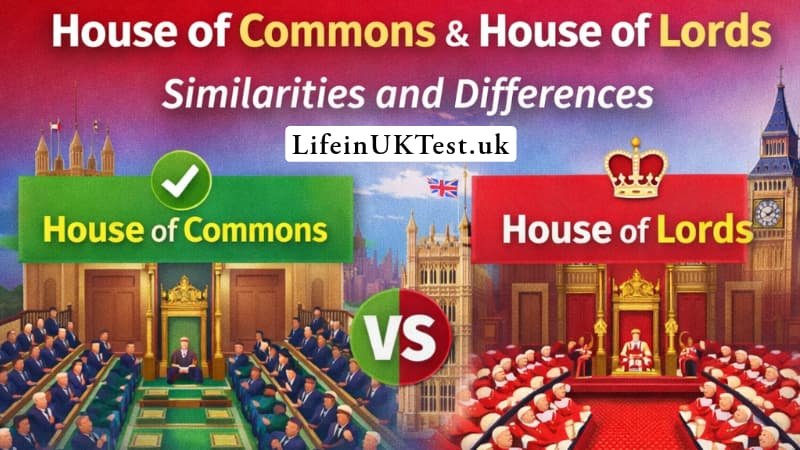
Right, so the UK runs what’s called a bicameral system. Fancy term, simple concept: two houses making laws together. The Commons sits in the green-benched chamber you’ve probably seen on TV, while the Lords—with their red benches—operates just down the corridor in Westminster.
Why two chambers? It goes back centuries, but the modern logic is actually pretty sound. The Commons represents everyone through elected MPs, while the Lords provides what’s supposed to be expert scrutiny without the pressure of fighting elections every few years.
The People Inside: Elected vs Appointed
Here’s where things get interesting. Every single Member of Parliament in the Commons won their seat through an election. Currently, there are 650 MPs representing constituencies across England, Scotland, Wales, and Northern Ireland. They face voters every five years maximum, which keeps them properly accountable.
The Lords? Completely different story. As of 2026, there are approximately 780 members, and not one of them was elected by the public.
| Aspect | House of Commons | House of Lords |
|---|---|---|
| Number of Members | 650 MPs | ~780 Peers |
| How They Got There | Elected by constituents | Appointed or inherited |
| Term Length | Maximum 5 years (then re-election) | Life tenure |
| Who They Represent | Geographic constituencies | No specific constituency |
| Average Constituency Size | ~70,000 voters | N/A |
| Removal Process | Lose election or recall petition | Virtually impossible to remove |
The Lords breakdown looks like this:
- Life peers (the vast majority) – appointed for expertise or political service
- Hereditary peers (only 92 remain after reforms) – inherited their title
- Lords Spiritual (26 bishops) – senior Church of England positions
And honestly? This appointment system is still massively controversial. There’s been talk of Lords reform for decades, but Parliament hasn’t managed to agree on what that should look like.
Power Dynamics: Who Actually Calls the Shots?
Let’s be real here—the Commons has significantly more power, and it’s not even close.
| Power | House of Commons | House of Lords |
|---|---|---|
| Pass Money Bills | Yes, exclusively | No – cannot delay or amend |
| Remove Prime Minister | Yes (vote of no confidence) | No power over PM |
| Block Legislation Permanently | Yes | No – maximum 1 year delay |
| Force General Elections | Yes | No |
| Final Say on Laws | Always | Never (Parliament Acts 1911/1949) |
| Amend Bills | Yes | Yes, but Commons can reject |
| Initiate Most Bills | Yes | Can initiate, but limited |
There’s this law called the Parliament Act (1911 and 1949) that basically ensures the Commons gets the final say. The Lords tried blocking the Commons budget in 1909, and that power grab backfired spectacularly—they lost most of their teeth in the reforms that followed.
Money Matters: The Golden Rule
Here’s a rule that never gets broken: the House of Lords cannot touch money bills. Can’t delay them, can’t amend them, can’t even slow them down. Any legislation involving taxation or government spending gets waved through the Lords whether they like it or not.
This goes back to a fundamental principle—only elected representatives should decide how public money gets raised and spent. Makes sense when you think about it. Why should unelected peers control your tax rate?
The Day-to-Day Reality
How the Commons Operates
Walk into the Commons on a typical Wednesday, and you’ll see Prime Minister’s Questions—probably the rowdiest political event you’ll ever witness. MPs shout, jeer, and wave their order papers like it’s a football match. The Speaker tries maintaining order (good luck with that).
The Commons runs on party politics. Whips ensure MPs vote along party lines. The government sits on one side, opposition on the other, and they’re deliberately positioned two sword-lengths apart (yes, really—it’s a historical thing).
MPs typically represent around 70,000 constituents each, and constituency work takes up a massive chunk of their time. Surgeries every Friday, hundreds of emails weekly, casework that ranges from potholes to immigration issues.
How the Lords Operates
The atmosphere in the Lords is… calmer. Significantly calmer. They call each other “noble Lord” or “noble Baroness,” they don’t have a Speaker (they have a Lord Speaker with basically no powers), and there’s this expectation of self-regulation.
Debates run longer, speeches get more technical, and there’s genuine expertise on display. You might have a former Supreme Court judge discussing legal implications, a retired military commander on defense policy, or a professor analyzing education reforms.
| Feature | House of Commons | House of Lords |
|---|---|---|
| Atmosphere | Rowdy, combative, theatrical | Calm, collegial, measured |
| Party Politics | Dominates everything | Less influential |
| Whip System | Strong enforcement | Weaker, more guidance |
| Crossbenchers | Don’t exist | ~180 members with no party |
| Average Speech Length | Shorter, time-limited | Longer, more detailed |
| Presiding Officer | Speaker (strong powers) | Lord Speaker (largely ceremonial) |
| Dress Code | Business attire | Business attire (robes for state occasions) |
Party politics matters less here. Crossbenchers—peers with no party affiliation—make up a significant bloc. They vote on merit rather than party loyalty, which can make Lords votes genuinely unpredictable.
Legislative Process: The Journey of a Bill
Most bills start in the Commons. Here’s what happens:
| Stage | What Actually Happens | Commons | Lords |
|---|---|---|---|
| First Reading | Bill title announced, no debate | Formality | Formality |
| Second Reading | Major debate on principles | Crucial vote | Detailed scrutiny |
| Committee Stage | Line-by-line examination | Public Bill Committee | Whole House usually |
| Report Stage | Consider committee amendments | Can be contentious | Further refinement |
| Third Reading | Final debate and vote | Last chance to reject | Final polish |
| Royal Assent | Monarch approves (automatic) | ✓ | ✓ |
Then it heads to the Lords, where the same process repeats. If the Lords suggest changes, it bounces back to the Commons. This “ping-pong” continues until both agree or the Commons invokes the Parliament Act.
Some bills start in the Lords (usually less controversial ones), but the process works the same way in reverse.
Legitimacy and Accountability
This is where the contrast gets stark. MPs face their constituents regularly. Mess up, and you’re out next election. That accountability shapes everything they do.
Lords serve for life (well, life peers do). They can’t be voted out. This means they can take unpopular positions without electoral consequences, which is simultaneously their greatest strength and biggest weakness.
The Commons can claim democratic legitimacy for everything they do. The Lords? They rely on expertise, experience, and the quality of their arguments. When these two types of legitimacy clash, democracy always wins.
What They Actually Do Well
| Strength | House of Commons | House of Lords |
|---|---|---|
| Democratic Representation | Direct connection to voters | None |
| Constituency Work | Thousands of cases annually | N/A |
| Political Accountability | Constant (elections, media) | Minimal |
| Expert Scrutiny | Limited by political pressures | Extensive, apolitical analysis |
| Long-term Thinking | Constrained by election cycles | Free from electoral pressure |
| Technical Expertise | Variable (generalist politicians) | High (specialists in fields) |
| Cross-party Cooperation | Rare due to whip system | Common, especially crossbenchers |
| Amendment Quality | Often political | Often technical improvements |
In 2024-2025, the Lords suggested over 4,000 amendments to government bills. Many were accepted because they genuinely improved the legislation. That’s the system working as intended.
The Similarities (Yes, There Are Some)
Despite everything I’ve said, they share certain features:
| Shared Characteristic | Details |
|---|---|
| Location | Both in Palace of Westminster |
| Parliamentary Privilege | Both protected by ancient rights of free speech |
| Committee System | Both conduct detailed investigations |
| Question Time | Both question government ministers |
| Can Initiate Legislation | Both can propose bills (though Commons dominates) |
| Ancient Procedures | Both follow centuries-old traditions |
| Third-Person References | Both avoid using names directly in debate |
They’re both ridiculously formal. Standing orders, ancient procedures, weird traditions—Parliament loves this stuff. MPs and Lords alike refer to each other in third person: “Will the Right Honourable Member for…” instead of just using names.
The Reform Question Nobody Can Answer
Here’s the uncomfortable bit: almost everyone agrees the Lords needs reforming, but nobody agrees on how.
Should it be fully elected? That might just create a second Commons competing for legitimacy. Fully appointed? That concentrates too much power with whoever does the appointing. Mixed? How do you balance elected and appointed members?
| Reform Option | Pros | Cons | Likelihood |
|---|---|---|---|
| Fully Elected | Democratic legitimacy | Would rival Commons authority | Moderate |
| Smaller Appointed | Expertise maintained | Still undemocratic | Low |
| 80% Elected/20% Appointed | Balances both concerns | Complicated, messy | Moderate |
| Abolish Entirely | Simplifies system | Loses scrutiny function | Very Low |
| Status Quo | No disruption needed | Increasingly indefensible | High (by default) |
Since the House of Lords Act 1999 removed most hereditary peers, there’ve been countless proposals: 80% elected, regional representation, term limits, reduced numbers. Labour’s 2024 manifesto promised Lords reform again. We’ll see if it actually happens this time.
Current Issues and Controversies (2025-2026)
The Lords has grown enormous—around 780 members compared to 650 MPs. It’s literally the second-largest legislative chamber in the world after China’s National People’s Congress. That’s absurd.
| Current Problem | Why It Matters | Proposed Solutions |
|---|---|---|
| Excessive Size | 780 members vs 650 MPs | Mandatory retirement age, attendance requirements |
| Appointments Process | PMs stack with party loyalists | Independent appointments commission |
| Poor Attendance | Some peers rarely appear | Minimum attendance rules, “retire or attend” |
| Daily Allowance | £332/day just for showing up | Salary system instead, or scrap payments |
| No Retirement | Peers serve until death | Automatic retirement at 80 |
| Cronyism | Donors and allies rewarded | Cap on PM appointments |
Some peers barely show up. Attendance isn’t mandatory, yet they can claim allowances. There’ve been calls for a retirement age or attendance requirements.
The appointments process remains murky. Prime Ministers stuff the Lords with party supporters before leaving office. Boris Johnson created 86 new peers during his time. Liz Truss nominated several despite serving only 49 days. It looks dodgy because, frankly, it is.
International Perspective
Most democracies have two legislative chambers, but Britain’s setup is genuinely unusual.
| Country | Second Chamber | How Chosen | Powers |
|---|---|---|---|
| UK | House of Lords | Appointed/Inherited | Limited delay only |
| USA | Senate | Elected (2 per state) | Equal to House, sometimes stronger |
| Germany | Bundesrat | Appointed by state governments | Strong veto on state matters |
| Australia | Senate | Elected (proportional) | Near-equal power |
| Canada | Senate | Appointed by PM | Rarely blocks Commons |
| France | Sénat | Indirectly elected | Can delay, not block |
| New Zealand | None | Abolished 1951 | N/A |
The UK’s combination of elected and appointed chambers, with clear supremacy for the elected one, occupies a weird middle ground. It works reasonably well in practice, but it’s philosophically awkward.
Looking Forward
The Commons isn’t changing anytime soon. It’s the democratic heart of British politics, and that’s non-negotiable.
The Lords? That’s where pressure for change keeps building. Public polling consistently shows majority support for an elected second chamber. Younger voters especially question why unelected peers should have any legislative role at all.
But here’s the thing—reform requires political will, parliamentary time, and agreement on what replaces the current system. Those three factors rarely align. So we muddle along with this historical compromise that somehow still functions.
What This Means Practically
If you’re trying to influence legislation, understand the different dynamics. Lobbying MPs means focusing on constituents’ interests and electoral concerns. Approaching peers means emphasizing evidence, expertise, and long-term impacts.
When controversial bills pass despite Lords opposition, that’s democracy working—elected representatives overruling appointed ones. When the Lords successfully forces amendments, that’s expertise improving hastily-drafted legislation.
Both matter. Both contribute. They’re just fundamentally different beasts operating under the same roof.
The House of Commons and House of Lords create a system that’s simultaneously ancient and adaptive, democratic and aristocratic, unified and divided. It probably shouldn’t work as well as it does. But for all its quirks and contradictions, this bicameral system has evolved into something that—mostly—serves Britain reasonably well.
Whether it’ll look the same in another decade? That’s the question everyone’s asking but nobody can answer.
Useful Resources
| Resource | What You’ll Find | Link |
|---|---|---|
| UK Parliament Official | Live proceedings, voting records, bill progress | https://www.parliament.uk |
| TheyWorkForYou | Track your MP’s voting record and speeches | https://www.theyworkforyou.com |
| Hansard | Official verbatim record of parliamentary debates | https://hansard.parliament.uk |
| House of Lords Library | Research briefings and analysis | https://lordslibrary.parliament.uk |
| Institute for Government | Independent analysis of parliament and reform proposals | https://www.instituteforgovernment.org.uk |