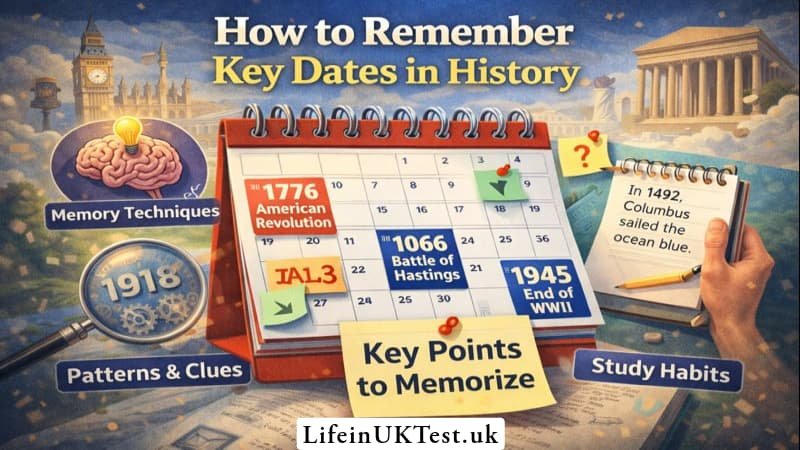
How to Remember Key Dates in History – If you are preparing for Life in the UK test, Remembering key dates in history can feel like one of the hardest parts of studying—especially when names, events, and years all start to blur together. Many learners know the story behind an event but freeze when it comes to recalling the exact date. This article on how to remember key dates in history is designed to make that process easier and more natural.
How to Remember Key Dates in History
By using practical memory techniques, simple patterns, and real-life study habits, you’ll learn how to fix important historical dates in your mind without endless rote learning. Whether you’re revising for an exam, a citizenship test, or personal interest, these strategies will help you remember dates with confidence and clarity.
Look, I get it. You’re staring at a timeline of British history and your brain’s already checking out. 1066, 1215, 1588… they all blur together, right? But here’s the thing—remembering historical dates doesn’t have to feel like cramming random numbers into your head.
Why Your Brain Hates Random Numbers
I’ve watched students panic before exams, desperately trying to memorize dates they’ll forget the moment they leave the exam hall. But the ones who actually remember? They’re using these tricks. Not because they’re smarter, but because they’ve figured out how memory actually works.
Top 10 Memory Hacks for British History
Your brain wasn’t designed to store disconnected facts. It wants stories, patterns, emotions. That’s why you can remember the plot of a film you watched years ago but forget what you studied last week. So let’s work with your brain, not against it.
1. The Rhyme Method (Seriously, It Works)
This one feels childish until you realize it’s the reason you still remember “In 1492, Columbus sailed the ocean blue.” Checkout this article on 25 key dates in British history with rhymes where I already provided few tips and techniques.
For British history, try this:
- 1066 – “Ten sixty-six, Norman tricks”
- 1215 – “Twelve-fifteen, Magna Carta scene”
- 1588 – “Fifteen eighty-eight, Armada met its fate”
- 1649 – “Sixteen forty-nine, Charles lost his head in time”
Make them ridiculous. The weirder, the better. Your brain latches onto unusual things.
2. Create a Memory Palace (No, Really)
Think of a route you walk every day—maybe your house or your commute. Now attach historical events to specific locations along that route.
Let’s say you’re walking through your house:
- Front door: 1066, Norman Conquest (imagine William the Conqueror breaking down your door)
- Kitchen: 1348, Black Death (picture plague victims at your kitchen table—grim, but memorable)
- Living room: 1605, Gunpowder Plot (Guy Fawkes hiding behind your sofa)
- Bedroom: 1914, WWI begins (soldiers marching past your bed)
When you need to recall these dates during an exam, you mentally walk through your house. It sounds bizarre, but memory champions use this technique to remember thousands of items.
3. Number Chunking (Break It Down)
Your brain handles small chunks better than long strings. Instead of seeing 1688 as one big number, break it down:
1688 becomes “16” and “88”
- 16 = sweet sixteen (think of a birthday)
- 88 = two snowmen standing together
So the Glorious Revolution? Picture two snowmen celebrating a sweet sixteen party. Weird? Absolutely. Effective? You bet.
4. The Story Chain Method
Link events together like a chain. Each date triggers the memory of the next one.
Start with 1066 (Norman Conquest). William the Conqueror builds castles everywhere. Those castles need rules, which leads to 1215 (Magna Carta). King John signs away some power, but later kings want it back, causing conflicts. Fast forward to 1485 (Battle of Bosworth), ending the Wars of the Roses. The Tudors take over, leading to 1534 (Henry VIII breaks from Rome) because he wants a divorce…
See how each event naturally flows into the next? You’re not memorizing isolated dates anymore—you’re following a narrative.
5. Use Your Hands (Finger Memory)
Assign each finger to a century. Your left pinkie could be the 11th century, your left ring finger the 12th century, and so on.
When you think of an event, physically touch the corresponding finger and visualize the date. The physical action creates an additional memory pathway. During exams, you can subtly touch your fingers to trigger recall.
6. Anchor to What You Already Know
Connect historical dates to modern things you already remember.
- 1666 – Great Fire of London. Same number as the “devil’s number” 666, just with an extra 1 at the front.
- 1815 – Battle of Waterloo. Think “18-15” like a sports score (18-15, Britain wins!)
- 1945 – End of WWII. Split it: 19 (your gran’s house number?) and 45 (your dad’s age?)
Everyone’s anchors will be different. Use what matters to you.
7. The Peg System (Numbers as Images)
Assign an image to each number 0-9:
- 0 = ball
- 1 = candle
- 2 = swan
- 3 = pitchfork
- 4 = sailboat
- 5 = hook
- 6 = elephant trunk
- 7 = cliff
- 8 = snowman
- 9 = balloon
For 1815 (Battle of Waterloo): Picture a candle (1), snowman (8), candle (1), and hook (5) fighting Napoleon. Honestly, the more absurd your mental image, the better it sticks.
8. Timeline Landmarks (The Signpost Approach)
Instead of memorizing every single date, pick major “landmark” dates and position others relative to them.
Your landmarks might be:
- 1066 – Norman Conquest
- 1485 – Tudor period begins
- 1649 – English Civil War ends
- 1815 – Napoleonic Wars end
- 1945 – WWII ends
Then slot other events around these: “The Great Fire happened between the Civil War and Waterloo” or “Henry VIII’s break from Rome was about 50 years after the Tudors took power.”
9. Flashcard Plus Emotion
Regular flashcards are boring. Flashcards with emotional connections? Gold.
Don’t just write “1605 – Gunpowder Plot.” Write “1605 – Guy Fawkes nearly blew up Parliament! Imagine the chaos if he’d succeeded.”
Add exclamation points. Draw terrible stick figures. Write in different colors. Make yourself feel something about each date. Boredom is the enemy of memory.
10. The Phonetic System (For the Overachievers)
This one’s advanced, but students who use it swear by it. Convert numbers to consonant sounds, then create words.
In the Major System:
- 1 = T or D sound
- 6 = soft G or J sound
So 1666 might become “Touch judge” (T-J-J-J). Then picture yourself touching a judge while London burns behind you.
It takes practice, but once you’ve learned the system, you can memorize hundreds of dates.
The Comparison Table You Actually Need
Here’s your British history cheat sheet in chronological order. Print it, stick it on your wall, and use it with the methods above:
| Year | Event | Quick Memory Tip |
|---|---|---|
| 1066 | Norman Conquest (Battle of Hastings) | “Ten sixty-six, Norman tricks” |
| 1215 | Magna Carta signed | “Twelve-fifteen, Magna Carta scene” |
| 1348 | Black Death arrives in England | “Thirteen forty-eight, plague at the gate” |
| 1455 | Wars of the Roses begin | “Fourteen fifty-five, roses come alive” |
| 1485 | Battle of Bosworth (Tudor era begins) | “Fourteen eighty-five, Tudors arrive” |
| 1534 | Henry VIII breaks from Rome | “Fifteen thirty-four, Henry wants more” |
| 1588 | Spanish Armada defeated | “Fifteen eighty-eight, Armada met its fate” |
| 1605 | Gunpowder Plot | “Sixteen-oh-five, Guy’s failed dive” |
| 1649 | Execution of Charles I | “Sixteen forty-nine, Charles lost his head in time” |
| 1666 | Great Fire of London | Think: Devil’s number (666) + 1000 |
| 1688 | Glorious Revolution | “Sixteen eighty-eight, William and Mary’s date” |
| 1707 | Acts of Union (Great Britain formed) | “Seventeen-oh-seven, union feels like heaven” |
| 1815 | Battle of Waterloo | Sports score: 18-15, Britain wins! |
| 1837 | Victorian Era begins | “Eighteen thirty-seven, Victoria reigns from heaven” |
| 1914 | World War I begins | “Nineteen-fourteen, war’s horrific scene” |
| 1939 | World War II begins | “Nineteen thirty-nine, Churchill’s finest time” |
| 1945 | World War II ends | “Nineteen forty-five, glad to be alive” |
| 1969 | Voting age lowered to 18 | “Sixty-nine, eighteen can vote just fine” |
| 1982 | Falklands War | “Nineteen eighty-two, Thatcher’s naval crew” |
| 1997 | Tony Blair becomes PM (New Labour) | “Ninety-seven, Blair’s in PM heaven” |
What Actually Works (Let’s Be Honest)
You won’t use all ten methods. That’s fine. Pick two or three that click with you.
Most students I’ve helped end up combining the rhyme method with a memory palace or story chain. Some swear by the peg system once they’ve invested time learning it. A few just chunk numbers and create mental images.
The worst thing you can do? Keep rereading your notes hoping the dates will magically stick. They won’t. Your brain needs active engagement—creating, visualizing, connecting.
Common Mistakes to Avoid
Don’t mix up similar dates. 1588 and 1598 can blur together. Make your memory tricks distinct enough that this doesn’t happen.
Don’t cram the night before. These techniques work best when you practice over time. Spend 10 minutes daily rather than 3 hours the night before your exam.
Don’t forget context. A date without meaning is just a number. Always connect the year to why it mattered. 1215 isn’t just a date—it’s the moment English kings first had their power limited by law.
Practice Makes Permanent
Here’s your homework (sorry, but it helps): Pick five dates from the table above. Right now. Use at least two different memory methods on each one. Tomorrow, see how many you remember without looking.
Then add five more. And five more the next day.
By the time your exam rolls around, you won’t be frantically memorizing—you’ll be reviewing stories and images you created weeks ago.
Key Takeaway
Memory isn’t about having a “good brain” or being naturally smart. It’s about using techniques that work with how your brain actually functions. British history dates are just numbers until you give them meaning through rhymes, stories, mental images, or physical anchors.
Start with the landmark dates (1066, 1485, 1649, 1815, 1945). Build from there. Mix methods until you find what sticks for you. And remember—the goal isn’t to memorize every date in British history. It’s to understand the flow of events well enough that dates become reference points, not obstacles.
Now stop reading and start creating your first memory palace. William the Conqueror is waiting at your front door.