Life in the UK Test key points to memorize – When you start preparing for the Life in the UK Test, it quickly becomes clear that it’s not just about reading the handbook—it’s about remembering the right information. From key historical events to how the UK government works, there’s a lot to take in, and trying to memorise everything can feel daunting.
This guide focuses on the most important Life in the UK Test key points to memorise, helping you concentrate on the facts that actually matter in the exam. Whether you’re working towards British citizenship or Indefinite Leave to Remain (ILR), these practical revision tips are designed to make your preparation more manageable, more focused, and a lot less stressful.
Life in the UK Test key points to memorize
So you’re preparing for the Life in the UK Test? Let’s be real—this exam can feel overwhelming. You’re sitting there with a handbook full of dates, names, and facts about a country you’re trying to call home. The good news? Not everything in that book matters equally.
I’ve broken down what you actually need to memorize. No fluff, no corporate speak. Just the facts that keep showing up on test day.
Why Some key points to memorize matter
Here’s something they don’t tell you upfront: the test pulls questions from specific categories. British history dominates about 40% of the questions. Government and law? Another 25%. The rest covers culture, sports, and traditions.
Most people waste time memorizing every single detail. Don’t be that person. Focus on patterns. Wars, monarchs, major laws—these repeat constantly.
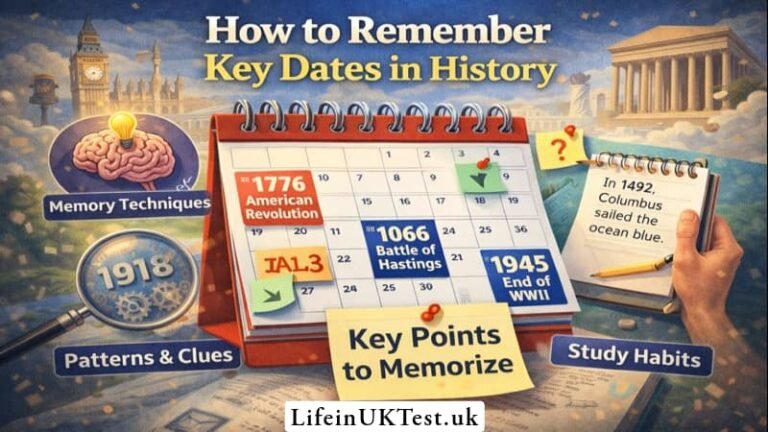
Historical Dates You Can’t Afford to Skip
Honestly, the historical section trips up more people than anything else. But here’s the thing: you don’t need to memorize every battle. You need the game-changers.
Pre-1500s Foundation:
- 1066: Norman Conquest (William the Conqueror beats Harold at Hastings)
- 1215: Magna Carta signed (King John limiting royal power)
- 1314: Battle of Bannockburn (Robert the Bruce defeats English)
- 1348: Black Death arrives in Britain
- 1415: Battle of Agincourt (Henry V’s victory)
Tudor Period (1485-1603):
- 1534: Henry VIII breaks from Roman Catholic Church
- 1588: Spanish Armada defeated
- 1603: Union of Crowns (James VI of Scotland becomes James I of England)
17th Century Chaos:
- 1642-1651: English Civil War
- 1649: Charles I executed
- 1660: Monarchy restored (Charles II)
- 1688: Glorious Revolution (William of Orange)
- 1689: Bill of Rights established
Empire Building (1700s-1800s):
- 1707: Act of Union creates Great Britain
- 1776: American Declaration of Independence
- 1801: Act of Union with Ireland
- 1805: Battle of Trafalgar (Nelson defeats French and Spanish)
- 1815: Battle of Waterloo (Wellington defeats Napoleon)
- 1833: Slavery abolished in British Empire
- 1847: Factory Act limits women’s working hours
- 1870: Married Women’s Property Act
20th Century Turning Points:
- 1903: Emmeline Pankhurst founds Women’s Social and Political Union
- 1914-1918: First World War
- 1918: Women over 30 get the right to vote
- 1928: All women over 21 can vote
- 1939-1945: Second World War
- 1948: NHS established, SS Empire Windrush arrives
- 1949: Ireland leaves Commonwealth, becomes republic
- 1957: Treaty of Rome (founding of EEC)
- 1969: Voting age lowered from 21 to 18
- 1973: UK joins European Economic Community
Recent History:
- 1998: Good Friday Agreement (Northern Ireland peace)
- 1999: Scottish Parliament and Welsh Assembly established
- 2016: Brexit referendum
The Monarchs They Actually Ask About
You’ll see questions about specific rulers. Not all of them—just the ones who changed things.
| Period | Monarch | Key Facts to Remember |
|---|---|---|
| 1066-1087 | William the Conqueror | Norman Conquest, Domesday Book (1086) |
| 1154-1189 | Henry II | Common law development, legal reforms |
| 1189-1199 | Richard I (Lionheart) | Led Third Crusade, rarely in England |
| 1199-1216 | King John | Forced to sign Magna Carta (1215) |
| 1272-1307 | Edward I | Conquered Wales, Model Parliament (1295) |
| 1509-1547 | Henry VIII | Six wives, broke from Catholic Church, dissolved monasteries |
| 1558-1603 | Elizabeth I | Defeated Spanish Armada, never married, Shakespeare era |
| 1603-1625 | James I (VI of Scotland) | United crowns, King James Bible |
| 1625-1649 | Charles I | Civil War, executed 1649 |
| 1649-1660 | Commonwealth | Oliver Cromwell as Lord Protector |
| 1660-1685 | Charles II | Restoration, Great Fire of London (1666) |
| 1689-1702 | William III & Mary II | Joint monarchs, Glorious Revolution, Bill of Rights |
| 1702-1714 | Anne | Act of Union 1707, last Stuart monarch |
| 1837-1901 | Victoria | Longest reign until Elizabeth II, British Empire peak |
| 1901-1910 | Edward VII | Edwardian era |
| 1910-1936 | George V | WWI, changed royal name to Windsor (1917) |
| 1952-2022 | Elizabeth II | Longest-reigning monarch (70 years) |
| 2022-Present | Charles III | Current monarch |
Wars and Battles: What Actually Appears
The test loves asking about military conflicts. But you don’t need battle strategies. You need winners, dates, and consequences.
Medieval Battles:
- Battle of Hastings (1066): Harold Godwinson killed, Norman rule begins
- Battle of Bannockburn (1314): Scottish independence under Robert the Bruce
- Battle of Agincourt (1415): Henry V defeats French despite being outnumbered
Tudor and Stuart Conflicts:
- Spanish Armada (1588): Elizabeth I’s navy defeats Spanish invasion
- English Civil War (1642-1651): Cavaliers (Royalists) vs. Roundheads (Parliamentarians), Parliament wins
- Battle of the Boyne (1690): William III defeats James II in Ireland
Empire and World Wars:
- Battle of Trafalgar (1805): Nelson defeats combined French-Spanish fleet, dies in battle
- Battle of Waterloo (1815): Wellington and Prussians defeat Napoleon
- First World War (1914-1918): Battle of the Somme (1916) major British battle
- Second World War (1939-1945): Battle of Britain (1940), D-Day (1944)
Government Structure: Know How It Actually Works
This section catches people off guard. They memorize dates but forget how Britain operates today.
Parliament Basics:
- Two chambers: House of Commons (elected) and House of Lords (appointed)
- Commons has 650 elected MPs
- Prime Minister leads the government (usually leader of majority party)
- Elections must happen at least every 5 years
- First-past-the-post voting system
- Monarch’s role is ceremonial (must sign all laws but always does)
UK Nations and Devolution:
| Nation | Capital | Parliament/Assembly | Established |
|---|---|---|---|
| England | London | UK Parliament only | N/A |
| Scotland | Edinburgh | Scottish Parliament | 1999 |
| Wales | Cardiff | Senedd (Welsh Parliament) | 1999 |
| Northern Ireland | Belfast | Northern Ireland Assembly | 1999 (restored after Good Friday Agreement 1998) |
You Need to Know:
- Scotland has separate legal and education systems
- All nations use pound sterling
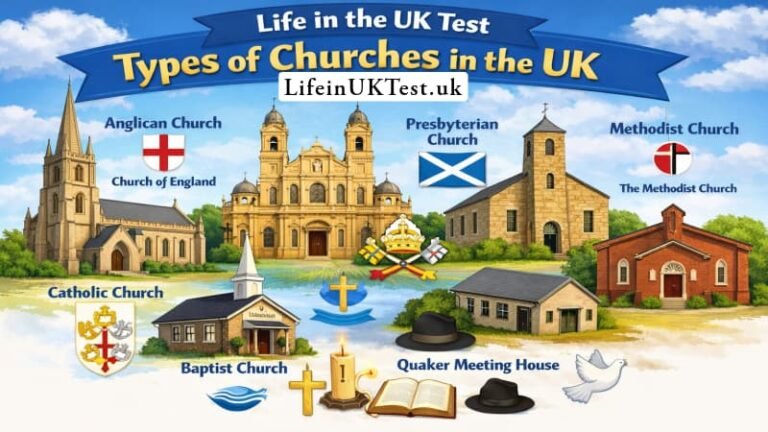
- Church of England is established church in England
- Presbyterian Church of Scotland is established in Scotland
- No established church in Wales or Northern Ireland
Legal Rights and Responsibilities
Every test includes questions about your rights and duties as a resident or citizen. Get these wrong and you’re in trouble.
Rights Everyone Has:
- Freedom of speech (within the law)
- Freedom of religion
- Equal treatment regardless of sex, race, religion, age, disability, sexual orientation
- Right to fair trial
- Right to participate in elections (if eligible)
Citizen Responsibilities:
- Respect and obey the law
- Participate in jury service if called
- Pay taxes
- Respect rights of others
- Look after yourself and family
- Look after the area you live in
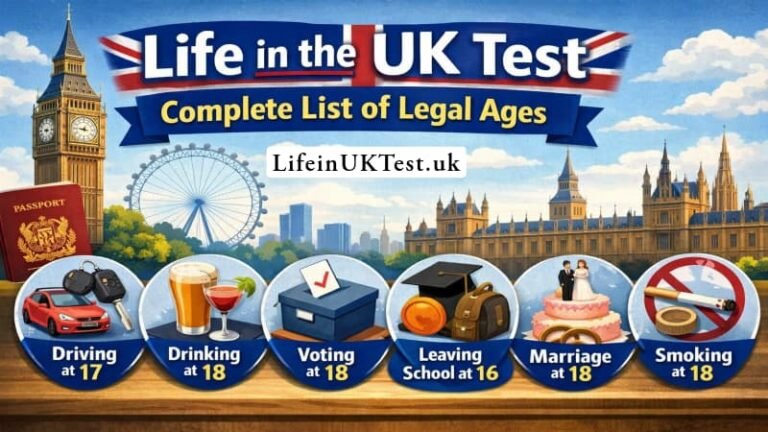
Key Legal Ages:
| Age | What You Can Do |
|---|---|
| 16 | Leave school, work full-time (with restrictions), get married (with parental consent in England/Wales), consent to sexual activity |
| 17 | Drive a car, apply to armed forces |
| 18 | Vote, buy alcohol, buy tobacco, get married without consent, stand for public office, serve on jury |
Cultural Facts That Keep Appearing
Sports, traditions, and culture questions seem random. They’re not. Certain topics repeat endlessly.
National Days:
- St. David’s Day (Wales): March 1
- St. Patrick’s Day (Northern Ireland): March 17
- St. George’s Day (England): April 23
- St. Andrew’s Day (Scotland): November 30
Sports Invented in Britain:
- Football (soccer)
- Cricket
- Rugby (both codes)
- Golf (Scotland)
- Tennis (modern rules)
- Hockey
- Boxing (modern Queensberry Rules)
Major Cultural Figures You’ll See:
| Field | Key Names | What to Remember |
|---|---|---|
| Literature | William Shakespeare | Playwright, Romeo and Juliet, Hamlet, 1564-1616 |
| Literature | Charles Dickens | Victorian novelist, Oliver Twist, A Christmas Carol |
| Literature | Jane Austen | Pride and Prejudice, Sense and Sensibility |
| Science | Isaac Newton | Gravity, laws of motion |
| Science | Charles Darwin | Evolution theory, On the Origin of Species |
| Science | Alexander Fleming | Discovered penicillin (1928) |
| Engineering | Isambard Kingdom Brunel | Railways, bridges, SS Great Britain |
| Engineering | Robert Stephenson | Built “The Rocket” locomotive |
| Nursing | Florence Nightingale | Founder of modern nursing, Crimean War |
| Architecture | Sir Christopher Wren | Rebuilt St. Paul’s Cathedral after Great Fire |
Immigration Milestones You Must Know
Since you’re taking this test, immigration history matters. The handbook emphasizes Britain’s diversity.
Timeline of Immigration:
| Year | Event | Significance |
|---|---|---|
| 1840s-1850s | Irish immigration | Potato Famine refugees |
| 1880s-1914 | Jewish immigration | Fleeing persecution from Russia and Eastern Europe |
| 1948 | SS Empire Windrush | 492 passengers from Caribbean, start of large-scale Caribbean migration |
| 1950s-1960s | Commonwealth immigration | From India, Pakistan, Bangladesh, Caribbean |
| 1972-1973 | Ugandan Asians | Expelled by Idi Amin, settled in UK |
| 2004 onwards | EU expansion | Migration from Eastern European countries |
Windrush Generation: Critical to know. Caribbean citizens invited to work in UK after WWII. Arrived on SS Empire Windrush in 1948. Helped rebuild Britain, especially in NHS and transport.
Women’s Rights Timeline
Gender equality questions appear regularly. Know the progression.
| Year | Milestone |
|---|---|
| 1847 | Factory Act limits women’s working hours to 10 per day |
| 1870 | Married Women’s Property Act (women can keep earnings) |
| 1903 | Emmeline Pankhurst founds WSPU (suffragettes) |
| 1918 | Women over 30 (with property) get vote |
| 1928 | All women over 21 get vote (equal with men) |
| 1970 | Equal Pay Act |
| 1975 | Sex Discrimination Act |
Common Test Traps (Where People Mess Up)
After helping dozens of people prepare, I’ve noticed patterns in what confuses test-takers.
Date Confusion:
- People mix up 1215 (Magna Carta) with 1265 (first parliament)
- Act of Union: 1707 is Great Britain (England + Scotland), 1801 adds Ireland
- Women’s voting: 1918 is over 30, 1928 is equal rights at 21
Name Mix-Ups:
- Brunel (father Marc, son Isambard Kingdom)—questions usually ask about IK Brunel
- Stephenson (father George, son Robert)—both built railways
- Victoria (longest reign) vs. Elizabeth II (actually longer)—Elizabeth II now holds record
Geographic Gotchas:
- Northern Ireland is part of UK, Republic of Ireland is not
- Britain = England, Scotland, Wales
- Great Britain = geographic island
- United Kingdom = political union (England, Scotland, Wales, Northern Ireland)
- British Isles = geographic term (includes Ireland)
How to Actually Memorize This Stuff
Reading lists doesn’t work. Here’s what does:
Create mental anchors: Connect dates to something personal. If you were born in 1988, remember the Armada was 1588 (400 years earlier).
Use the pattern method: Notice that major events cluster. 1600s = Civil War and monarchy drama. 1800s = Industrial Revolution and empire. 1900s = world wars and welfare state.
Practice with real conditions: The actual test is 45 minutes, 24 questions, on a computer. You need 75% correct (18 out of 24). Practice under time pressure.
Don’t memorize the handbook word-for-word: They test understanding, not recitation. Know the facts, but they’ll phrase questions differently.
Key Takeaway
The Life in the UK Test isn’t about knowing everything—it’s about knowing the right things. Focus on major historical turning points (1066, 1215, 1588, 1649, 1707, 1914-1918, 1939-1945, 1948). Memorize monarch names for Tudor period onwards. Understand current government structure. Know the ages for legal rights.
Most importantly, this test is passable. People stress because the handbook is massive, but the exam draws from a smaller pool. You’ve got this. Read through these facts twice, take practice tests, and you’ll walk in confident.
The test isn’t designed to trick you. It’s checking whether you understand British values, history, and how society works. Learn these facts, understand the context, and on test day, you’ll be fine.
Good luck. Seriously—you’re going to pass.
Need more help? Take official practice tests at the LifeinUKTest.uk website. The real exam test pulls similar questions, so practicing builds familiarity. Don’t cram the night before. Space your study over two weeks minimum. Your brain needs time to lock this information in.
And hey, once you pass? Keep this knowledge. It’s not just for the test. It’s understanding the place you’re calling home.