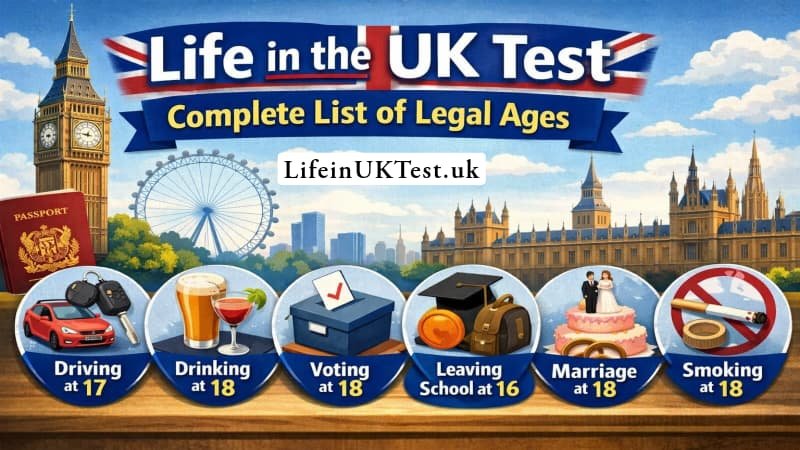
So you’re preparing for the Life in the UK Test, and you’ve hit the section about legal ages. Honestly, this part trips up more people than you’d think. Why? Because the ages seem random at first glance, and let’s be real—when you’re nervous during a test, remembering whether you can buy fireworks at 16 or 18 becomes surprisingly difficult.
Life in the UK Test: Complete List of Legal Ages
Here’s the thing: the test will ask you specific questions about what age you can do certain things in the UK. Not understanding these ages could cost you valuable points. But don’t worry – I’m going to break this down in a way that actually makes sense.
Why Legal Ages Matter for Your Test
Before we get into the numbers, let me tell you something important. The Life in the UK Test isn’t just checking if you’ve memorized facts. It’s testing whether you understand how British society works. Legal ages are a big part of that because they show you understand rights, responsibilities, and how the law protects people at different stages of life.
You might get a question like “At what age can someone legally buy alcohol in a pub?” or “When can a young person work full-time?” These aren’t trick questions, but they’re specific. You need to know the exact ages.
Complete List of Legal Ages: From Youngest to Oldest
Here’s everything you need to know, arranged by age so it’s easier to remember. I’ve broken it down age by age because that’s how the information will stick in your mind better.
Age 5: Starting School
What you can do:
- Must start compulsory education (school)
This is straightforward. Every child in the UK must begin their formal education at age 5. It’s the law, and it’s where the journey of legal ages begins.
Age 13: First Steps into Work
What you can do:
- Do light part-time work (with restrictions)
At 13, young people can start earning their own money through part-time work. We’re talking about things like paper rounds, helping in family businesses, or light work. There are strict rules about hours and the type of work, but this is when it legally starts.
Age 14: Entering Pubs (But Not Drinking!)
What you can do:
- Enter a pub but cannot buy or drink alcohol
This one confuses people. Yes, a 14-year-old can physically be in a pub, but they absolutely cannot consume alcohol. Think of it as being allowed in the building, nothing more.
Age 16: The Big Independence Year
What you can do:
- Leave school and start full-time work (though you must stay in some form of education or training until 18 in England)
- Buy lottery tickets
- Consent to sexual activity
- Join the armed forces (with parental consent)
- Ride a moped or light motorcycle (with provisional license and after completing CBT – Compulsory Basic Training)
- Drink beer, wine, or cider with a meal in a restaurant (if accompanied by an adult who purchases it – This is important!)
Important note about marriage at 16:
This is a BIG change many people get wrong. You CANNOT get married at 16 in England and Wales anymore – not even with parental consent. The law changed on February 27, 2023, raising the marriage age to 18 with NO exceptions.
In Scotland, you can still marry at 16 without parental consent, but for the Life in the UK test, remember that in England and Wales it’s 18.
Important note about tobacco at 16:
Before 2007, you could buy cigarettes and tobacco at 16. That changed—now the legal age is 18 for buying tobacco.
Age 16 is still a major milestone. You’re legally considered a “young adult.” You can leave school (though in England you must stay in education or training until 18). You can work full-time. You can consent to relationships. You can ride mopeds. Basically, 16 is when society says “okay, you’re growing up, here are some freedoms, but you’re not quite there yet.”
Age 17: Behind the Wheel
What you can do:
- Drive a car (with provisional license, then full license after passing test)
- Be interviewed by police without an adult present
Most people remember 17 because of driving. This is the magic number for getting behind the wheel of a car. You need to pass your test, obviously, but 17 is when you’re legally allowed to drive on public roads.
The police interview thing is less known but still important. At 17, police can question you without a parent or guardian present, treating you more like an adult in legal situations.
Age 18: Full Adulthood Unlocked
What you can do:
- Vote in elections
- Buy and drink alcohol in pubs and shops
- Get married or enter a civil partnership (in England and Wales – this is now the minimum age with NO exceptions)
- Buy fireworks
- Serve on a jury
- Buy cigarettes and tobacco products (current legal age)
- Place a bet and buy National Lottery tickets
- Get a tattoo
- Buy knives
- Watch, rent, or buy an 18-rated film or game
- Join the armed forces without parental consent
- Stand for election as a councillor or MP
- Sue or be sued in court
- Make a will
- Change your name by deed poll
This is it. The big one. At 18, you’re a full legal adult in the UK. Everything that requires you to be a “grown-up” happens at this age. You can vote and have a real say in how the country is run. You can legally drink alcohol in pubs and shops. You can get married (remember, in England and Wales, 18 is now the ONLY legal marriage age). You can get that tattoo you’ve been thinking about. You can gamble, buy fireworks, and serve on a jury.
Here’s what’s interesting: at 18, you can also stand for election as a local councillor or Member of Parliament. You’re trusted to help run the country. You can make a legally binding will, change your name officially, and handle all your own legal affairs. This is complete independence.
Age 21: Supervising Others
What you can do:
- Supervise a learner driver (must have held full license for 3+ years)
- Adopt a child (in some cases)
Age 21 doesn’t have as much as 18, but there are still a couple of important things. If you passed your driving test at 17 or 18, you can now supervise learner drivers at 21 (since you’ll have had your license for 3+ years). Some adoption processes also require you to be 21, though this varies.
Age 25: Political Office (Sort Of)
What you can do:
- Stand for election to the House of Commons
Here’s something that trips people up: this was lowered to 18 back in 2006. So technically, you can stand for Parliament at 18 now, not 25. But it’s worth knowing this changed, in case the test mentions historical information.
Age 70: License Renewal Time
What you must do:
- Renew your driving license (then every 3 years after that)
When you hit 70, you need to renew your driving license. After that, it’s every three years. You don’t automatically lose the right to drive—you just need to keep your license current and confirm you’re still fit to be on the road.
Quick Memory Tips That Actually Work
Look, I know staring at that table won’t make it stick. Here are some tricks that helped other test-takers:
The “16 is the freedom year” rule: Many basic freedoms start at 16. You can leave school, work full-time, and consent to relationships. Think of 16 as when you become a “young adult” in UK law. BUT remember: you cannot get married at 16 in England and Wales anymore (that changed in 2023).
18 is independence day: This is when you become a full adult. Voting, drinking, getting tattoos—all the “proper adult” stuff happens at 18. No more needing permission from parents for major decisions.
The odd ones to memorize separately:
- Age 5 for school (because it’s the starting point)
- Age 13 for light work (because it’s the earliest work age)
- Age 17 for driving cars (because most people remember this one anyway)
- Age 70 for license renewal (because it’s the only one for older people)
The “almost but not quite” trap: At 14, you can enter a pub but can’t drink. At 16, you can’t buy alcohol even though you can do many other adult things. At 17, you can drive but can’t buy alcohol. These are easy to mix up, so pay attention.
Common Confusions (And How to Avoid Them)
Confusion #1: Marriage Age – LAW CHANGED IN 2023!
This is where people make mistakes because the law CHANGED recently. Before February 27, 2023, you could get married at 16 with parental consent in England and Wales. That’s NO LONGER TRUE.
Current law (as of February 2023):
- England and Wales: You must be 18 to marry. NO exceptions, even with parental consent.
- Scotland: You can still marry at 16 without parental consent.
- Northern Ireland: You can marry at 16 with parental consent (as of my knowledge, but check current status).
For the Life in the UK test, remember: In England and Wales, the legal marriage age is 18.
Confusion #2: Alcohol Is Complicated
- Age 14: Can be in a pub (but no drinking)
- Age 16: Can drink wine, beer, or cider with a meal if bought by an adult (this one rarely appears on the test, but it’s worth knowing)
- Age 18: Can buy and drink alcohol anywhere legally
For the test, just remember: 18 is the legal drinking and purchasing age.
Confusion #3: Working Ages
At 13, children can do light part-time work like delivering newspapers. At 16, they can work full-time. This distinction matters because the test might ask about when full-time work is allowed.
Confusion #4: Smoking and Tobacco
The law changed in 2007, making it illegal to sell tobacco to anyone under 18. Before that, it was 16. The test focuses on current law, so remember: 18 is the legal age to buy tobacco.
Confusion #5: Voting Rights
It’s 18 to vote in the UK. Some people get confused because there’s been debate about lowering it to 16, and in Scotland, 16-year-olds can vote in Scottish Parliament elections. But for the Life in the UK Test, remember: 18 for general UK elections.
What the Test Actually Asks
The questions usually come in these formats:
Direct questions:
- “At what age can you vote in a general election?”
- “What is the minimum age to buy alcohol?”
True/False statements:
- “You can get a tattoo at age 16.” (False—it’s 18)
- “You must be 18 to serve on a jury.” (True)
Scenario-based questions:
- “Sarah is 17. Can she drive a car?” (Yes, with a license)
- “Tom is 16. Can he buy fireworks?” (No—that’s 18)
The test won’t ask you every single age, but it will test the most important ones. Focus on ages 16, 17, and 18 because these come up most often.
What to Actually Study
Let’s be practical. You don’t need to memorize every single detail. Here’s what you should definitely know cold:
Must-know ages:
- 5 (school starts)
- 16 (leave school, work full-time, consent to sexual activity)
- 17 (drive a car)
- 18 (vote, drink alcohol, get married in England and Wales, full legal adult)
Should-know ages:
- 13 (part-time work)
- 18 (jury service, buy tobacco, get tattoos)
- 70 (driving license renewal)
The rest? Skim them. Understand the pattern rather than cramming every detail.
Study Strategy That Works
Here’s what I recommend based on what actually helps people pass:
- Read the table three times: First time, just read it. Second time, try to find patterns. Third time, cover the right column and test yourself.
- Use real-life context: Think about what you or people you know did at each age. “Oh yeah, my friend started driving at 17.” Personal connections make facts stick.
- Focus on the tricky ones: Don’t waste time on what you already know. If you know voting is at 18, move on. Spend time on the ones that surprise you.
- Test yourself with questions: Don’t just read—actively quiz yourself. “Can a 16-year-old buy alcohol?” Make it a game.
- The night before: Don’t cram new information. Just review the must-know ages (5, 16, 17, 18). Trust that you’ve learned the rest.
Most Asked Questions Before the Test
Q: Will they ask about ages that changed recently?
They test current law. So if something changed years ago (like the smoking age in 2007), you only need to know the current age (18).
Q: Do I need to know the exact wording of the law?
No. You need to know the age and what it allows. You don’t need legal terminology.
Q: What if I’m not sure between two ages?
Use logic. Most “adult” activities (drinking, voting, gambling) are 18. Most “young adult” activities (leaving school, working) are 16. When in doubt, guess 18 for adult stuff and 16 for independence stuff.
Q: How many questions about ages will be on my test?
Typically 2-4 questions out of 24. Not a huge portion, but enough that getting them wrong could affect your result.
Q: Is the driving age definitely 17?
Yes. You can apply for a provisional license at 15 years and 9 months, but you can’t actually drive a car until 17.
Key Takeaway
The Life in the UK Test legal ages section isn’t about memorizing random numbers. It’s about understanding how British society gives people rights and responsibilities as they grow up. Focus on the key ages—5, 16, 17, and 18—and understand what happens at each stage. Think of it as a timeline of growing up in the UK: you start school at 5, gain some independence at 16, start driving at 17, and become a full adult at 18 (including the ability to marry in England and Wales).
Most importantly, be aware that laws change. The marriage age in England and Wales increased to 18 in February 2023 with no exceptions. Don’t panic if you forget one or two details. The test is designed to check your general knowledge, not catch you out on technicalities. Know the main ages, understand the logic behind them, and you’ll do fine.
Now, go review that table one more time. You’ve got this.
Quick Reference for Last-Minute Review
Age 5: School starts
Age 16: Leave school, work full-time, consent to sexual activity
Age 17: Drive a car
Age 18: Vote, drink alcohol, get married (England & Wales), full adult rights
Age 70: Renew driving license
Everything else builds around these five ages. Remember them, and you’re already ahead of most test-takers.
Official UK Government Sources on Legal Ages
- Age of Criminal Responsibility (gov.uk) – shows that in England and Wales, the age of criminal responsibility is 10 years old (with different arrangements in Scotland). Age of criminal responsibility – GOV.UK (official)
- Driving and Provisional Licence Information (gov.uk) – official guidance on applying for a driving licence and minimum ages to start learning to drive (you can apply at 15 yrs 9 months and generally drive at 17).
- Alcohol Licensing: Age Verification (gov.uk) – explains that it’s illegal to sell alcohol to someone under 18 in England and Wales and outlines verification requirements. Alcohol licensing: age verification – GOV.UK consultation (relevant official guidance)
- “Assessing age” (gov.uk) – guidance on age assessment in official contexts (primarily immigration cases), which includes legal definitions around age.
- Youth Strategy and Voting Age – the UK Government’s Youth Strategy documents note government plans to lower the voting age to 16 for all elections ahead of the next UK general election, indicating official policy direction.