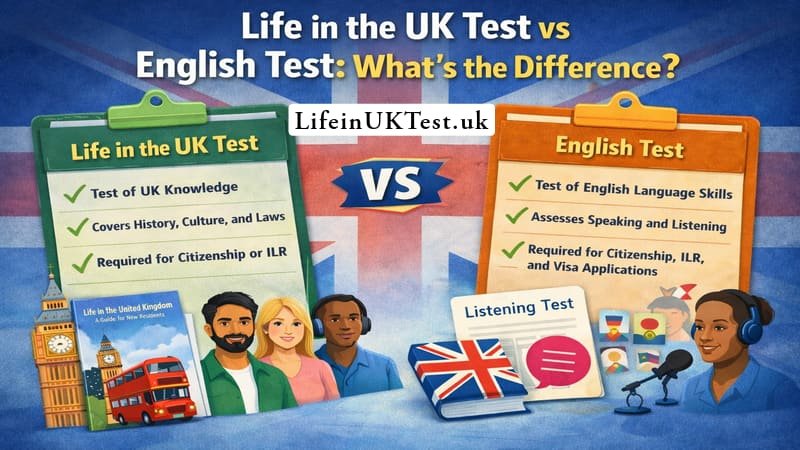
Life in the UK Test vs English Test: What’s the Difference? This is a common question for people applying for British citizenship or indefinite leave to remain (ILR). While both tests are key UK immigration requirements, they serve very different purposes. The Life in the UK Test focuses on British history, values, and everyday life, whereas the English test assesses your ability to read, write, speak, and understand English. In this article, we clearly explain the differences between the Life in the UK Test and the English test, who needs to take each one, and how to prepare for them.
Life in the UK Test vs English Test: What’s the Difference?
So you’re planning to settle in the UK, and you’ve heard about these tests you need to take. Maybe you’re feeling a bit overwhelmed—I get it. There’s the Life in the UK Test, there’s something called an English language test, and honestly, it can all feel like alphabet soup when you’re trying to figure out what applies to you.
Let me break this down for you in plain English (pun intended). These are two completely different tests that serve different purposes, and understanding the distinction will save you time, money, and a whole lot of confusion.
Important note: As of January 2026, the UK immigration system is undergoing significant changes, particularly around English language requirements. I’ll make sure you know exactly what applies to you based on the latest rules.
The Quick Answer: What’s the Core Difference?
Here’s the thing: the Life in the UK Test checks your knowledge about British culture, history, and values, while English language tests prove you can actually communicate in English. Think of it this way—one tests what you know about the UK, the other tests whether you can have a proper conversation at the post office.
Most people applying for settlement or citizenship need to pass both. Yeah, I know—it’s a bit of a double whammy. But they’re testing completely different skills, and you’ll prepare for them in totally different ways.
Life in the UK Test: Your Crash Course in Being British
What It Actually Tests
The Life in the UK Test is essentially a 45-minute exam about British history, traditions, government, and everyday life. You’ll answer 24 multiple-choice questions, and you need to get at least 18 correct to pass (that’s 75%, if you’re keeping score).
The questions can be surprisingly specific. We’re talking about everything from who built Hadrian’s Wall to how the UK court system works. You might get asked about famous British inventors, significant historical events, or even details about UK public holidays.
What You’ll Study
To prepare, you’ll need to read the official handbook called “Life in the United Kingdom: A Guide for New Residents” (currently in its third edition). Honestly, it’s quite a read—covering everything from the Stone Age to modern Britain. Some bits are genuinely interesting (the history sections are actually pretty engaging), while others feel like you’re memorizing a phonebook.
Here’s what the handbook covers:
- British history from ancient times to present day
- The UK government and law system
- British values and principles
- Traditions and customs
- Famous British people and their contributions
- Everyday life and practical information
When You Need It
You’ll need to pass this test if you’re applying for:
- Indefinite Leave to Remain (ILR) / settlement
- British citizenship (naturalisation)
- Some visa extensions
Important note: If you’re under 18 or over 65, you’re exempt from this requirement. There are also exemptions for people with certain long-term physical or mental conditions that prevent them from taking the test.
Recent Updates (2025-2026)
In October 2025, the Home Office announced plans to modernize the Life in the UK Test. However, as of early January 2026, no revised syllabus or new handbook has been published. You should continue preparing with the current official materials until formal updates appear on the government website. The test format—24 questions, 45 minutes, 75% pass mark—remains unchanged.
The Practical Details
| Aspect | Details |
|---|---|
| Cost | £50 |
| Duration | 45 minutes |
| Questions | 24 multiple-choice |
| Pass mark | 75% (18 out of 24) |
| Results | Immediate (you’ll know right away) |
| Validity | Lifetime (once you pass, it’s done) |
| Booking | Through the official government website |
You can take the test at approved test centres across the UK, and you’ll know your result as soon as you finish. If you fail, you can retake it as many times as needed, but you’ll pay £50 each time—so it’s worth studying properly the first time around.
English Language Tests: Proving You Can Communicate
What These Tests Measure
English language tests are all about your ability to speak, listen, read, and write in English. Unlike the Life in the UK Test (which you could theoretically pass by memorizing facts even if your English was shaky), these tests directly assess your communication skills.
The UK government accepts specific English tests for immigration purposes, and they’re not all created equal. The main ones you’ll encounter are:
- IELTS for UKVI (Academic or General Training)
- IELTS Life Skills (for some visa routes)
- Trinity College London GESE (Graded Examinations in Spoken English)
- Trinity College London ISE (Integrated Skills in English)
- PTE Academic UKVI (Pearson Test of English)
- LanguageCert
The CEFR Levels Explained
These tests measure your English against the Common European Framework of Reference (CEFR). You’ll hear about levels like A1, A2, B1, B2, and so on. Here’s what they actually mean:
- A1: Basic user—you can introduce yourself and ask simple questions
- A2: Elementary—you can handle routine tasks requiring simple exchanges
- B1: Intermediate—you can deal with most situations when traveling and describe experiences (equivalent to GCSE level)
- B2: Upper intermediate—you can interact with native speakers fairly fluently and understand complex texts (equivalent to A-Level)
- C1: Advanced—you can use English flexibly for social, academic, and professional purposes
- C2: Proficiency—basically, you’re functioning at a near-native level
CRITICAL 2026 CHANGE: B2 Requirement for Skilled Workers
This is huge: From 8 January 2026, new applicants for Skilled Worker, High Potential Individual, and Scale-up visas must demonstrate English at B2 level (upper intermediate), not B1 as before. This is a significant increase—it means you need to show A-Level standard English across all four skills: reading, writing, speaking, and listening.
Let me be clear about who this affects:
- New applicants only: If you’re applying for your first Skilled Worker visa on or after 8 January 2026
- Extensions are different: If you’re already on a Skilled Worker visa and extending it, you’ll still only need B1
This change reflects the government’s push to ensure skilled workers can function confidently in professional settings from day one.
Which Level Do You Need? (Updated for 2026)
This depends entirely on what you’re applying for and when:
| Application Type | Required Level (2026) | When It Applies |
|---|---|---|
| Skilled Worker visa (new applications) | B2 (all four skills) | From 8 Jan 2026 |
| Skilled Worker visa (extensions) | B1 (Speaking & Listening) | Current rule maintained |
| High Potential Individual visa | B2 (all four skills) | From 8 Jan 2026 |
| Scale-up visa | B2 (all four skills) | From 8 Jan 2026 |
| Spouse/Partner visa (initial) | A1 (Speaking & Listening) | Current |
| Spouse/Partner visa (extension) | A2 (Speaking & Listening) | Current |
| Adult dependants (initial entry) | A1 | New requirement from 2026 |
| Adult dependants (extension) | A2 | New requirement from 2026 |
| Settlement (ILR) – current rules | B1 (Speaking & Listening) | Current until proposed changes |
| Settlement (ILR) – proposed | B2 | Proposed for implementation 2026 |
| Citizenship | B1 (Speaking & Listening) | Current until proposed changes |
| Student visa | B2 (typically, varies by institution) | Unchanged |
Major Changes Coming: Proposed ILR Requirements
Here’s something you absolutely need to know: the UK government is proposing massive changes to settlement requirements. Under the new “Earned Settlement” system expected to begin in April 2026 (subject to consultation closing 12 February 2026):
English requirement for ILR will increase from B1 to B2. This is a significant jump—instead of intermediate English, you’ll need upper intermediate proficiency to settle permanently.
What this means practically: If you’re planning to apply for ILR soon, you might want to consider applying before these changes take effect (if you’re eligible). Once the new rules kick in, you’ll need that higher B2 level, which typically requires 600-800 hours of study depending on your starting point.
The Tests in Detail
IELTS Life Skills is probably the most popular choice for current settlement applications. It only tests speaking and listening (no reading or writing), which makes it more focused than full IELTS. You’ll have a conversation with an examiner and another test-taker, and you’ll need to complete some practical tasks. However, with the proposed B2 requirement for ILR, you’ll likely need the full IELTS or equivalent that tests all four skills.
IELTS for UKVI tests all four skills and is now essential for Skilled Worker visa applicants from 8 January 2026. You’ll need to achieve B2 across reading, writing, speaking, and listening. This typically means:
- Overall band score of 5.5-6.0
- No individual component below 5.5
Trinity GESE is another solid option. It’s a face-to-face speaking exam where you’ll chat with an examiner about various topics. Different grades correspond to different CEFR levels. For B2, you’d typically take Grade 7, 8, or 9.
Trinity ISE tests all four skills and is suitable for the new B2 requirements. ISE II corresponds to B2 level.
Practical Information (Updated for 2026)
| Test Type | Cost (approx.) | Duration | Skills Tested | Suitable For |
|---|---|---|---|---|
| IELTS Life Skills A1 | £150 | 16-18 minutes | Speaking & Listening | Spouse visa (initial) |
| IELTS Life Skills B1 | £150 | 22 minutes | Speaking & Listening | Current ILR only |
| IELTS for UKVI (Academic/General) | £220-240 | 2 hours 45 minutes | All four skills | Skilled Worker (from Jan 2026), proposed ILR |
| Trinity GESE Grade 5 (B1) | £150-160 | 15 minutes | Speaking & Listening | Current ILR only |
| Trinity ISE II (B2) | £180-200 | Varies | All four skills | Skilled Worker (from Jan 2026), proposed ILR |
| PTE Academic UKVI | £200-215 | 2 hours | All four skills | Skilled Worker (from Jan 2026), proposed ILR |
CRITICAL WARNING: Make absolutely sure you book a test that’s approved for UKVI (UK Visas and Immigration). Not all test centres are approved. If you accidentally take a standard IELTS instead of IELTS for UKVI, for example, it won’t be accepted for your visa application—I’ve seen people make this expensive mistake.
Also, for the new B2 requirement effective 8 January 2026, you MUST take a test that assesses all four skills (reading, writing, speaking, listening). Life Skills tests won’t cut it anymore for Skilled Worker visa applications.
Exemptions from English Tests
You might not need to take an English test if:
- You’re a national of a majority English-speaking country (USA, Canada, Australia, New Zealand, Ireland, etc.)
- You have a degree taught in English (and you can prove it with an ECCTIS certificate—this costs around £210 and takes time, so don’t leave it to the last minute)
- You’re over 65
- You have a long-term physical or mental condition that prevents you from meeting the requirement
The Big Comparison: Side by Side
Let me lay this out clearly so you can see the differences at a glance:
| Feature | Life in the UK Test | English Language Test (2026) |
|---|---|---|
| Purpose | Tests knowledge of UK culture, history, and values | Tests English communication ability |
| Format | 24 multiple-choice questions | Varies: conversation, tasks, reading, writing (depends on test type) |
| Content | British history, government, traditions | English speaking, listening, reading, writing |
| Preparation | Study the official handbook | Practice English skills, take practice tests |
| Duration | 45 minutes | 16 minutes to 3 hours (depends on test) |
| Pass requirement | 75% (18/24 correct) | Meet required CEFR level for your application |
| Cost | £50 | £150-£240 |
| Results | Immediate | 2-7 days typically |
| Retakes | Unlimited (pay each time) | Unlimited (pay each time) |
| Skills tested | Memory and reading comprehension | Language proficiency |
| Recent changes | Modernization announced but not yet implemented | Major change: B2 now required for Skilled Worker (from 8 Jan 2026) |
Do You Need Both? Let’s Talk Real Scenarios (2026 Edition)
Scenario 1: You’re Applying for a NEW Skilled Worker Visa (From 8 January 2026)
You need to prove English at B2 level across all four skills (reading, writing, speaking, listening). You won’t need the Life in the UK Test until you apply for settlement years later.
This is a significant change from before. You’ll need to take a comprehensive English test like IELTS for UKVI and achieve at least B2 in every component. Plan for this—B2 is a solid intermediate level that takes time to achieve if you’re not there already.
Scenario 2: You’re Extending Your Skilled Worker Visa
Good news—you only need B1 level. The B2 requirement only applies to new applications, not extensions. You also won’t need the Life in the UK Test yet.
Scenario 3: You’re Applying for Indefinite Leave to Remain (ILR) NOW
Under current rules (as of early January 2026), you need B1 level English (speaking and listening) plus the Life in the UK Test. Both are required.
However—and this is important—the government has proposed increasing the English requirement to B2 for ILR applications. This change is expected to come into effect in April 2026 after a consultation period. If you’re close to being eligible for ILR, you might want to apply sooner rather than later to avoid the higher requirement.
Scenario 4: You’re Applying for ILR Later in 2026 (After Proposed Changes)
If the proposed changes go through (expected April 2026), you’ll need B2 level English across all four skills PLUS the Life in the UK Test. This is a much higher bar than current requirements.
Additionally, under the new “Earned Settlement” system, you’ll need to show you’ve earned at least £12,570 annually for three to five years before applying. The qualifying period may also extend from 5 to 10 years for many routes, though high earners (£50,270+) may still qualify after five years.
Scenario 5: You’re Applying for British Citizenship
Currently, you need B1 English (speaking and listening) plus the Life in the UK Test. However, watch for changes as the ILR requirements increase—citizenship requirements often follow suit.
Scenario 6: You’re on a Spouse Visa
For the initial visa, you need A1 English (very basic). For extensions, you need A2. When you apply for ILR, you currently need B1, but this may increase to B2 if the proposed changes go through. You’ll also need to pass the Life in the UK Test when applying for settlement.
New from 2026: Adult dependants will now need to prove English ability—A1 for initial entry, A2 for extensions, and B2 for settlement under the proposed rules.
Scenario 7: You’re a Graduate Visa Holder Switching to Skilled Worker
If you’re applying for a Skilled Worker visa from 8 January 2026 onwards, you need B2 English. Even though you studied in the UK, unless your degree meets the English language exemption criteria (and you can prove it with ECCTIS), you’ll need to take the test.
Also be aware: from 1 January 2027, the Graduate visa duration is being reduced from 24 months to 18 months (though PhD graduates still get 3 years).
Common Mistakes People Make (Learn from Others’ Pain)
Mistake #1: Taking the wrong English test
I cannot stress this enough—not all English tests are accepted for immigration. With the new B2 requirements, taking a Life Skills test when you need a full four-skills assessment is a costly error. Always check the current approved test list on the gov.uk website, and make absolutely sure you’re booking IELTS for UKVI, not regular IELTS.
Mistake #2: Not preparing for the B2 level increase
The jump from B1 to B2 is significant. B1 is about getting by in everyday situations; B2 means you can handle complex professional conversations, understand detailed texts, and write clear, structured documents. If you’re planning to apply for a Skilled Worker visa after 8 January 2026, start preparing now. This level typically requires months of study.
Mistake #3: Assuming your degree exempts you automatically
Having a degree taught in English is great, but you need to get it verified through ECCTIS (formerly UK NARIC). Don’t leave this to the last minute—it takes time and costs around £210. Your university won’t do this for you.
Mistake #4: Not keeping up with the changing rules
UK immigration rules are in significant flux in 2026. The English language requirement for settlement is expected to increase from B1 to B2, and the entire ILR system is being overhauled. Stay informed by regularly checking the official gov.uk immigration pages.
Mistake #5: Underestimating the Life in the UK Test
Some people think, “Oh, I’ve lived here for years, I’ll be fine.” Then they fail because they don’t know which king was executed in 1649 or what percentage of the population is under 19. The test is specific. Study the handbook properly—this is not a test you can wing.
Mistake #6: Taking tests too close to application deadlines
Give yourself breathing room, especially now with changing requirements. What if you need to retake? What if results are delayed? What if the rules change while you’re waiting? Book your tests with plenty of time to spare before your visa or application deadline.
Mistake #7: Not keeping your certificates safe
Once you pass, your certificates are gold. You’ll need the originals for your application. Keep them somewhere safe—losing them means retaking the test, which is particularly frustrating if you took the test under old rules and now need to meet new requirements.
Mistake #8: Applying just after major rule changes
If you’re eligible to apply before major changes take effect (like the B2 increase on 8 January 2026, or the proposed ILR changes in April 2026), seriously consider doing so. Once new rules are in place, you’re stuck with them. Talk to an immigration adviser if you’re on the borderline.
How to Prepare: Practical Tips from People Who’ve Been There
For the Life in the UK Test:
Get the official handbook (3rd edition) and actually read it. You can buy it from bookshops or download it. Some people find physical books easier to study from than screens.
Take practice tests obsessively. There are loads of free practice tests online. Keep taking them until you’re consistently scoring above 80%. The real test questions feel similar to the practice ones.
Focus on the tricky bits. Dates, percentages, and specific names trip people up. Make flashcards for these details if that helps you memorize. The government structure section and historical dates are particularly important.
Don’t just memorize—try to understand the context. The information sticks better when it makes sense rather than when you’re just cramming random facts.
Book your test early. Test centre slots can fill up, especially if you’re in a smaller area. Don’t leave this to the last minute.
For English Language Tests (Especially B2):
Understand what test you need first. As of 8 January 2026, if you’re applying for a Skilled Worker visa, you need a full four-skills test at B2 level. Don’t waste money on the wrong test.
Recognize that B2 is a significant step up from B1. You’ll need to:
- Understand detailed texts and complex ideas
- Express yourself fluently in professional settings
- Write clear, detailed documents
- Follow extended speech and complex conversations
This typically requires 600-800 hours of study if you’re starting from a lower level. Be realistic about your timeline.
Practice all four skills equally. Many people are stronger in reading and writing than speaking and listening (or vice versa). You need to pass in ALL four areas for the new requirements.
Take mock tests under timed conditions. Get familiar with the test format you’ll be taking. IELTS, Trinity, and PTE all have different structures.
Consider professional preparation courses. Given the B2 requirement is new and higher than before, investing in a good preparation course might save you money in the long run by helping you pass first time.
Book your test early. With new requirements coming in, test centres may see increased demand. Book as soon as you’re ready—tests typically need to be booked weeks in advance.
Verify your test centre is UKVI-approved. This is non-negotiable. Only tests from approved centres count for immigration purposes.
For Both Tests:
Check if you’re exempt before spending money on tests. If you have a degree taught in English, get the ECCTIS verification sorted. If you’re from an English-speaking country, you may not need the English test at all.
Keep digital and physical copies of all certificates. Store them somewhere safe. You’ll need these for multiple applications potentially.
Don’t wait until the last minute. With rule changes happening throughout 2026, give yourself buffer time. Apply before deadlines when possible.
The Proposed “Earned Settlement” Changes: What You Need to Know
This is probably the biggest change to UK immigration in decades, and it’s worth understanding even if you’re years away from applying for ILR.
What’s Changing
The government proposes moving from an automatic 5-year route to settlement to a merit-based system where:
Qualifying periods are longer: Most people will need 10 years instead of 5 (though high earners above £50,270 may still qualify after 5 years, and those earning above £125,140 may qualify after just 3 years).
English requirement increases to B2: Instead of B1, you’ll need upper intermediate English across all four skills.
You must demonstrate economic contribution: Earning at least £12,570 annually for 3-5 years before applying.
Integration matters: Passing the Life in the UK Test is mandatory, and community engagement may be considered.
Character requirements tighten: Any immigration breaches, criminal convictions, or public funds usage could extend your qualifying period significantly—potentially to 15, 20, or even 30 years.
Who’s Affected
The government has stated these changes could apply to everyone in the UK who hasn’t already received ILR. Yes, that potentially includes you if you’re already here on a visa. However, they’re consulting on “transitional arrangements” for borderline cases.
The consultation closes 12 February 2026, with implementation expected to begin in April 2026.
Exceptions to the 10-Year Rule
Some routes will keep faster pathways:
- Spouses/partners of British citizens: 5 years
- Global Talent visa holders: 3 years
- Innovator Founder visa holders: 3 years
- British Nationals (Overseas) from Hong Kong: 5 years
What You Should Do
If you’re close to being eligible for ILR under current rules, seriously consider applying before April 2026. Once the new system is in place, you’ll face:
- Double the waiting time (for many routes)
- Higher English requirements (B2 instead of B1)
- Additional earnings requirements
- Stricter character assessments
Talk to an immigration adviser if you’re uncertain about timing.
Useful Resources and Where to Book
Life in the UK Test
Official Government Website: https://www.gov.uk/life-in-the-uk-test
This is where you’ll book your test. You’ll need to create an account, find a test centre near you, and pay online.
Official Handbook: “Life in the United Kingdom: A Guide for New Residents” (3rd Edition) – Available from major bookstores or online retailers. Make sure you get the current edition.
Practice Tests: There are many free practice test websites. Just search “Life in the UK practice test” and you’ll find plenty. Take these regularly to gauge your readiness.
English Language Tests
IELTS for UKVI: https://www.ielts.org/ (CRITICAL: Make sure you book IELTS for UKVI, not regular IELTS)
Trinity College London: https://www.trinitycollege.com/
Pearson PTE: https://www.pearsonpte.com/
LanguageCert: https://www.languagecert.org/
Always verify the test centre is approved for UKVI purposes. The gov.uk website has a list of approved centres.
Checking Your Degree
ECCTIS (formerly UK NARIC): https://www.ecctis.com/
If you’re claiming exemption based on a degree taught in English, you’ll need a statement of comparability from here. Budget around £210 and several weeks for processing.
Immigration Rules and Updates
Official UK Immigration Rules: https://www.gov.uk/guidance/immigration-rules
Statement of Changes: Check regularly for updates to immigration rules
Earned Settlement Consultation: https://www.gov.uk/government/consultations/earned-settlement
The Bottom Line for 2026
Look, navigating UK immigration in 2026 is more complex than it’s been in years. Between the B2 English requirement for Skilled Workers starting 8 January 2026, the proposed overhaul of settlement rules expected in April 2026, and various other changes throughout the year, it’s a lot to keep track of.
But here’s the thing: thousands of people are still successfully getting visas and settling in the UK. You can too—you just need to understand the current landscape and plan accordingly.
The Life in the UK Test and English language tests serve different purposes—one checks your knowledge about the UK, the other checks your ability to communicate. For most settlement and citizenship applications, you’ll need both, and as of 2026, the bar is being raised for English proficiency.
My Genuine Advice for 2026:
If you’re applying for a Skilled Worker visa: Start preparing for B2 English now if you’re applying from 8 January 2026 onwards. This is a significant step up from B1. Don’t underestimate the preparation time needed.
If you’re close to being eligible for ILR: Consider applying before the proposed changes in April 2026. Moving from B1 to B2 requirement, plus potential changes to qualifying periods, could significantly impact your timeline.
If you’re already on a visa and planning long-term: Keep yourself informed about the Earned Settlement proposals. Your pathway to permanent residence may look very different than you initially planned.
For everyone: Don’t panic, but don’t procrastinate either. Give yourself adequate time to prepare for both tests. Read the official materials, take practice tests, and make absolutely sure you’re booking the correct approved tests for UKVI purposes.
Get professional advice if you’re uncertain. With so many changes happening in 2026, talking to a qualified immigration adviser could save you significant time, money, and stress. They can help you navigate timing decisions and ensure you’re meeting the right requirements.
And remember—passing these tests isn’t about being perfect. It’s about meeting the requirements. You don’t need to know everything about British history or speak English like Shakespeare. You just need to demonstrate the required level of knowledge and language proficiency for your specific application.
The UK immigration system is changing, but it’s still navigable with proper preparation and planning. You’ve got this. Thousands of people have walked this path before you, and with solid preparation and awareness of the 2026 changes, you’ll join them on the other side with your certificates in hand, ready for the next step in your UK journey.
Good luck!
Disclaimer: This article reflects UK immigration rules as of early January 2026 and includes proposed changes subject to consultation. Immigration rules can change. Always check the official gov.uk website for the most current information, and consider seeking professional immigration advice for your specific situation.