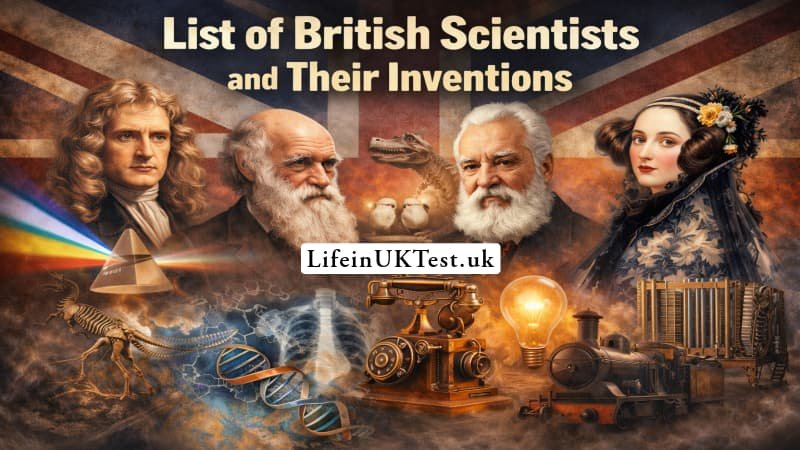
List of British scientists and their inventions – British scientists have played a crucial role in shaping the modern world through groundbreaking discoveries and inventions. From the laws of motion and evolution to life-saving medical breakthroughs and revolutionary technologies, the United Kingdom has produced some of the most influential scientific minds in history.
This article presents a comprehensive list of British scientists and their inventions, highlighting their contributions to science, industry, medicine, and everyday life. Whether you’re a student, researcher, or history enthusiast, this guide explores how British innovation has transformed the world across centuries.
List of British scientists and their inventions
Look, when I first started preparing for the Life in the UK test, the section on British scientists seemed overwhelming. There are so many names and inventions to remember. But here’s what I learned: you don’t need to memorize everything—just the key figures and their groundbreaking work.
British Scientists Who Changed the World: Your Essential Guide for the Life in the UK Test
Let me walk you through the British scientists who’ve genuinely shaped our modern world. These aren’t just names in a textbook. These are people who invented things you probably used today without even thinking about it.
Why This Matters for Your Test
The Life in the UK test loves asking about British contributions to science and technology. You might see questions about who discovered DNA’s structure or who invented the World Wide Web. Getting these right can make the difference between passing and having to retake the exam.
Honestly, once you see how these inventions connect to everyday life, they become much easier to remember.
The Complete List: British Scientists and Their Inventions
Here’s the comprehensive table covering ALL scientists mentioned in the Life in the UK Test handbook. I’ve organized it chronologically because that’s how I found it easiest to memorize:
| Scientist | Invention | Year | Key Terms to Remember | Why It Matters |
|---|---|---|---|---|
| Isaac Newton | Laws of Motion and Gravity | 1687 | Universal gravitation, Principia Mathematica, calculus, reflecting telescope | Foundation of modern physics and mathematics |
| Robert Hooke | Named the cell | 1665 | Microscopy, cell biology, Micrographia | Discovered building blocks of life |
| Robert Boyle | Boyle’s Law (gas pressure) | 1662 | Chemistry, gas laws, pressure and volume | Father of modern chemistry |
| Edward Jenner | Vaccination (smallpox vaccine) | 1796 | Immunization, smallpox, cowpox, pioneer of vaccines | Saved millions of lives, eradicated smallpox |
| Richard Arkwright | Water frame (spinning machine) | 1769 | Industrial Revolution, textile industry, cotton spinning | Revolutionized textile production |
| Michael Faraday | Electromagnetic induction | 1831 | Electricity generation, electric motors, dynamo, Faraday cage | Made electric power generation possible |
| Charles Darwin | Theory of Evolution by Natural Selection | 1859 | Natural selection, Origin of Species, evolution, HMS Beagle | Revolutionized biology and our understanding of life |
| Joseph Lister | Antiseptic surgery | 1867 | Sterilization, infection control, carbolic acid, antiseptics | Made surgery safe and reduced deaths |
| James Clerk Maxwell | Electromagnetic theory | 1860s | Radio waves, electromagnetism, Maxwell’s equations, light | Unified electricity, magnetism and light |
| Lord Kelvin (William Thomson) | Absolute temperature scale | 1848 | Kelvin scale, thermodynamics, absolute zero | Fundamental to physics and engineering |
| Ernest Rutherford | Split the atom | 1917 | Nuclear physics, atomic structure, radioactivity, proton | Father of nuclear physics |
| Alexander Fleming | Penicillin (first antibiotic) | 1928 | Antibiotics, mold, bacterial infections, medicine | First antibiotic, saved countless lives |
| John Logie Baird | Television | 1925-1926 | Mechanical TV, broadcasting, moving images | Created modern television technology |
| Frank Whittle | Jet engine | 1930s (patented 1930) | Turbojet, aviation, aircraft propulsion | Revolutionized air travel |
| Alan Turing | Turing machine, broke Enigma code | 1936-1950s | Computer science, artificial intelligence, codebreaking, Enigma | Father of modern computing and AI |
| Bernard Lovell | Radio telescope (Jodrell Bank) | 1957 | Radio astronomy, space observation, Jodrell Bank Observatory | Pioneered radio astronomy |
| Francis Crick | DNA double helix structure | 1953 | Double helix, genetics, molecular biology, Nobel Prize | Unlocked the genetic code (with Watson) |
| James Watson | DNA double helix structure | 1953 | Double helix, genetics, molecular biology, American-British collaboration | Co-discovered DNA structure with Crick |
| Rosalind Franklin | DNA X-ray crystallography (Photo 51) | 1952 | Photo 51, X-ray diffraction, DNA imaging, unrecognized contribution | Her work was critical to DNA discovery |
| Maurice Wilkins | DNA structure research | 1950s | X-ray diffraction, DNA research, Nobel Prize with Crick & Watson | Shared Nobel Prize for DNA discovery |
| Dorothy Hodgkin | X-ray crystallography of biomolecules | 1940s-1960s | Penicillin structure, insulin structure, vitamin B12, Nobel Prize | Determined structure of important molecules |
| Stephen Hawking | Black hole theory, Hawking radiation | 1970s-2000s | Black holes, cosmology, A Brief History of Time, theoretical physics | Advanced understanding of the universe |
| Tim Berners-Lee | World Wide Web | 1989 | WWW, internet, HTTP, HTML, web browsers, CERN | Created the modern internet as we know it |
| Peter Higgs | Higgs boson theory | 1964 (confirmed 2012) | God particle, mass, particle physics, CERN, Nobel Prize | Explained how particles acquire mass |
| Robert Watson-Watt | Radar development | 1930s | Radar, World War II, aircraft detection, radio waves | Critical for British defense in WWII |
| Christopher Cockerell | Hovercraft | 1950s | Air cushion vehicle, amphibious transport | Invented practical hovercraft technology |
| John Harrison | Marine chronometer | 1735-1773 | Longitude problem, naval navigation, precise timekeeping | Solved the longitude problem for navigation |
| Isambard Kingdom Brunel | Engineering innovations (bridges, railways, ships) | 1800s | Great Western Railway, SS Great Britain, Clifton Suspension Bridge | Greatest engineer of Victorian era |
Breaking Down by Scientific Field
Let me organize this differently so it makes more sense for studying:
| Field | Key British Scientists | Main Contributions |
|---|---|---|
| Physics | Isaac Newton, Michael Faraday, James Clerk Maxwell, Ernest Rutherford, Stephen Hawking, Peter Higgs | Gravity, electricity, electromagnetism, nuclear physics, cosmology, particle physics |
| Medicine & Biology | Edward Jenner, Alexander Fleming, Joseph Lister, Charles Darwin, Dorothy Hodgkin | Vaccines, antibiotics, antiseptics, evolution, molecular structures |
| Genetics & DNA | Francis Crick, James Watson, Rosalind Franklin, Maurice Wilkins, Robert Hooke | DNA structure, cell discovery, genetic understanding |
| Computing & Technology | Alan Turing, Tim Berners-Lee | Modern computing, artificial intelligence, World Wide Web |
| Engineering & Innovation | Richard Arkwright, Frank Whittle, John Logie Baird, Robert Watson-Watt, Christopher Cockerell, Isambard Kingdom Brunel, John Harrison | Industrial machinery, jet engines, television, radar, hovercraft, infrastructure, navigation |
| Chemistry | Robert Boyle, Dorothy Hodgkin | Gas laws, molecular structures |
| Astronomy | Bernard Lovell | Radio astronomy, space observation |
Timeline: When Britain Led the World in Science
| Period | Major Breakthroughs | Key Scientists |
|---|---|---|
| 17th Century | Laws of physics and gravity, cell discovery, gas laws | Newton, Hooke, Boyle |
| 18th Century | Vaccination breakthrough, Industrial Revolution begins, navigation solved | Jenner, Arkwright, Harrison |
| 19th Century | Evolution theory, electricity generation, antiseptic surgery, electromagnetic theory | Darwin, Faraday, Lister, Maxwell, Kelvin |
| Early 20th Century (1900-1930) | Split atom, penicillin discovered, television invented | Rutherford, Fleming, Baird |
| Mid 20th Century (1930-1960) | Jet engine, radar, codebreaking, DNA structure discovered, radio telescope | Whittle, Watson-Watt, Turing, Crick, Watson, Franklin, Lovell |
| Late 20th Century (1960-2000) | Black hole theories, World Wide Web, Higgs boson theory, hovercraft | Hawking, Berners-Lee, Higgs, Cockerell |
| 21st Century | Higgs boson confirmed at CERN | Peter Higgs (Nobel Prize 2013) |
The Absolute Must-Know Scientists for Your Test
Here’s my honest take on which ones appear most frequently in test questions:
| Scientist | What to Remember | Common Test Question |
|---|---|---|
| Isaac Newton | Gravity and laws of motion | “Who discovered gravity?” |
| Edward Jenner | First vaccination (smallpox) | “Who pioneered vaccination?” |
| Charles Darwin | Theory of evolution by natural selection | “Who developed the theory of evolution?” |
| Alexander Fleming | Discovered penicillin | “Who discovered penicillin?” |
| Alan Turing | Father of computing, broke Enigma code | “Who is known as the father of computer science?” |
| Francis Crick & James Watson | Discovered DNA double helix structure | “Who discovered the structure of DNA?” |
| Rosalind Franklin | Photo 51, crucial to DNA discovery | “Which scientist’s work was critical to discovering DNA?” |
| Tim Berners-Lee | Invented World Wide Web | “Who invented the World Wide Web?” |
| Frank Whittle | Invented jet engine | “Who invented the jet engine?” |
| John Logie Baird | Invented television | “Who invented the television?” |
Common Mistakes People Make (And How to Avoid Them)
I’ve seen people confuse these all the time:
Don’t mix up Crick and Watson. Francis Crick was British; James Watson was American. They worked together at Cambridge, but for the UK test, remember Crick as the British half.
Alexander Fleming discovered penicillin, not Alexander Graham Bell. Bell invented the telephone and was Scottish-born but worked in America.
Tim Berners-Lee invented the World Wide Web, not the internet. The internet already existed. He created the way we browse it using websites, browsers, and HTTP.
Rosalind Franklin deserves credit too. Her Photo 51 was essential to discovering DNA’s structure, but Crick, Watson, and Wilkins got the Nobel Prize. She died before the prize was awarded (Nobel Prizes aren’t given posthumously).
Robert Hooke named the cell, he didn’t discover cells themselves. He looked at cork under a microscope and the tiny compartments reminded him of monks’ cells, so he called them cells.
Ernest Rutherford split the atom; he didn’t invent the atomic bomb. That’s a common confusion.
How Victorian and Modern Era Scientists Changed Everything
| Era | Scientific Revolution | Impact on Daily Life |
|---|---|---|
| Victorian Era (1837-1901) | Darwin’s evolution, Faraday’s electricity, Lister’s antiseptics, Maxwell’s electromagnetism | Modern medicine, electric power, understanding of nature |
| Edwardian & WWI Era (1901-1918) | Rutherford splits atom, early aviation advances | Nuclear age begins, transportation evolves |
| Interwar Period (1918-1939) | Fleming discovers penicillin, Baird invents TV, Whittle develops jet engine | Modern medicine, mass communication, faster travel |
| WWII Era (1939-1945) | Turing breaks Enigma, radar developed | Won the war, modern computing begins |
| Post-War (1945-1970) | DNA structure discovered, radio astronomy advances | Genetic revolution, space exploration |
| Modern Era (1970-present) | Hawking’s cosmology, World Wide Web, Higgs boson | Digital revolution, internet age, particle physics |
How to Actually Remember All This
Here’s my honest advice: don’t try to memorize the entire table in one go. That’s a recipe for forgetting everything.
Instead, group them by what they invented:
Medicine Heroes:
- Jenner = vaccines (smallpox)
- Fleming = penicillin (antibiotics)
- Lister = antiseptics (safe surgery)
- Hodgkin = molecular structures (insulin, vitamin B12)
Physics Legends:
- Newton = gravity and motion
- Faraday = electricity generation
- Maxwell = electromagnetic theory
- Rutherford = split the atom
- Hawking = black holes
- Higgs = how particles get mass
Tech Innovators:
- Turing = computers and AI
- Berners-Lee = World Wide Web
- Whittle = jet engine
- Baird = television
- Watson-Watt = radar
- Cockerell = hovercraft
Life Science Pioneers:
- Darwin = evolution
- Hooke = named cells
- Crick & Watson = DNA structure
- Franklin & Wilkins = DNA research
Industrial Revolution Heroes:
- Arkwright = textile machinery
- Brunel = railways, bridges, ships
- Harrison = marine navigation
Chemistry Founders:
- Boyle = gas laws
Astronomy Experts:
- Lovell = radio telescope
Create mental images. When I think of Fleming, I picture moldy bread fighting off germs. For Newton, it’s that apple falling. For Berners-Lee, it’s the entire web connecting the world. These silly associations actually work.
What the Test Actually Asks
The Life in the UK test won’t ask you to write essays about these scientists. You’ll get multiple-choice questions like:
- “Who discovered penicillin?”
- “Who invented the World Wide Web?”
- “Which scientist developed the theory of evolution?”
- “Who is credited with discovering the structure of DNA?”
- “Who invented the jet engine?”
The answers are straightforward if you know the basics. Focus on matching names to their main invention or discovery.
Key Takeaway
British scientists have genuinely changed how we live, from the medicines that keep us healthy to the technology we use every second of the day. For your Life in the UK test, focus on these core connections:
Top Priority Scientists (Most Common in Tests)
| Scientist | Key Discovery/Invention |
|---|---|
| Newton | Gravity and motion |
| Jenner | First vaccine |
| Darwin | Evolution |
| Fleming | Penicillin |
| Turing | Modern computing |
| Crick & Watson (with Franklin) | DNA structure |
| Berners-Lee | World Wide Web |
| Whittle | Jet engine |
Secondary Priority (Still Important)
| Scientist | Key Discovery/Invention |
|---|---|
| Faraday | Electricity generation |
| Lister | Antiseptic surgery |
| Baird | Television |
| Hawking | Black holes |
| Rutherford | Split the atom |
Know These Too
| Scientist | Key Discovery/Invention |
|---|---|
| Arkwright | Industrial Revolution machinery |
| Brunel | Victorian engineering |
| Watson-Watt | Radar |
| Hooke | Named cells |
| Maxwell | Electromagnetic theory |
Get the top priority list locked in your memory, and you’ll handle most science questions confidently. The secondary and additional scientists give you complete coverage for any curveball questions.
The beauty of studying British scientists is that you’re not just memorizing facts for a test—you’re learning about people who’ve shaped the entire modern world. Every time you take medicine, use the internet, or benefit from modern technology, you’re experiencing their legacy.
And when you pass that test? You’ll be joining a country with an incredible tradition of scientific achievement. That’s something worth celebrating.