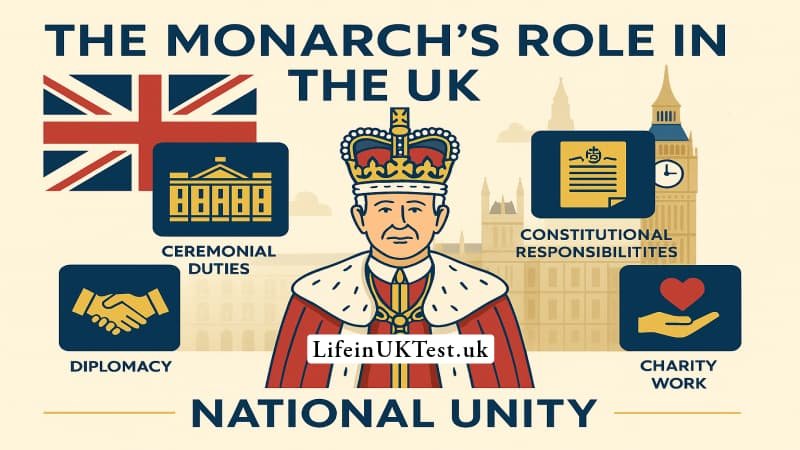
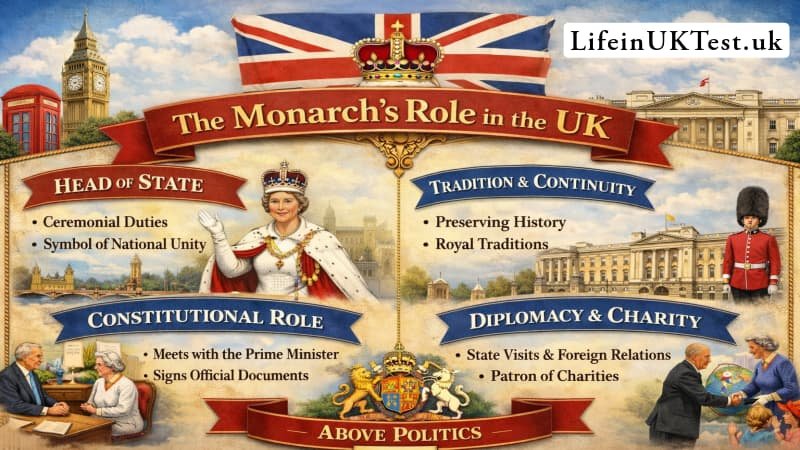
The Monarch’s Role in the UK – The monarch plays an important constitutional role in the United Kingdom, acting as the Head of State while remaining politically neutral. Understanding the monarch’s role in the UK is essential for anyone preparing for the Life in the UK test or learning how the British system of government works. Although the monarch does not govern directly, they carry out key duties such as opening Parliament, giving Royal Assent to laws, and representing the UK at home and abroad.
The Monarch’s Role in the UK: What You Need to Know for 2026
You know what surprises most people preparing for the Life in the UK Test? It’s not the history dates or the cultural facts. It’s understanding what the monarch actually does in modern Britain.
Let’s be real—when you think of King Charles III, you might picture ceremonies, palaces, and fancy carriages. But there’s more to it than just wearing a crown and waving at crowds.
So What Does the Monarch Actually Do?
Here’s the thing: the UK is what we call a constitutional monarchy. That means the monarch is the head of state, but—and this is crucial—they don’t run the country. Parliament does that job.
Think of it like this. The Prime Minister is your manager who makes all the daily decisions. The monarch is more like the company chairman who signs off on things but doesn’t tell everyone what to do.
The monarch’s powers are mostly ceremonial these days. Yes, technically the King has the power to appoint the Prime Minister, dissolve Parliament, and give royal approval to laws. But honestly? He can’t just do whatever he wants. These actions follow strict rules and traditions.
The Weekly Meeting You’ve Never Heard About
Every week, the King meets with the Prime Minister. Just the two of them. No cameras, no recordings, no one else in the room.
During these meetings, the monarch can advise, encourage, and warn. That’s it. Three verbs that sum up the modern monarchy’s political influence. The Prime Minister isn’t obligated to follow the King’s advice, but having decades of experience and a neutral perspective can be valuable.
Royal Assent: The Rubber Stamp That Matters
When Parliament passes a new law, it needs royal assent before becoming official. The last time a monarch refused this? That was in 1708. Queen Anne said no to a Scottish militia bill, and honestly, no one’s done it since.
So while the power exists on paper, it’s essentially a formality now. The monarch doesn’t judge whether laws are good or bad—they just approve what Parliament sends them.
Head of State vs Head of Government
This confuses people all the time, so let me break it down simply:
| Position | Who Holds It | Main Powers | Accountability |
|---|---|---|---|
| Head of State | The Monarch (King Charles III) | Ceremonial duties, royal assent, appointing PM, dissolving Parliament | Not accountable to Parliament; acts on government advice |
| Head of Government | The Prime Minister | Policy decisions, running departments, proposing laws, leading party | Accountable to Parliament and voters |
Two different jobs. The monarch stays above politics—no voting, no public opinions on policies, no taking sides. The Prime Minister? That’s where the real political power sits.
What Happens When a New Monarch Takes Over?
When Queen Elizabeth II died in September 2022, her son immediately became King Charles III. There’s no gap, no election, no application process. The moment one monarch dies, the next one automatically takes the throne.
The official coronation ceremony came later in May 2023, but Charles was already King from day one. The coronation is the formal celebration, not the moment he gained the title.
The Monarch’s Constitutional Powers
Let me show you what powers the monarch technically has, versus what actually happens in practice:
| Constitutional Power | What It Means | Reality in 2026 |
|---|---|---|
| Appointing the Prime Minister | The King invites someone to form a government | Always the leader of the party with most MPs—no personal choice involved |
| Dissolving Parliament | The King can end a parliamentary session | Only happens on PM’s advice or after a fixed term |
| Royal Assent | The King must approve all laws | Automatically given; last refusal was 1708 |
| Appointing Ministers | The King appoints government ministers | Appointed on PM’s recommendation only |
| Declaring War | The King can declare war/make peace | Parliament and government make these decisions |
| Granting Honours | The King awards titles and honours | Recipients chosen by government committees |
Notice a pattern? The monarch has these powers on paper, but Parliament and the government guide every single decision.
The Monarch’s Other Roles
Beyond politics, the monarch wears several other hats:
Head of the Armed Forces: All military members swear allegiance to the Crown, not to the government. The King is the commander-in-chief, though actual military decisions come from the government.
Head of the Church of England: The monarch holds the title “Defender of the Faith.” They appoint bishops and archbishops based on the Prime Minister’s recommendations.
Head of the Commonwealth: King Charles III leads the Commonwealth of Nations, a voluntary association of 56 independent countries. This role involves promoting cooperation and shared values among member states.
Patron of Charities: The Royal Family supports hundreds of charities and organizations. This work raises awareness and funds for important causes across the UK.
Breaking Down the Monarch’s Weekly Schedule
People always ask—what does the King actually do day-to-day? Here’s a realistic breakdown:
| Activity Type | Examples | Frequency |
|---|---|---|
| State Duties | Meeting the PM, signing documents, royal assent | Weekly/as needed |
| Ceremonial Events | State Opening of Parliament, Trooping the Colour, Remembrance Sunday | Annual/seasonal |
| Diplomatic Work | Hosting foreign leaders, state visits abroad, receptions | Monthly |
| Charity Work | Visiting organizations, attending fundraisers, patronage events | Weekly |
| Audiences | Meeting ambassadors, military leaders, and other officials | Several per week |
| Regional Visits | Touring different parts of the UK | Regular throughout year |
The Civil List and Sovereign Grant
Let’s talk money because this comes up in conversations all the time.
The monarch doesn’t get a salary like you or me. Instead, there’s something called the Sovereign Grant, which covers official duties, staff, palace upkeep, and travel.
| Funding Aspect | Details |
|---|---|
| Source | Profits from the Crown Estate (royal-owned properties managed by government) |
| Percentage | 25% of Crown Estate profits (increased from 15% for Buckingham Palace renovations) |
| What It Covers | Official duties, staff salaries, palace maintenance, official travel |
| What It Doesn’t Cover | Private expenses, which come from private income (Duchy of Lancaster) |
| Accountability | Published annually in the Sovereign Grant Report |
In 2026, debates about royal finances continue, but the system remains largely unchanged from recent years. All spending is documented and publicly available.
Political Neutrality: The Golden Rule
Here’s something you absolutely need to understand for the Life in the UK Test and for life in Britain: the monarch must remain politically neutral.
No campaigning. No endorsing candidates. No public statements about government policies. When people criticize the government, the monarch stays silent. When elections happen, the monarch doesn’t vote.
This neutrality lets the monarchy survive regardless of which party wins elections. It’s how the institution has lasted this long in a democratic society.
The Line of Succession (2026)
| Position | Name | Relationship to King Charles III |
|---|---|---|
| 1st | Prince William | Son |
| 2nd | Prince George | Grandson |
| 3rd | Princess Charlotte | Granddaughter |
| 4th | Prince Louis | Grandson |
| 5th | Prince Harry | Son |
| 6th | Prince Archie | Grandson |
| 7th | Princess Lilibet | Granddaughter |
| 8th | Prince Andrew | Brother |
The rules changed in 2013 with the Succession to the Crown Act. Now the oldest child inherits the throne regardless of gender. Before that change, younger brothers would have jumped ahead of older sisters. This is why Princess Charlotte remains ahead of her younger brother Prince Louis.
The Commonwealth and the Monarchy
| Aspect | Details |
|---|---|
| Number of Countries | 56 independent nations |
| Population | Approximately 2.5 billion people |
| Commonwealth Realms | 15 countries where the King is head of state (including UK, Canada, Australia, New Zealand) |
| Republics in Commonwealth | 36 countries (like India, South Africa) where King is NOT head of state |
| King’s Role | Symbolic head; promotes cooperation but has no governing power |
| Membership | Voluntary; countries can leave if they choose |
Common Mistakes People Make
Mistake #1: Thinking the monarch runs the government. Nope. Parliament does that.
Mistake #2: Believing the King can refuse to sign laws he doesn’t like. Technically possible, but hasn’t happened in over 300 years.
Mistake #3: Assuming the monarchy has no purpose. Even in 2026, many British people value the stability, tradition, and diplomatic role the monarchy provides.
Mistake #4: Confusing the Prime Minister’s power with the monarch’s power. Remember—the PM has the real political authority.
Mistake #5: Thinking the monarch can be sued or prosecuted. Under the principle of “sovereign immunity,” the monarch cannot be taken to court for civil or criminal proceedings.
Why This Matters for Your Test
The Life in the UK Test will definitely ask about the monarchy. You might see questions about:
- What type of monarchy Britain has (constitutional)
- The difference between head of state and head of government
- Royal assent and what it means
- The monarch’s relationship with Parliament
- Political neutrality requirements
- The line of succession
- The Commonwealth
Make sure you understand the concepts, not just memorize facts. The test likes to ask questions that need you to actually understand how the system works.
Key Life in the UK Test Facts
| Topic | What You Must Know |
|---|---|
| Type of Monarchy | Constitutional monarchy—monarch is head of state but doesn’t govern |
| Current Monarch | King Charles III (since September 2022) |
| Royal Assent | Monarch’s approval needed for laws; given automatically |
| Political Role | Strictly neutral; cannot vote or express political opinions publicly |
| PM Meetings | Weekly private meetings to advise, encourage, and warn |
| Succession | Automatic; oldest child inherits regardless of gender (since 2013) |
| Church Role | Head of the Church of England |
| Commonwealth | King leads 56-nation voluntary association |
What About the Future?
Public opinion about the monarchy shifts over time. Some people want to keep it, others want a republic. But for now, and certainly for your 2026 Life in the UK Test, the constitutional monarchy remains firmly in place.
King Charles III brought his own style to the role—more focus on environmental issues in his charitable work, a slightly smaller royal household, and efforts to modernize certain aspects of royal life while maintaining core traditions.
Whatever happens politically in the UK, the monarchy adapts. It’s survived civil wars, world wars, political upheavals, and massive social changes. That ability to evolve while staying recognizable is part of why it’s still here.
Key Takeaway
The British monarch in 2026 is a constitutional figurehead with ceremonial powers and symbolic importance. King Charles III represents the nation, provides continuity, and performs official duties, but Parliament and the Prime Minister hold the real political power. The monarchy stays neutral in politics, signs laws without refusal, and adapts to modern expectations while maintaining centuries-old traditions. For the Life in the UK Test, remember this: the UK is a constitutional monarchy where the King reigns but does not rule.
Understanding this balance between tradition and democracy is essential—not just for passing your test, but for genuinely understanding how Britain works today.
Official References and Resources
All information in this article is based on official government and royal sources. For further reading and verification:
Official Royal Websites
| Resource | Website | Purpose |
|---|---|---|
| The Royal Family Official Website | https://www.royal.uk | Official information about the monarchy, duties, history, and news |
| The Royal Household | https://www.royal.uk/inside-the-royal-household | Details about how the monarchy operates and staff structure |
| Sovereign Grant Reports | https://www.royal.uk/media-centre/financial-reports | Annual financial transparency reports |
| The Commonwealth | https://thecommonwealth.org | Official Commonwealth organization website |
Government Resources
| Resource | Website | Purpose |
|---|---|---|
| UK Parliament | https://www.parliament.uk/about/how/role/relations-with-other-institutions/parliament-crown/ | Explains Parliament’s relationship with the Crown |
| GOV.UK – The Monarchy | https://history.blog.gov.uk/category/the-monarchy/ | Government information about the constitutional role |
| UK Parliament – Royal Assent | https://www.parliament.uk/about/how/laws/passage-bill/lords/lrds-royal-assent/ | How royal assent works in law-making |
Life in the UK Test Preparation
| Resource | Website | Purpose |
|---|---|---|
| Official Life in the UK Test | https://www.gov.uk/life-in-the-uk-test | Official government page for test booking and information |
| Life in the UK Handbook (3rd Edition) | Available from TSO (The Stationery Office) | The official study guide for the test |
Important Note: This article is written for educational purposes to help people prepare for the Life in the UK Test. All constitutional and factual information has been carefully researched from official sources. The monarchy’s role is defined by constitutional conventions, statutes, and centuries of practice. When in doubt, always refer to the official resources listed above.
Disclaimer: While every effort has been made to ensure accuracy, the UK constitutional system evolves through practice and convention. For legal advice or official information about citizenship, visas, or the Life in the UK Test, always consult official government sources at GOV.UK or seek professional legal counsel.