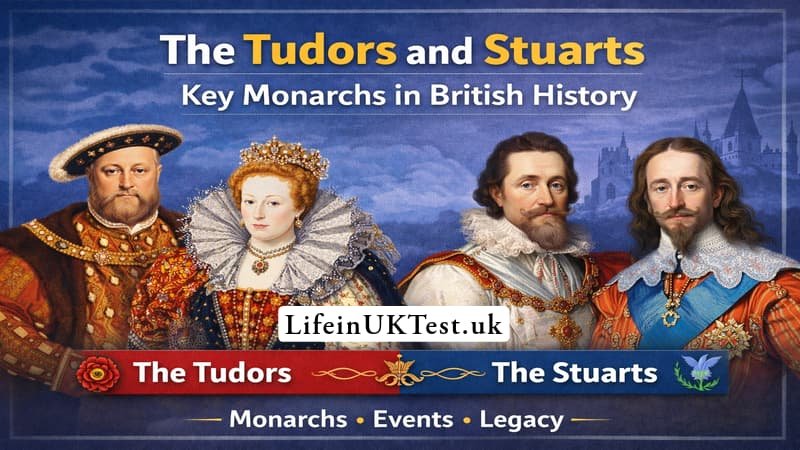
The Tudors and Stuarts were two of the most influential royal dynasties in British history, shaping England’s monarchy, religion, and political system between the 15th and 18th centuries. From Henry VII and Henry VIII to Elizabeth I, and from James I to Charles I and the Glorious Revolution, these eras were marked by dramatic change, religious conflict, and the growth of parliamentary power. This guide explores the Tudor and Stuart periods in detail, highlighting key monarchs, major events, and their lasting impact on the history of England and the United Kingdom.
Let’s discuss Tudors and Stuarts – Key Monarchs, Events, and Legacy in British History.
The Tudors and Stuarts: When England Got Really Interesting
Look, I’ll be honest with you—when I first heard about the Tudors and Stuarts, I thought it would be another dry history lesson about dusty old monarchs. Turns out, this period from 1485 to 1714 is basically the original drama series, complete with beheadings, religious chaos, and enough family dysfunction to fill a dozen reality TV shows.
Why These Two Families Matter
Here’s the thing: the Tudors and Stuarts didn’t just wear crowns and wave from balconies. These people fundamentally rewired England in ways we still feel today. The Tudors kicked things off in 1485 when Henry VII won the Battle of Bosworth Field. The Stuarts wrapped up their messy run in 1714 when Queen Anne died without an heir.
What happened between those dates? Absolute chaos, brilliance, and transformation.
The Tudor Dynasty (1485-1603)
| Monarch | Reign | What They’re Known For | The Drama |
|---|---|---|---|
| Henry VII | 1485-1509 | Ended Wars of Roses, stabilized kingdom | Won throne in battle, married his enemy’s daughter |
| Henry VIII | 1509-1547 | Created Church of England | Six wives, broke from Rome, seized monastery lands |
| Edward VI | 1547-1553 | Pushed Protestant reforms | Became king at 9, died at 15 |
| Mary I | 1553-1558 | Tried restoring Catholicism | Burned 280 Protestants, earned “Bloody Mary” nickname |
| Elizabeth I | 1558-1603 | Defeated Spanish Armada, Shakespeare era | Never married, ruled 45 years, made England a power player |
Henry VII: The Guy Who Actually Started It All
Henry VII (1485-1509) was the ultimate underdog. After years of civil war—the Wars of the Roses, which sounds way prettier than the brutal reality—he defeated Richard III and married Elizabeth of York. By uniting the Lancaster and York families, he basically forced everyone to stop fighting.
But nobody really remembers Henry VII as much as they remember his son.
Henry VIII: More Than Just Six Wives
Henry VIII (1509-1547) is the one everyone knows. Six wives. We’ve all heard it: divorced, beheaded, died, divorced, beheaded, survived. But here’s what’s wild—the man was so desperate for a male heir that he created an entirely new church just to get a divorce. The Pope refused, so Henry essentially said, “Fine, I’ll be my own Pope.”
Henry VIII’s Six Wives
| Wife | Married | What Happened | The Real Story |
|---|---|---|---|
| Catherine of Aragon | 1509-1533 | Divorced | Spanish princess, gave him a daughter (Mary), not the son he wanted |
| Anne Boleyn | 1533-1536 | Beheaded | Mother of Elizabeth I, accused of adultery and treason |
| Jane Seymour | 1536-1537 | Died | Finally gave him a son (Edward), died days after childbirth |
| Anne of Cleves | 1540 | Divorced | Henry called her “The Flanders Mare,” marriage lasted six months |
| Catherine Howard | 1540-1542 | Beheaded | Teenage bride, executed for alleged adultery |
| Catherine Parr | 1543-1547 | Survived | Outlived Henry, was actually married four times in total |
This wasn’t just marital drama. The English Reformation completely upended society. Monasteries were destroyed, church property was seized, and England severed ties with Catholic Rome. Imagine the chaos—one day you’re attending Mass in Latin at your local monastery, the next that monastery is being demolished and its treasures sold off.
Three Siblings, Three Completely Different Englands
Edward VI (1547-1553) was only nine when he became king. The kid was sickly from the start and surrounded by Protestant advisors who pushed England even further from Catholicism. He died at fifteen.
Mary I (1553-1558) earned the nickname “Bloody Mary” for a reason. A devoted Catholic, she tried reversing the Reformation by force. About 280 Protestants were burned at the stake during her five-year reign. Not her best legacy.
Then came Elizabeth I (1558-1603), and this is where England really found its footing. The “Virgin Queen” ruled for 45 years without marrying, which was unheard of for a female monarch. She found a middle ground on religion, defeated the Spanish Armada in 1588, and presided over what we now call the English Renaissance. Shakespeare wrote his plays during her reign. England became a serious European power.
The Stuart Dynasty (1603-1714)
| Monarch | Reign | Their Big Move | How It Ended |
|---|---|---|---|
| James I | 1603-1625 | United English & Scottish crowns | Died naturally, left a powder keg |
| Charles I | 1625-1649 | Sparked English Civil War | Executed by his own Parliament |
| Commonwealth | 1649-1660 | Cromwell’s joyless military state | Everyone got sick of it |
| Charles II | 1660-1685 | Brought back the fun, rebuilt London | Died naturally, no legitimate heir |
| James II | 1685-1688 | Tried forcing Catholicism on England | Fled to France in the night |
| William III & Mary II | 1689-1702 | Accepted limits on royal power | Mary died 1694, William ruled alone till 1702 |
| Anne | 1702-1714 | United England & Scotland officially | Died childless after 17 tragic pregnancies |
James I and His Divine Right Nonsense
When Elizabeth died childless, the throne passed to her cousin’s son, James VI of Scotland, who became James I of England (1603-1625). England and Scotland now shared a monarch, though they stayed separate kingdoms.
James believed in the “Divine Right of Kings”—basically, that monarchs answer only to God, not Parliament. Parliament wasn’t thrilled with this idea. James also spent money like water, which didn’t help his relationship with the people who controlled the purse strings.
Charles I: When Stubbornness Costs You Your Head
Charles I (1625-1649) inherited his father’s belief in divine right but had zero skill at political maneuvering. He dissolved Parliament repeatedly, tried ruling without them for eleven years, and eventually triggered the English Civil War (1642-1651).
Parliament won. They put their own king on trial for treason and beheaded him in 1649. England became a Commonwealth under Oliver Cromwell, who ruled as a military dictator. Cromwell banned Christmas, shut down theaters, and made life pretty miserable for most people.
When Cromwell died in 1658, everyone was so fed up they invited Charles I’s son back from exile.
The Merry Monarch and His Not-So-Merry Brother
Charles II (1660-1685) had learned some lessons from his father’s execution. He was charming, knew when to compromise, and brought back all the stuff Cromwell banned. Theaters reopened, the arts flourished again, and after the Great Fire of 1666, London was rebuilt with stunning new architecture.
James II (1685-1688) was Charles’s Catholic brother, and he immediately proved why everyone had been nervous. He tried aggressively promoting Catholicism in a Protestant country. Parliament decided they’d had enough of problematic Stuarts and invited his Protestant daughter Mary and her Dutch husband William to take over.
The “Glorious Revolution” of 1688 was relatively bloodless—James fled to France, and William III and Mary II (1689-1702) became joint monarchs. But they had to accept the Bill of Rights 1689, which permanently limited what monarchs could do. Parliament now held ultimate authority. Game-changing stuff.
Anne (1702-1714) was the last Stuart. She presided over the Acts of Union 1707, which officially merged England and Scotland into Great Britain. Tragically, despite seventeen pregnancies, none of her children survived to adulthood. When she died, the throne went to a distant German cousin, ending the Stuart line.
The Religious Whiplash Timeline
| Period | Religion | What Changed |
|---|---|---|
| Before 1534 | Catholic | Standard Roman Catholic everything |
| 1534-1547 | Protestant-ish | Henry VIII breaks from Rome but keeps Catholic-style worship |
| 1547-1553 | Hardcore Protestant | Edward VI’s advisors push extreme reforms |
| 1553-1558 | Back to Catholic | Mary I reverses everything, burns Protestants |
| 1558-1603 | Moderate Protestant | Elizabeth I’s practical “middle way” |
| 1603-1640s | Protestant with tensions | Anglicans vs. Puritans fighting |
| 1649-1660 | Puritan | Cromwell’s strict, joyless version |
| 1660-1688 | Anglican officially | But Catholic fears everywhere |
| 1688 onwards | Protestant locked in | Bill of Rights bans Catholic monarchs |
What Changed Beyond the Palace Walls
Politically, England transformed from a country where monarchs did basically whatever they wanted to a constitutional monarchy where Parliament called the shots. The English Civil War and Glorious Revolution weren’t just dramatic events—they fundamentally shifted where power lived.
Cultural Stuff Worth Knowing About
| Achievement | When | Why You Should Care |
|---|---|---|
| Shakespeare’s plays | 1590s-1610s | Created works still performed everywhere today |
| King James Bible | 1611 | Shaped how English speakers write and talk |
| Spanish Armada defeat | 1588 | Made England a naval superpower |
| Scientific breakthroughs | 1600s | William Harvey figured out blood circulation, Newton revolutionized physics |
| London’s rebuilding | 1666-1670s | Christopher Wren’s architectural masterpieces after the Great Fire |
| Colonial expansion | Throughout | Planted seeds of the British Empire |
Setting the Record Straight
The Tudors weren’t all bloodthirsty tyrants. Henry VIII and Mary I get the headlines, but Elizabeth I was actually a skilled diplomat who avoided war when she could.
The Civil War wasn’t just about religion. Money, constitutional principles, regional rivalries, and personal grudges all played parts. It’s messier than “Catholics vs. Protestants.”
The Stuarts weren’t complete idiots. They faced genuinely tough situations—managing multiple kingdoms, navigating intense religious divisions, dealing with an increasingly powerful Parliament. Some handled it better than others, sure, but the challenges were real.
Why Any of This Still Matters
The Tudors and Stuarts created the framework for modern Britain. Constitutional monarchy, the Church of England, the union of England and Scotland, parliamentary supremacy—it all traces back to this period.
Their cultural impact still echoes. Shakespeare’s plays are performed worldwide. The King James Bible influenced English literature for centuries. The legal and political precedents from this era shaped democracies around the globe, including America’s system.
These weren’t inevitable success stories or grand historical narratives. They were real people making decisions—sometimes brilliant, sometimes catastrophic—that happened to reshape the world. The Tudor who created a church to get a divorce. The Stuart king who lost his head. The queen who never married but made England great.
That’s what makes their story worth remembering. It’s messy, human, and surprisingly relevant to how we think about power and governance today.