Understanding the UK’s Earned Settlement Consultation
The UK Home Office launched a groundbreaking consultation on 20 November 2025, fundamentally reshaping how migrants can obtain Indefinite Leave to Remain (ILR) in the United Kingdom. This consultation, which closes on 12 February 2026, represents the most significant overhaul of the UK’s settlement system in five decades.
Earned Settlement Consultation Survey Link
To access earned settlement consultation survey
- Go to – UK Gov earned-settlement and click on Respond online. OR
- Direct access from this ukhomeoffice link.
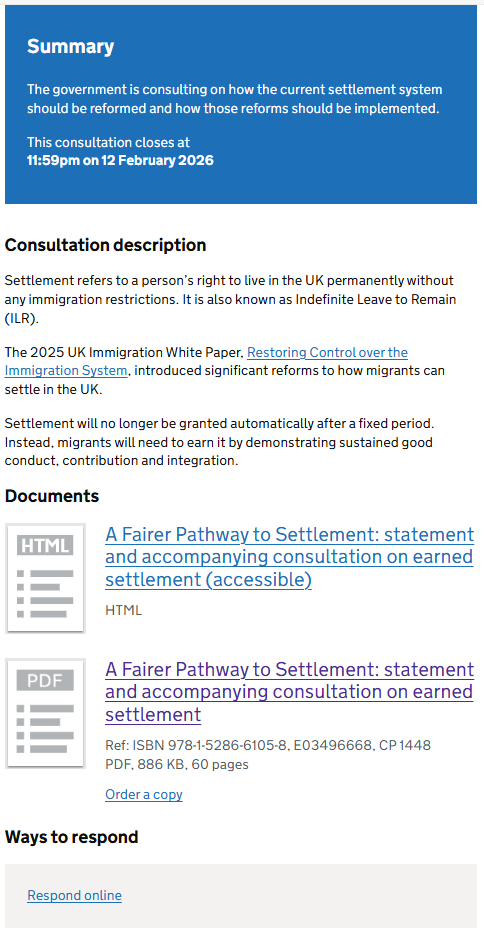
https://www.gov.uk/government/consultations/earned-settlement
What is Earned Settlement?
Earned settlement transforms the UK immigration system from an automatic time-based model to one where permanent residency must be earned through demonstrable contributions to British society. Instead of automatically qualifying after five years, applicants will now need to prove their value through character, contribution, integration, and continuous residence.
This reform follows the May 2025 Immigration White Paper “Restoring Control over the Immigration System” and addresses concerns about unprecedented migration levels between 2021-2024, which saw approximately 2.6 million more arrivals than departures.
The Four Core Pillars of Earned Settlement
1. Character
Applicants must demonstrate sustained good conduct and meet suitability requirements outlined in Part 9 of the Immigration Rules. This includes:
- Clean criminal record throughout residence
- Compliance with all immigration requirements
- No involvement in activities contrary to public good
- Financial responsibility with no outstanding UK debts
2. Contribution
Economic contribution to British society will be measured through:
- Continuous National Insurance contributions
- Minimum earnings thresholds
- Tax compliance
- Limited or no reliance on public funds
3. Integration
Meaningful engagement with UK society requires:
- English language proficiency at B2 level (upper intermediate) – equivalent to A-level standard
- Passing the Life in the UK test
- Demonstrated understanding of British values and customs
- Active participation in community life
4. Continuous Residence
Lawful, unbroken residence in the UK throughout the qualifying period, with specific limits on absences.
New Qualifying Periods: From 5 to 30 Years
Baseline Qualifying Period: 10 Years
Most migrants will face a baseline 10-year qualifying period, double the current five years.
Extended Period: 15 Years
Lower-skilled workers (RQF levels 3-5) and Health and Care visa holders face a 15-year baseline.
Reductions to Baseline (Fastest Routes):
3 Years:
- Income above £125,140 for 3 years (top tax rate)
- Global Talent visa holders
- Innovator Founders
5 Years:
- Income above £50,270 for 3 years (higher tax rate)
- NHS and public service workers
- Teaching professionals
5-7 Years:
- Significant volunteering (subject to consultation)
9 Years:
- English proficiency at degree level (C1 standard)
Increases to Baseline Period:
15 Years:
- Receipt of public funds for less than 12 months
20 Years:
- Receipt of public funds for more than 12 months
- Refugees on core protection status
30 Years:
- Illegal entry to the UK
- First entry on visitor visa (subsequently switching)
- Overstaying by six months or more
Home Office Consultation Survey Questions & Sample Answers
Section 1: About You
Question: Are you responding as an individual or as a representative of an organisation?
Sample Answer: “I am responding as an individual currently in the UK on a Skilled Worker visa, concerned about how these proposed changes will affect my family’s future and settlement prospects.”
Section 2: Character Requirements
Question: Do you have any comments on how ‘Character’ should be considered in relation to settlement? (Max 200 words)
Sample Answer: “While maintaining character requirements is essential for public confidence in the immigration system, the proposals lack clarity on minor infractions. A clear framework distinguishing between serious criminal conduct and minor administrative breaches would ensure fairness. For instance, a single late visa renewal due to postal delays should not carry the same weight as deliberate non-compliance.
The requirement for ‘no UK debts’ needs careful definition. Does this include disputed parking fines or contested charges? Many migrants face exploitation by unscrupulous landlords or employers, leading to debts not of their making.
I support robust character checks but recommend:
- Clear guidelines on what constitutes disqualifying conduct
- Appeals process for disputed matters
- Recognition that administrative errors differ from intentional rule-breaking
- Protection for victims of exploitation or domestic abuse who may have debt circumstances beyond their control
The system should distinguish between those who pose genuine risks and those caught in complex situations, ensuring character assessments are both rigorous and fair.”
Section 3: Integration Requirements
Question: The government proposes requiring applicants to speak English at B2 level (upper intermediate). Do you agree with this proposal?
Sample Answer Options:
If you agree: “Yes, I agree that B2-level English proficiency supports meaningful integration. This standard enables participation in professional environments, community activities, and civic life. However, the government should provide accessible, affordable English language courses and ensure testing accommodations for individuals with learning disabilities or those who face barriers due to age or educational background.”
If you disagree: “No, while language proficiency is important, B2 level is unnecessarily restrictive. Many successful, contributing migrants operate effectively at B1 level in their daily lives and employment. This requirement may disproportionately affect older migrants, those from non-English speaking backgrounds, or individuals with learning difficulties. A more flexible approach recognizing different pathways to integration would be fairer.”
Question: Should the Life in the UK test continue to be required?
Sample Answer: “The Life in the UK test should be retained but reformed. Currently, it focuses heavily on historical trivia rather than practical knowledge about British institutions, rights, responsibilities, and contemporary society. The test should assess understanding of the UK legal system, democratic processes, healthcare access, education system, and community participation rather than obscure historical dates. This would better serve its purpose of confirming genuine integration readiness.”
Section 4: Contribution and Economic Requirements
Question: Do you agree with using salary thresholds to determine qualifying periods for settlement?
Sample Answer Options:
If you support with reservations: “I partially agree but with significant concerns. While recognizing high earners’ tax contributions makes sense, this approach:
- Ignores regional salary variations – £50,270 means something vastly different in London versus northern England
- Devalues essential workers (teachers, nurses, social workers) whose societal contribution extends beyond salary
- Discriminates against those in caring responsibilities or studying for professional qualifications
- Fails to account for career progression – someone earning £30,000 today may earn £60,000 in three years
I recommend:
- Regional salary adjustments
- Recognition of career progression trajectories
- Alternative contribution measures (community service, professional qualifications)
- Protected pathways for essential public sector workers regardless of salary”
Question: How should National Insurance contributions be assessed?
Sample Answer: “NI contributions should be assessed over the entire qualifying period with some flexibility. The system should:
- Count all contributions, not just continuous employment
- Recognize maternity/paternity leave periods
- Accommodate career breaks for caring responsibilities or illness
- Consider total contributions rather than rigid annual requirements
- Account for self-employed workers whose contributions differ from employed persons
Contributions should demonstrate sustained economic participation rather than penalizing natural career fluctuations.”
Section 5: Public Funds and Settlement
Question: Do you agree with adding 5-10 years to the qualifying period for those who receive public funds?
Sample Answer: “No, this proposal is fundamentally unjust for several reasons:
First, many public fund claimants are temporary circumstances – job loss, illness, or caring for sick family members. Penalizing people for life circumstances creates a two-tier system based on luck rather than character.
Second, many migrants pay significantly more in taxes than they receive in benefits. A person who pays £100,000 in taxes over eight years but claims £3,000 Universal Credit during a three-month job search would face 15-year qualifying periods – this is disproportionate.
Third, the policy discourages integration. People may avoid claiming legitimate entitlements, leading to poverty, exploitation, and health issues.
Finally, it impacts children disproportionately. Families may refuse Child Benefit to which they’re entitled, disadvantaging children.
Recommended approach:
- Net contribution assessment (taxes paid minus benefits received)
- Time-limited exemptions for unavoidable circumstances
- Protection for children’s benefits
- Recognition that welfare states exist to catch people during temporary hardship”
Section 6: Qualifying Period for Lower-Skilled Workers
Question: Do you agree with a 15-year qualifying period for workers in RQF 3-5 occupations?
Sample Answer: “No, this proposal is discriminatory and economically counterproductive. Care workers, hospitality staff, and other essential workers contribute enormously to society yet would face triple the qualifying period of higher-skilled workers.
This creates several problems:
Workforce Impact: The UK faces critical shortages in social care. A 15-year pathway will deter workers, worsening staffing crises in essential sectors.
Fairness Issues: Contribution to society cannot be measured solely by qualification level. A care worker providing dignified end-of-life care contributes as meaningfully as a software engineer.
Family Impact: Many affected workers have young children who would grow up in uncertainty for 15 years.
Skill Classification Errors: Many workers sponsored under RQF 3-5 codes actually perform level 6 work but were misclassified by employers unaware of consequences.
Economic Contribution: These workers pay taxes, NI contributions, and support local economies. Their qualification level doesn’t diminish their economic contribution.
Recommended approach: Maintain 10-year baseline for all workers, with reductions based on actual contribution measures rather than arbitrary skill classifications.”
Section 7: Transitional Arrangements
Question: Should there be transitional arrangements for people already in the UK on the pathway to settlement?
Sample Answer: “Yes, transitional arrangements are absolutely essential for fairness and legal certainty. People who came to the UK under five-year settlement rules made life-changing decisions based on those terms – purchasing homes, having children, building careers. Retrospectively changing these rules constitutes bad faith.
Proposed transitional framework:
Protected Group 1: Anyone with 3+ years continuous residence by April 2026 should retain five-year qualifying periods with original requirements.
Protected Group 2: Those with 1-3 years residence should have a seven-year qualifying period maximum.
New Arrivals: Only those arriving after the rule changes should face ten-year baselines.
This approach:
- Honors legitimate expectations
- Protects families who planned their futures
- Maintains UK’s reputation for fair dealing
- Prevents legal challenges based on legitimate expectations
- Recognizes that people cannot change decisions already made (property purchases, children’s schooling)
Without transitional protection, the UK risks widespread legal challenges and reputational damage as a destination that doesn’t honor its commitments.”
Section 8: Special Groups
Question: Should children born in the UK have different settlement requirements?
Sample Answer: “Yes, children born and raised in the UK should have preferential settlement pathways. By age 10, a child born in the UK has spent their entire remembered life as British in everything but legal status. They attend British schools, have British friends, and identify as British.
Proposed approach:
- Children born in UK and resident for 7+ years: automatic settlement eligibility
- Children arriving before age 5 and resident for 10+ years: settlement eligibility
- Protection from parents’ negative factors (e.g., benefit receipt shouldn’t affect children)
- Best interests consideration in all cases
The current proposal risks creating a generation of young people stateless in the only country they’ve ever known. This contradicts Article 3 of the UN Convention on the Rights of the Child, which requires decisions to prioritize children’s best interests.”
Question: Should refugees have different settlement pathways?
Sample Answer: “Yes, refugees require distinct settlement pathways. The proposed 20-year period for core protection status contradicts the UK’s humanitarian obligations.
Refugees flee persecution – they did not choose to leave their countries. Penalizing them with 20-year qualifying periods:
- Contradicts the 1951 Refugee Convention’s spirit
- Creates prolonged uncertainty for traumatized individuals
- Prevents meaningful integration and recovery
- Affects children who grow up in limbo
Recommended approach:
- Maintain 5-year qualifying period for refugees
- Support integration through language courses, employment support
- Recognize that refugees’ forced displacement differs fundamentally from voluntary migration
The UK should lead in refugee protection, not create the longest qualifying periods in the developed world.”
Section 9: Settlement and Public Funds Access
Question: Should those granted settlement continue to have ‘no recourse to public funds’ restrictions?
Sample Answer: “No, this proposal fundamentally misunderstands what ‘settlement’ means. Indefinite Leave to Remain has always meant full membership in UK society, including safety net access.
This proposal creates second-class permanent residents who:
- Pay full taxes but receive fewer benefits
- Cannot access unemployment support during job searches
- Face poverty traps and exploitation
- Cannot claim child benefits for British-born children
This is economically irrational – most settled migrants are net contributors who rarely claim benefits. Creating restrictions:
- Increases poverty and homelessness
- Discourages reporting of workplace exploitation
- Forces people to remain in abusive relationships
- Creates public health risks (avoiding NHS preventive care)
True integration means full participation in society, including both responsibilities (taxes) and rights (safety net access). Settled migrants should have identical rights to British citizens except voting.”
Section 10: Impact on Your Circumstances
Question: How would these proposals affect you, your family, or your organisation?
Sample Answer for Individual: “These proposals would devastatingly impact my family. I arrived in 2023 on a Skilled Worker visa, planning for settlement in 2028. My wife and I purchased a home, our children attend local schools, and we are active community members.
Under new proposals:
- Our settlement timeline extends to 2033 or later
- We face £20,000+ in additional visa fees
- Our children will spend their entire childhoods in uncertainty
- We cannot plan for retirement or higher education
- Job mobility becomes impossible – changing employers risks visa issues
- We fear retroactive application despite our legitimate expectations
Financial impact: An additional five years means approximately £15,000 in visa fees, £10,000 in Immigration Skills Charge, £5,000 in NHS surcharges, and £2,000 in ancillary costs – £32,000 total we hadn’t budgeted.
Psychological impact: Constant uncertainty affects mental health, children’s wellbeing, and prevents feeling ‘at home’ in our community.
We urge the government to protect those already on the settlement pathway with transitional arrangements.”
Sample Answer for Employer: “As a healthcare employer sponsoring 200+ international workers, these proposals will severely impact recruitment and retention.
Specific impacts:
- 15-year qualifying periods for care workers make UK positions unattractive compared to Canada (3 years), Australia (4 years)
- Extended sponsorship periods cost £2.5 million additional in Immigration Skills Charge alone
- Workers seek opportunities in other countries with faster settlement
- Training investments are lost when workers leave due to uncertainty
- Patient care suffers from increased turnover
We face a care worker shortage of 150,000 nationally. These proposals worsen the crisis rather than addressing it.
Recommendations:
- Retain 5-year pathways for essential healthcare workers
- Recognize healthcare work’s societal value beyond salary
- Provide employer certainty for workforce planning
- Exempt shortage occupations from extended periods”
Section 11: Additional Comments
Question: Do you have any other comments about the earned settlement proposals?
Sample Answer: “While the government’s desire to ensure meaningful contribution is understandable, these proposals risk causing severe unintended consequences:
1. Brain Drain: Talented migrants will choose Canada, Australia, or Europe over decade-long UK uncertainty.
2. Economic Impact: Extended sponsorship costs discourage employers from hiring skilled workers, harming competitiveness.
3. Social Cohesion: Prolonged temporary status prevents integration – people cannot fully invest in communities they may need to leave.
4. Fairness Concerns: Retrospective application breaks fundamental legal principles of legitimate expectations.
5. Children’s Welfare: Growing up in immigration limbo affects mental health and life planning.
6. Administrative Burden: Complex points-based systems create massive bureaucracy.
Constructive Recommendations:
- Retain 5-year baselines for all migrants
- Assess contribution holistically, not solely through salary
- Provide clear, predictable pathways
- Honor commitments to those already in the system
- Focus enforcement on those who breach rules, not those contributing positively
- Benchmark against competitor countries to avoid brain drain
The UK should welcome and retain talented, hardworking migrants – not create the developed world’s most restrictive settlement system.”
How to Complete the Survey Effectively
1. Access the Survey
Visit: https://ukhomeoffice.qualtrics.com/jfe/form/SV_1yMmiaG7zqwPuM6
2. Prepare Your Response
- Read the full consultation document
- Consider your personal circumstances
- Gather relevant documentation
- Note specific impacts on you or your organization
3. Be Specific and Evidence-Based
- Use concrete examples
- Reference specific costs, timelines, impacts
- Cite relevant laws, conventions, or precedents
- Provide alternatives, not just criticism
4. Stay Within Word Limits
Most open-ended questions have 200-word limits. Be concise but comprehensive.
5. Maintain Professional Tone
- Be respectful but firm
- Focus on practical impacts
- Suggest constructive solutions
- Avoid emotional language that might undermine your message
6. Submit Before Deadline
Consultation closes at 11:59 PM GMT on 12 February 2026
Who Should Respond?
Essential Respondents:
- Current UK visa holders on any route to settlement
- Employers sponsoring skilled workers
- Family members of migrants
- Immigration lawyers and advisors
- Refugee support organizations
- Educational institutions
- Healthcare providers
- Community organizations
- Anyone concerned about immigration policy
You do not need to answer every question – focus on areas that affect you most significantly.
Additional Ways to Make Your Voice Heard
1. Write to Your MP
Contact your local Member of Parliament to express concerns. Find your MP: https://www.parliament.uk/get-involved/contact-your-mp/
2. Respond to Parliamentary Inquiries
Home Affairs Committee Inquiry:
Open until 2 December 2025 Focus: Settlement eligibility criteria Submit evidence: https://committees.parliament.uk/work/8703
Justice and Home Affairs Committee:
New inquiry into Settlement, Citizenship, and Integration Submit evidence through committee website
3. Engage with Advocacy Groups
- Joint Council for the Welfare of Immigrants (JCWI)
- Migrants’ Rights Network
- Immigration Law Practitioners’ Association (ILPA)
- Refugee Council
4. Share Your Story
Media outlets, blogs, and social media can amplify concerns. Consider:
- Writing to national newspapers
- Sharing experiences on social media (#EarnedSettlement)
- Contributing to immigration blogs
- Speaking to journalists covering immigration
Timeline of Key Dates
- 20 November 2025: Consultation launched
- 2 December 2025: Home Affairs Committee evidence deadline
- 12 February 2026: Consultation closes (11:59 PM GMT)
- April 2026: New immigration rules expected to begin changing (subject to consultation outcome)
- 2027-2030: Estimated peak period for settlement applications under current rules
Frequently Asked Questions (FAQs)
Q1: Will these changes affect me if I’m already in the UK?
Answer: Yes, unless transitional arrangements are implemented. The consultation document states changes would apply to “everyone in the country today who has not already received indefinite leave to remain.” However, the consultation specifically asks for views on transitional arrangements, so outcomes remain uncertain. This is precisely why submitting consultation responses is crucial.
Q2: When will the new rules take effect?
Answer: The Home Secretary indicated immigration rules will begin changing from April 2026, but this depends on the consultation outcome. Implementation may be phased.
Q3: Can I still qualify in 5 years under the new system?
Answer: Yes, if you meet specific criteria:
- Earn over £50,270 for 3 years (higher tax rate), OR
- Earn over £125,140 for 3 years (top tax rate), OR
- Work in NHS or public service teaching roles, OR
- Hold Global Talent or Innovator Founder visas
Q4: What happens to my spouse’s settlement application?
Answer: Under current proposals, spouses on dependent visas would need to qualify for ILR independently rather than alongside the main applicant. This represents a significant change requiring separate qualification under the new criteria.
Q5: Do these changes affect British citizenship applications?
Answer: Not directly. The consultation focuses on ILR requirements. However, since most people must have ILR for one year before applying for citizenship, longer settlement periods indirectly delay citizenship eligibility.
Q6: What if I overstayed by mistake in the past?
Answer: Overstays of six months or more could add 20 years to your qualifying period. However, the consultation lacks detail on:
- Whether innocent overstays differ from deliberate violations
- Appeals processes for disputed overstays
- Treatment of overstays subsequently resolved
This uncertainty makes consultation responses addressing these scenarios critical.
Q7: How is “RQF level” determined for my job?
Answer: Your occupation code determines RQF level. Unfortunately, many workers were assigned codes without understanding long-term implications. The Home Office provides no formal guidance on choosing codes, and some jobs genuinely fit multiple codes at different RQF levels.
If you’re concerned your code is incorrect for your actual duties, raise this in your consultation response and consider seeking immigration advice about potential reclassification.
Q8: What counts as “public funds” that would trigger longer qualifying periods?
Answer: “Public funds” typically includes:
- Universal Credit
- Housing Benefit
- Child Benefit
- Income Support
- Job Seeker’s Allowance
- Working Tax Credit
- Child Tax Credit
However, the consultation lacks clarity on:
- Whether NHS usage counts
- Treatment of COVID-related support payments
- Children’s benefits claimed by UK citizen spouses
- Emergency homelessness assistance
These ambiguities deserve attention in consultation responses.
Q9: I’m a refugee – why would my qualifying period be 20 years?
Answer: The government proposes 20-year qualifying periods for those granted refugee status under “core protection.” However, refugees could potentially qualify faster by switching to work or study visas. This controversial proposal has been widely criticized by refugee advocates as contradicting humanitarian obligations.
Q10: Will the Life in the UK test change?
Answer: The consultation doesn’t propose specific test changes, though it confirms the test will continue. However, test reform has been suggested by various stakeholders to focus more on practical integration knowledge rather than historical trivia.
Q11: Can I respond to the consultation anonymously?
Answer: Yes, you can choose not to provide identifying information. However, providing some context about your situation (visa type, time in UK) helps contextualize your response without requiring personal details.
Q12: What if English isn’t my first language?
Answer: You can still respond. While the consultation is in English, responses need not be perfectly written. Consider:
- Using translation tools
- Asking a friend to help edit
- Focusing on content rather than perfect grammar
- Contacting advocacy organizations for assistance
Q13: Will my consultation response be made public?
Answer: The Home Office typically publishes summary reports of consultation responses but not individual submissions unless you specifically consent. You can request confidentiality when submitting.
Q14: How much weight does the government give to consultation responses?
Answer: Legally, the government must “have regard to” consultation responses but isn’t bound by them. However, consultations have influenced policy changes in the past, especially when:
- Large numbers of responses raise similar concerns
- Evidence demonstrates unintended consequences
- Practical implementation problems are highlighted
- Legal challenges are likely
Q15: What happens if I don’t respond to the consultation?
Answer: Your voice won’t be heard in the policy development process. Since these proposals would fundamentally change settlement pathways, responding is your opportunity to influence the outcome. Even if the government proceeds, strong consultation responses can lead to modifications, exemptions, or transitional arrangements.
Q16: Can I submit multiple responses?
Answer: While technically possible, it’s better to submit one comprehensive, well-thought-out response. Multiple submissions from the same person may be consolidated or disregarded.
Q17: Should I also contact my MP?
Answer: Yes, absolutely. MPs can raise issues in Parliament, influence debates, and add pressure for reasonable amendments. Your MP represents you and should hear constituents’ concerns about policies affecting them.
Q18: What evidence should I include in my response?
Answer: Strong responses include:
- Personal circumstances and specific impacts
- Financial calculations of additional costs
- Timeline impacts on family planning
- Comparisons with other countries’ systems
- Legal concerns (e.g., legitimate expectations)
- Evidence of contribution (taxes paid, community involvement)
- Impact on children’s welfare
- Employment implications for businesses
Q19: Are there sample responses available elsewhere?
Answer: Immigration law firms and advocacy organizations often provide guidance. However, personalized responses are more impactful than template responses. Use samples as guidance but add your unique circumstances and perspectives.
Q20: What if my English isn’t at B2 level yet?
Answer: Under current proposals, you’d need to achieve B2 by your settlement application date, not immediately. However, start preparing now:
- Take English courses
- Use free online resources (BBC Learning English, Duolingo)
- Practice regularly
- Consider professional lessons if needed
- Document your progression
Key Recommendations for Survey Success
DO: ✓ Be specific about your circumstances ✓ Quantify impacts (financial, temporal, emotional) ✓ Suggest constructive alternatives ✓ Reference your contributions to UK society ✓ Explain effects on children or vulnerable family members ✓ Support points with evidence ✓ Remain respectful and professional ✓ Focus on practical implementation problems ✓ Submit before the deadline
DON’T: ✗ Use aggressive or emotional language ✗ Make it purely about personal convenience ✗ Submit without reading the consultation document ✗ Copy-paste generic template responses ✗ Miss the deadline ✗ Forget to explain WHY changes concern you ✗ Ignore word limits ✗ Only criticize without offering solutions
Conclusion
The Earned Settlement consultation represents a pivotal moment for UK immigration policy. Whether you’re a migrant building your life in the UK, an employer relying on international talent, or a British citizen concerned about your country’s values and competitiveness, your voice matters.
These proposals will determine the futures of hundreds of thousands of people and shape the UK’s attractiveness for decades. The consultation process is your democratic right to influence policy before it becomes law.
Make your voice count. Complete the survey, write to your MP, and engage with the process. The deadline is 11:59 PM GMT on 12 February 2026 – don’t let this opportunity pass.
Remember: policy is not just made by politicians but by the people who participate in shaping it. Your response matters.
Useful Resources
Official Consultation:
- Survey: https://ukhomeoffice.qualtrics.com/jfe/form/SV_1yMmiaG7zqwPuM6
- Full Document: https://www.gov.uk/government/consultations/earned-settlement
Find Your MP:
Parliamentary Inquiries:
- Home Affairs Committee: https://committees.parliament.uk/committee/83/home-affairs-committee
- Justice and Home Affairs Committee: https://committees.parliament.uk/committee/637/justice-and-home-affairs-committee
This guide is for informational purposes only and does not constitute legal advice. For advice specific to your circumstances, consult a qualified immigration lawyer.