In this article we will discuss UK skilled worker visa requirements and how to get skilled worker visa in UK.
Introduction to the UK Skilled Worker Visa
The UK Skilled Worker Visa represents a pathway for qualified international professionals to pursue employment opportunities in the United Kingdom. This immigration route enables foreign workers with specialized skills to contribute to the UK economy while working for approved employers.
Initially introduced at the conclusion of 2020 as a replacement for the Tier 2 visa system, this visa category has become the primary work immigration route for skilled professionals worldwide.
Understanding the Skilled Worker Visa
What Makes This Visa Unique?
This work permit allows international talent to accept employment positions with UK-based companies that hold valid sponsorship licenses. The visa serves as a long-term solution for those seeking to establish their careers in Britain, with initial grants lasting up to five years depending on your sponsorship certificate duration.
A crucial aspect to understand: your immigration permission remains tied to your specific role and sponsoring employer. Should you wish to transition to a different position or company, a fresh visa application becomes necessary.
Pathway to Permanent Residency
The Skilled Worker route offers a clear trajectory toward permanent settlement. After maintaining lawful residence for five consecutive years, you become eligible to apply for indefinite leave to remain (ILR). Following an additional twelve months with ILR status, British citizenship becomes attainable.
EU Nationals and Settlement Status
EU citizens holding Pre-Settled or Settled Status through the EU Settlement Scheme do not require this visa for UK employment. However, those without such status must obtain appropriate work authorization.
Essential Eligibility Requirements for 2026
1. Securing a Genuine Job Offer
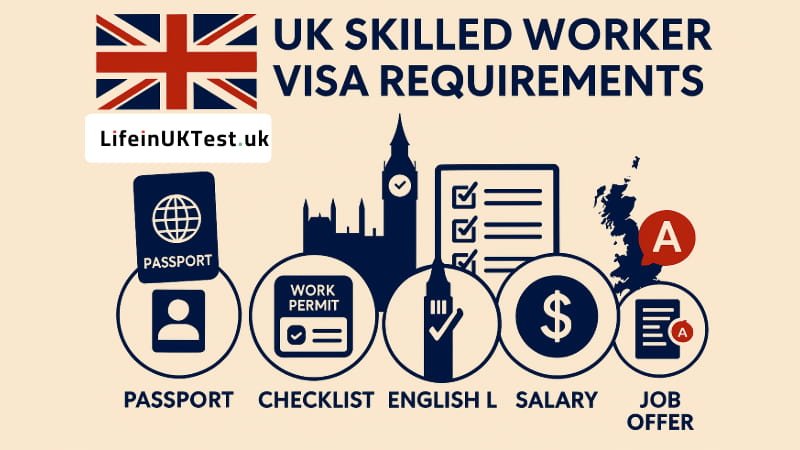
Your journey begins with obtaining a confirmed employment offer from a UK-based organization. This offer must originate from a company appearing on the Home Office’s register of licensed sponsors and holding an A-rating, which signifies full compliance with immigration regulations.
The position offered must appear on the eligible occupations list and satisfy minimum compensation thresholds.
2. Licensed Sponsor Verification
Your prospective employer must possess proper authorization to recruit international workers. Companies holding B-ratings cannot issue new sponsorship certificates until they achieve compliance and upgrade to A-rating status. Verifying your employer’s rating before proceeding helps avoid application delays or rejections.
3. Certificate of Sponsorship (CoS)
This digital document serves as your formal sponsorship proof. The certificate contains vital information including:
- Position title and classification
- Employment start and end dates
- Annual salary details
- Sponsor license number
- Certificate expiration date
4. Eligible Occupation Verification
UK Visas and Immigration exclusively grants visas for positions appearing on the approved occupations list. You must possess the requisite skills and experience to fulfill your designated role. Request the standard occupation code (SOC) from your employer to confirm eligibility.
5. Skill Level Standards
Applicants must demonstrate capabilities equivalent to RQF level 6 (bachelor’s degree standard or comparable). This requirement focuses on skill equivalency rather than mandatory qualification possession.
6. Updated Salary Thresholds for 2026
As of 22 July 2025, the general minimum salary threshold increased to £41,700 annually. Your compensation must meet either this threshold or your position’s “going rate,” whichever proves higher.
Reduced Salary Options
Certain circumstances allow for lower salary requirements:
- Relevant PhD holders (Option B): Minimum £37,500 or 90% of position’s going rate
- STEM PhD holders (Option C): Minimum £33,400 or 80% of position’s going rate
- New entrants (Option E): Minimum £33,400 or 70% of position’s going rate
- Immigration Salary List roles (Option D):
- Degree-level positions (RQF 6+): £33,400 minimum or going rate
- Sub-degree positions (RQF 3-5): £23,200 minimum or going rate
Your specific minimum salary depends on multiple factors including your role, qualifications, and whether you’re extending existing permission.
7. Financial Maintenance Requirement
You must demonstrate financial self-sufficiency by providing bank statements showing at least £1,270 in available funds. Alternatively, your employer may provide written confirmation of covering this requirement.
8. English Language Proficiency
Applicants must prove English language knowledge at minimum B1 level, changing to B2 level from 8 January 2026. Four acceptable methods exist:
- Passing an approved English language test from recognized providers
- Holding a degree-level qualification taught in English (non-UK degrees require Ecctis verification)
- Possessing relevant UK qualifications (GCSE, A-level, or Scottish equivalents) obtained before age 18
- Citizenship from English-speaking nations (including USA, Canada, Australia, New Zealand, and several Caribbean countries)
Required Documentation
Essential Application Materials
Prepare the following documents:
- Valid passport containing at least one blank page
- Certificate of Sponsorship reference number
- Position title and annual compensation details
- Occupation code for your role
- Employer name and sponsor license number
- Bank statements demonstrating financial maintenance
- Relationship evidence for accompanying family members
- Criminal record certificates (for specific sectors involving vulnerable populations)
- English proficiency documentation
- TB test results (for applicants from designated countries)
- PhD certificates or Ecctis references for relevant qualifications
Application Process Explained
Step-by-Step Application Guide
- Eligibility Assessment: Verify you meet all requirements
- Secure Employment: Obtain a job offer from a licensed sponsor
- Receive Sponsorship: Collect your Certificate of Sponsorship
- Document Preparation: Gather all supporting materials
- Online Application: Complete the appropriate form based on your location
- Fee Payment: Submit application fees, biometric fees, and healthcare surcharge
- Document Upload: Provide all required supporting evidence
- Biometric Appointment: Schedule fingerprint and photograph capture
Processing Timeframes
Applications submitted from outside the UK typically receive decisions within three weeks. UK-based applications may require up to eight weeks for processing. Should UKVI require additional information, they will contact you directly.
Changing Employers While on Visa
When New Applications Become Necessary
You must apply for a fresh visa when:
- Switching to a different employer
- Changing occupation types
- Modifying your occupation code
- Moving from a shortage occupation list role to a non-listed position
Valid visa holders can apply from within the UK and continue working until receiving a decision. Applications can be submitted up to three months before your new role’s start date, though processing may take eight weeks. Do not commence work with your new employer until receiving approval.
Visa Extension Options
Maintaining Your Status
Extension applications are possible provided you remain with the same sponsor in an identical occupation code. Those changing jobs or employers must apply for new visas rather than extensions. Multiple extensions are permissible without limitation.
Path to Indefinite Leave to Remain
Achieving Permanent Settlement
After five continuous years of lawful residence, you become eligible for indefinite leave to remain. This requires:
- No absences exceeding 180 days in any twelve-month period
- Continued employment with a sponsor license holder
- Meeting minimum salary requirements
- Passing the Life in the UK test (ages 18-65)
- Demonstrating English language proficiency
The five-year qualifying period can include time spent on various visa categories, including Representative of an Overseas Business, Innovator, Global Talent, and certain Tier 1 and Tier 2 visas.
Frequently Asked Questions
How long does initial permission last?
Initial grants extend up to five years, depending on your sponsorship certificate duration. Extensions are unlimited, and permanent settlement becomes available after five years.
What happens upon job loss?
Losing employment requires immediate action. You can either switch to a different visa category or apply for another Skilled Worker visa. During application processing, you may remain in the UK.
Can supplementary employment continue after job loss?
No. Supplementary work is only permissible while maintaining employment with your current sponsor. Upon losing sponsorship, all additional work must cease immediately until securing new sponsorship.
When does the curtailment period begin?
The curtailment period (60 days or remaining visa validity, whichever is shorter) starts when the Home Office issues the curtailment notice, not when employment ends. You need not wait for this notice before applying for a new visa.
Do dependants need new visas when changing jobs?
When extending your visa, dependants don’t strictly require simultaneous applications. However, if their visa expiry approaches, joint application proves advisable.
Does previous overstaying affect applications?
Overstays under 30 days or due to exceptional circumstances may not impact applications. However, overstays exceeding 30 days typically result in re-entry bans ranging from twelve months to five years.
Can I start employment later than the CoS states?
Starting up to 28 days after the CoS start date or visa grant date (whichever is later) is acceptable. Longer delays require employer notification to the Home Office with valid reasoning before the original start date.
Can I work for multiple companies?
Supplementary employment up to 20 hours weekly is permissible without Home Office notification, provided the role appears in Appendix Skilled Occupations and occurs outside your sponsored work hours. Exceeding 20 hours or working under different occupation codes requires obtaining a separate sponsorship certificate and visa application.
Conclusion
The UK Skilled Worker Visa provides a comprehensive pathway for international professionals seeking to build careers in Britain. Understanding the requirements, maintaining proper documentation, and ensuring compliance with all regulations maximizes your success prospects. Consider consulting immigration specialists to navigate complex requirements and ensure application accuracy.
This guide provides general information current as of January 2026. Immigration rules change regularly, so verify current requirements with official government sources or qualified immigration advisors before applying.