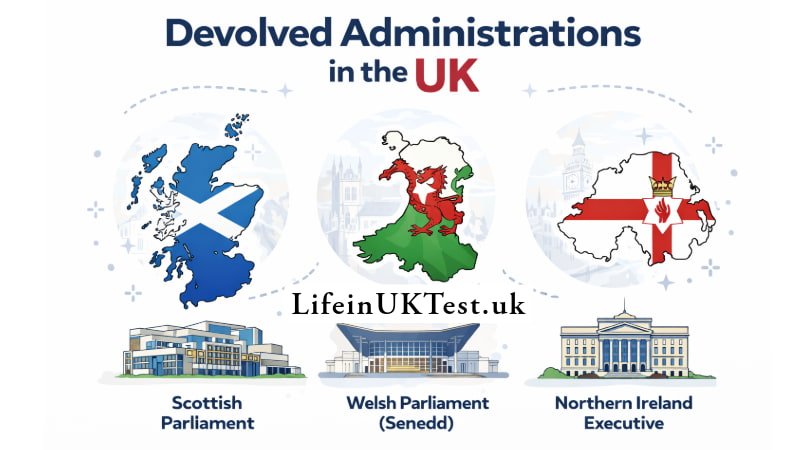
Devolved administrations in the UK are an important part of the country’s political system and a key topic in the Life in the UK Test. They refer to the governments of Scotland, Wales, and Northern Ireland, which were established through devolution to give these nations control over certain domestic matters such as health, education, transport, and housing. While the UK Parliament remains responsible for nationwide issues like defence and foreign policy, devolved administrations allow each nation to make decisions that reflect local needs. Understanding how devolution works and the role of devolved governments is essential for anyone preparing for the Life in the UK Test and learning about how the United Kingdom is governed.
What Are Devolved Administrations in the UK?
Think of the UK as a house where different rooms have their own thermostats. The main heating system still runs the whole place, but Scotland can decide how warm its room gets, Wales can adjust its temperature independently, and Northern Ireland has its own controls too. That’s essentially how devolved administrations work.
The Quick Version
Devolved administrations are the governments in Scotland, Wales, and Northern Ireland that make decisions on local matters instead of letting Westminster do everything. It’s power-sharing, British-style. Started properly in 1998–1999, it means your local politicians decide things like how your schools run, how hospitals operate, and what happens with housing – rather than MPs sitting hundreds of miles away in London.
Why It Exists (and Why It Matters to You)
Back in 1997, people in Scotland, Wales, and Northern Ireland voted in referendums saying “yes, we want more control over our own affairs.” Can’t blame them. If you’re in Edinburgh, you probably have different priorities than someone in Westminster. Local problems need local solutions.
Ron Davies, who was Secretary of State for Wales at the time, called devolution “a process, not an event.” He was right. It wasn’t a one-and-done deal. The powers keep evolving, expanding, sometimes getting tangled up in disputes. More on that shortly.
The Three Main Players
Scotland: The Confident One
The Scottish Parliament has been the most confident of the three from day one. Based in Edinburgh with 129 Members of the Scottish Parliament (MSPs), it handles a massive chunk of Scottish life. We’re talking health, education, housing, policing, transport – the whole kit.
Scotland even controls some tax powers now. Income tax rates? Scottish Government decides. Some social security benefits? Also Scottish. It’s gotten more powerful over the years through the Scotland Acts of 2012 and 2016. The Scottish Parliament operates on what’s called a “reserved powers” model, which basically means: if it’s not specifically reserved for Westminster (like defence or immigration), Scotland can handle it.
There’s been an ongoing debate about Scottish independence, with elections to the Scottish Parliament scheduled for May 2026. The conversation about Scotland’s future within the UK isn’t going away anytime soon.
Wales: The Growing Presence
Wales took a slower path but has caught up significantly. The Senedd Cymru (Welsh Parliament) – it changed its name from the National Assembly for Wales in May 2020 – has 60 Members of the Senedd (MSs).
Initially, Wales had quite limited powers. Couldn’t even pass primary legislation without asking Westminster first. The Government of Wales Act 2006 gave it more room to breathe, but the Wales Act 2017 changed things dramatically, moving Wales to the same reserved powers model that Scotland uses. Now the Senedd makes laws on health, education, local government, Welsh language, culture, and more.
Think about it this way: if you’re in Cardiff and something goes wrong with your local hospital or your child’s school, the people you should be shouting at are in Cardiff Bay, not Westminster. That’s devolution working as intended.
Northern Ireland: The Complicated One
Northern Ireland’s situation has always been unique, and honestly, a bit messier. The Northern Ireland Assembly has 90 Members of the Legislative Assembly (MLAs), and its system is built around power-sharing between communities – a key part of the Good Friday Agreement from 1998.
Here’s where it gets technical: Northern Ireland uses three categories instead of two. There are “transferred” matters (what Scotland and Wales would call devolved), “reserved” matters (might be transferred later), and “excepted” matters (staying with Westminster permanently, like defence).
The Assembly controls policing, justice, health, education, agriculture – the usual devolved suspects. But Northern Ireland’s administration has faced interruptions. The power-sharing arrangement means if major parties can’t agree, the whole thing can grind to a halt.
And grind to a halt it has. Multiple times. The Assembly has spent nearly 40% of its existence either suspended or not functioning properly. Let’s break that down:
| Suspension Period | Duration | Reason |
|---|---|---|
| February – May 2000 | 3 months | IRA decommissioning concerns |
| August 2001 | Brief | Decommissioning issues |
| September 2001 | Brief | Ongoing negotiations |
| October 2002 – May 2007 | 4.5 years | IRA spy ring allegations at Stormont |
| January 2017 – January 2020 | 3 years (1,097 days) | Renewable Heat Incentive scandal |
| February 2022 – January 2024 | Nearly 2 years | DUP protest over Northern Ireland Protocol |
During these suspensions, Westminster took back control through direct rule, and Northern Ireland was essentially governed by civil servants rather than elected politicians. Not exactly what anyone signed up for.
The most recent collapse in February 2022 happened when DUP First Minister Paul Givan resigned over the Northern Ireland Protocol – part of the Brexit deal that created trade barriers between Northern Ireland and the rest of the UK. The Assembly was eventually restored in early 2024 after a deal was reached addressing DUP concerns.
What Westminster Still Controls
Some things stay with the UK Parliament no matter where you live. These “reserved” matters include:
- Defence and national security
- Foreign policy and international relations
- Immigration and nationality
- Trade policy and most taxation
- Broadcasting (though Northern Ireland can legislate with Secretary of State consent)
- The constitution itself
- Social security (though Scotland and Northern Ireland have some powers here now)
Why keep these centralized? The argument is that some issues affect the whole UK and need UK-wide coordination. Whether you agree with that depends largely on where you stand on devolution generally.
Key Legislation Timeline: How We Got Here
Understanding devolution means understanding the laws that created and expanded it. Here’s the timeline:
| Year | Legislation | What Changed |
|---|---|---|
| 1998 | Scotland Act 1998 | Created the Scottish Parliament with extensive devolved powers using reserved powers model |
| 1998 | Northern Ireland Act 1998 | Established Northern Ireland Assembly with transferred/reserved/excepted powers model |
| 1998 | Government of Wales Act 1998 | Created National Assembly for Wales (limited powers initially) |
| 2006 | Government of Wales Act 2006 | Gave Wales primary law-making powers in devolved areas |
| 2012 | Scotland Act 2012 | Devolved tax powers including Stamp Duty Land Tax and Landfill Tax to Scotland |
| 2016 | Scotland Act 2016 | Further devolved income tax powers, some social security benefits, and transport/energy matters |
| 2017 | Wales Act 2017 | Moved Wales to reserved powers model; allowed income tax variation; permitted name change to Senedd |
| 2020 | UK Internal Market Act 2020 | Limited devolved regulatory autonomy (passed without devolved consent) |
The pattern? Devolution keeps expanding. The 1998 settlements weren’t the end – they were the beginning.
How They Actually Work Together
Each devolved nation has a Secretary of State in the UK Cabinet – for Scotland, Wales, and Northern Ireland respectively. Their job? Keep things running smoothly between Westminster and the devolved administrations. They’re the bridge, the translator, the person who stops constitutional arguments from becoming full-blown crises.
There’s also something called the Sewel Convention. Fancy name, simple idea: Westminster won’t normally legislate on devolved matters without consent from the relevant devolved body. They need what’s called a Legislative Consent Motion. Notice the word “normally” though – it’s not absolute.
That became a proper issue during Brexit. The UK Internal Market Act 2020 passed despite all three devolved governments withholding consent. It restricted their regulatory autonomy, which didn’t exactly strengthen the trust between Westminster and the devolved nations.
What’s Different About England?
Short answer: quite a lot.
England doesn’t have its own parliament. The UK Parliament essentially acts as England’s parliament for English-only matters, alongside its role as the overall UK legislature. What England does have is a patchwork of devolution to cities and regions through metro mayors.
As of early 2026, there are 12 metro mayors covering areas like Greater Manchester, the West Midlands, and London (which has had its own elected mayor since 2000). They have executive powers over transport, housing, skills, and some policing functions – but they can’t pass laws like the Scottish Parliament can.
The current government is pushing harder on English devolution. Sussex and Brighton, Norfolk and Suffolk, Greater Essex, and Hampshire and the Solent are set to elect their first mayors in May 2026. The English Devolution and Community Empowerment Bill (2025) aims to create a more systematic framework with different levels of “Strategic Authorities,” but England still won’t have anything like the legislative devolution that Scotland, Wales, and Northern Ireland enjoy.
Some English regions want more. Yorkshire has a movement calling for its own parliament. Cornwall occasionally resurfaces the same debate. Whether these movements gain real traction remains to be seen.
The Money Question: Block Grants and the Barnett Formula
Here’s where it gets interesting. The devolved administrations get funded through block grants from Westminster, calculated using something called the Barnett Formula – invented in 1978 by Joel Barnett (who later called it a “terrible mistake”).
The formula works like this: when England’s spending on devolved services changes, Scotland, Wales, and Northern Ireland get a population-based share of that change. It doesn’t determine total funding levels, just the year-on-year changes.
Current Funding (2025–26)
| Nation | Block Grant (2025-26) | Population Proportion | Notes |
|---|---|---|---|
| Scotland | £50 billion | 9.52% of England | Largest real-term settlement in devolution history |
| Wales | Approx. £19-20 billion | 5.68% of England | Includes 105% needs-based factor |
| Northern Ireland | Approx. £16-17 billion | 3.4% of England | Includes 124% needs-based factor |
Scotland’s £50 billion block grant for 2025–26 represents the largest settlement in the history of Scottish devolution. Wales and Northern Ireland both have “needs-based factors” built into their formulas – Wales at 105% (rising to 115% long-term) and Northern Ireland at 124% – recognizing higher perceived needs in these nations.
Once they’ve got the money, they can spend it however they want within their devolved powers. Want to prioritize NHS spending? Go ahead. Prefer to invest in housing? Your call. That’s the point of devolution – local priorities set locally.
Beyond the Block Grant
The block grant isn’t the whole story. Devolved administrations also get funding from:
- Devolved taxes – Scotland and Wales can vary income tax rates; Scotland also controls Land and Buildings Transaction Tax (their version of stamp duty) and Landfill Tax
- Annually Managed Expenditure (AME) – demand-led funding for things like student loans
- Borrowing powers – Scotland can borrow up to £3 billion for capital investment; Wales up to £1 billion
- Other UK government grants – for specific projects or needs
The Barnett Formula has critics. It doesn’t account for different needs or costs between regions. It’s not based on any objective assessment of what each nation requires. And crucially, it’s not statutory – it’s just Treasury policy that could theoretically be changed at any time.
The Tensions You Should Know About
Devolution isn’t a smooth ride. There are proper arguments about where the boundaries lie. Can the Scottish Parliament pass laws that indirectly affect reserved matters? What happens when Welsh regulations clash with UK-wide rules? Who gets final say when there’s disagreement?
Brexit amplified these tensions massively. Scotland and Northern Ireland voted to remain in the EU; England and Wales voted to leave. The result? Constitutional friction, debates about second Scottish independence referendums, and questions about Northern Ireland’s unique position with one foot in the UK and one foot (via the protocol) in EU regulations.
The UK Internal Market Act 2020 remains controversial in Scotland and Wales because it limits their ability to set different standards from England, even in devolved areas. The word “undermines” gets thrown around a lot in these discussions, and it’s not entirely wrong.
What’s Coming in 2026 and Beyond
Elections to the Scottish Parliament and Senedd are scheduled for May 2026. These will be significant political moments, especially in Scotland where constitutional questions about independence remain front and centre. The SNP continues to push for a second independence referendum, while unionists argue the 2014 referendum should be respected.
In England, the expansion of mayoral devolution continues with several new areas electing mayors in May 2026. The government wants 85% of England covered by some form of devolution, which would be a major shift from the current patchwork.
Northern Ireland faces its own challenges around power-sharing stability and its unique position post-Brexit. The arrangements there need constant maintenance and political goodwill – not always in abundant supply. With the Assembly having spent nearly 40% of its existence suspended, stability remains fragile.
What This Means for Your Daily Life
Here’s the practical bit: where you live determines who makes decisions about the services you use most.
School curriculum? Devolved in Scotland, Wales, Northern Ireland. Hospital waiting times? Devolved everywhere except England. Council tax levels and structure? Largely devolved. Train fares and bus services? Mostly devolved, though it varies. University tuition fees? Completely different in each nation.
That’s why a Scottish student at a Scottish university pays nothing in tuition fees, while an English student faces fees of up to £9,250 per year. It’s why prescription charges exist in England but not in Scotland or Wales. Devolution isn’t abstract – it directly affects your bank account and your daily experience of public services.
Policy Differences That Actually Matter
| Policy Area | England | Scotland | Wales | Northern Ireland |
|---|---|---|---|---|
| University Tuition Fees | Up to £9,250/year | Free for Scottish students | Variable (around £9,000) | Variable |
| Prescription Charges | £9.90 per item (2026) | Free | Free | Free |
| Personal Care for Elderly | Means-tested | Free personal care | Variable | Variable |
| Minimum Unit Pricing (Alcohol) | No | Yes (50p per unit) | No | Considering |
| Plastic Bag Charge | 10p | 10p | 25p | 5p |
These aren’t minor differences. They represent fundamentally different policy choices made by elected representatives closer to the people affected.
The Bottom Line
Devolved administrations are the governments in Scotland, Wales, and Northern Ireland that control local policy areas while Westminster keeps hold of UK-wide issues. It’s asymmetric, it’s evolving, and it occasionally causes constitutional headaches.
But for most people, it simply means the politicians making decisions about schools, hospitals, and housing are based closer to home rather than in London. Whether you think that’s a brilliant idea or a recipe for fragmentation probably depends on where you sit – both geographically and politically.
The system is a work in progress. Always has been. Ron Davies was right about that. And as 2026 brings new elections and potentially new powers, that process continues rolling forward.
The question isn’t whether devolution will keep changing – it’s how and how fast.
Quick Reference Table: What’s Devolved Where
| Policy Area | Scotland | Wales | Northern Ireland |
|---|---|---|---|
| Health and Social Care | ✓ Devolved | ✓ Devolved | ✓ Devolved |
| Education and Training | ✓ Devolved | ✓ Devolved | ✓ Devolved |
| Local Government | ✓ Devolved | ✓ Devolved | ✓ Devolved |
| Justice and Policing | ✓ Devolved | ✗ Reserved | ✓ Devolved (since 2010) |
| Transport | ✓ Devolved | ✓ Devolved | ✓ Devolved |
| Agriculture and Fisheries | ✓ Devolved | ✓ Devolved | ✓ Devolved |
| Some Taxation | ✓ Devolved | ✓ Devolved | ✓ Devolved |
| Some Social Security | ✓ Devolved | ✗ Reserved | ✓ Devolved (technically) |
| Sports and Arts | ✓ Devolved | ✓ Devolved | ✓ Devolved |
| Housing | ✓ Devolved | ✓ Devolved | ✓ Devolved |
| Environment | ✓ Devolved | ✓ Devolved | ✓ Devolved |
| Defence | ✗ Reserved | ✗ Reserved | ✗ Excepted |
| Foreign Affairs | ✗ Reserved | ✗ Reserved | ✗ Excepted |
| Immigration | ✗ Reserved | ✗ Reserved | ✗ Excepted |
| Broadcasting | ✗ Reserved | ✗ Reserved | ✗ Reserved* |
| Constitution | ✗ Reserved | ✗ Reserved | ✗ Excepted |
*Northern Ireland may legislate with Secretary of State consent
Note: This is a simplified overview. The reality is more complex, with some policy areas partially devolved and partially reserved. When in doubt, check with the specific devolved administration or the relevant UK government department.
Useful Resources
Looking for more detail? These sites have the official information:
- UK Parliament – Devolution Overview: https://www.parliament.uk/about/how/role/relations-with-other-institutions/devolved/
- Scottish Parliament: https://www.parliament.scot
- Senedd Cymru (Welsh Parliament): https://senedd.wales
- Northern Ireland Assembly: http://www.niassembly.gov.uk
- Institute for Government (detailed devolution analysis): https://www.instituteforgovernment.org.uk/our-work/topics/devolution
- House of Commons Library – Devolution Briefings: https://commonslibrary.parliament.uk (search for “devolution”)
- HM Treasury – Statement of Funding Policy (Barnett Formula details): https://www.gov.uk (search “Statement of Funding Policy”)
- GOV.UK – Devolution Guidance: https://www.gov.uk/guidance/devolution-of-powers-to-scotland-wales-and-northern-ireland