Attending your Life in the UK Test is a crucial step towards British citizenship or Indefinite Leave to Remain (ILR), and arriving without the correct documents can result in being refused entry to the test centre. Many candidates are unsure about what to bring to the Life in the UK Test Centre, especially as requirements and procedures are updated over time. In this article, “What to Bring to Your Life in the UK Test Centre – A Complete Document Checklist 2026,” we provide a clear, up-to-date checklist of essential documents, explain common mistakes to avoid, and help you prepare confidently for test day. This guide ensures you know exactly what to carry so you can focus on passing your Life in the UK Test without unnecessary stress.
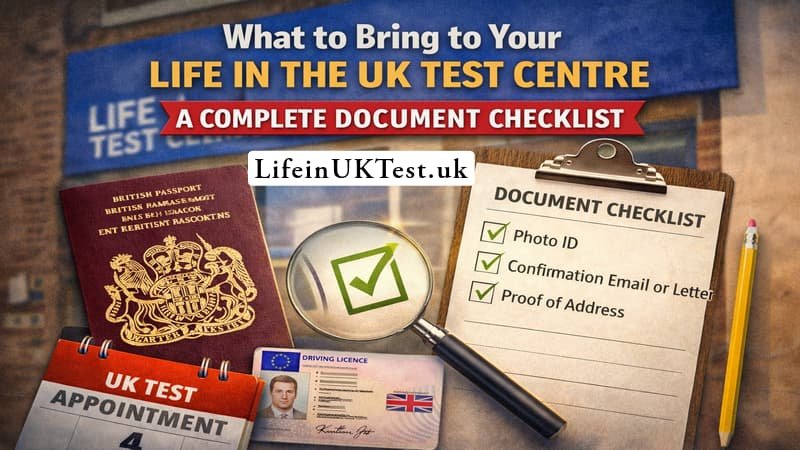
What to Bring to Your Life in the UK Test Centre: A Complete Document Checklist (2026)
Here’s what nobody tells you until it’s too late: the ID rules changed in 2025, and thousands of people are still showing up with outdated information. You studied for weeks, paid your £50, booked time off work—then got turned away at the door.
I’ve watched it happen. Not because people didn’t care, but because the UK’s switch to digital immigration status caught them off guard. Let’s make sure that doesn’t happen to you.
The Big Change: eVisas Are Here
Physical Biometric Residence Permits (BRPs) expired on 31 December 2024. Yes, all of them. If you’re holding one right now thinking it’s your ticket in—stop. The rules changed.
Here’s what actually works in 2026:
Your Primary ID Options (Pick ONE)
Option 1: eVisa Share Code (Recommended for Most Visa Holders)
If you have digital immigration status, this is your route. You’ll generate a unique 9-character code through your UKVI account.
How to get your share code:
- Go to the official GOV.UK “View and prove your immigration status” service
- Sign in to your UKVI account (create one if you haven’t already)
- Select “To prove my immigration status for anything else”
- Generate your share code—it’s valid for 90 days
- You’ll provide this code when booking your test
Important: You still need to bring your passport or the ID document linked to your UKVI account on test day. The share code alone isn’t enough. It’s a two-part system: share code for booking, physical ID for verification at the test centre.
Option 2: Valid Passport
Any nationality, any country. Must be current and not expired. The name must match your booking exactly—and I mean exactly. “Elizabeth” and “Liz” aren’t the same to the system.
Option 3: Expired BRP (Special Rules Apply)
This is where it gets specific. From January 2025, you can use an expired BRP for 18 months after the expiry date printed on the card. So if your BRP shows an expiry of 31 December 2024, you can use it until 30 June 2026 for booking and taking the Life in the UK test.
But here’s the catch: this concession is temporary. The Home Office is pushing everyone toward digital status. If you can get an eVisa, do it now. Don’t wait until your BRP becomes completely unusable.
Option 4: EU/EEA/Switzerland Identity Card
Must be current, in date, with your photo clearly visible.
Option 5: UK Photocard Driving Licence
Full or provisional—both work. Paper licences don’t count.
Option 6: Valid Travel Document
Must be in date. Emergency travel documents are specifically excluded.
What Happens at the Test Centre
Your photo will be taken on the day to confirm your ID. This is mandatory. If you refuse the photo, you won’t test, and you won’t get a refund.
This isn’t negotiable. The Home Office introduced this in late 2024 to combat fraud and identity theft. The photo links to your unique reference number and stays in the system to verify you actually took the test yourself.
The Exact Matching Rule
Your booking name must match your ID exactly. Here’s where people mess up:
- If your passport says “Robert James Smith,” book as Robert James Smith
- Don’t abbreviate: Rob J Smith will get you rejected
- Middle names matter. If it’s on your ID, include it in your booking
- Hyphenated surnames: keep the hyphen
- Maiden names vs married names: use what’s on your current ID
One woman I met at a test centre had her maiden name on her booking but her married name on her passport. She’d just updated her passport. Test centre couldn’t help her. £50 gone. Three-hour journey wasted.
What You Absolutely Cannot Bring
Test centres run airport-style security. Leave these at home or in your car:
- Mobile phones (including in your pocket)
- Smart watches or fitness trackers
- Bags, handbags, backpacks
- Study materials, books, notes
- Food or drinks (water included)
- Jackets with large pockets
- Hats or caps (unless religious/medical)
Some centres have lockers. Many don’t. Don’t gamble on it. Arrive with just your ID and booking confirmation.
What about glasses or hearing aids? Those are fine—they’re medical aids you need to function. Just be prepared to briefly remove glasses during the photo if asked.
Your Booking Confirmation
When you book online through the official GOV.UK service, you’ll receive a confirmation email. You’ll be told what time to arrive at the test centre.
Screenshot it. Print it. Save it offline. Your phone battery will choose test day to die—I’ve seen it happen countless times. A printed copy takes 30 seconds and could save your appointment.
Timing: The 15-Minute Window
If you do not arrive at the correct time, the test centre may cancel your test and you will not get a refund. “Correct time” means the appointment time on your booking, not when you feel like showing up.
My advice? Arrive 20-30 minutes early. Traffic happens. Parking fills up. You get lost. The person ahead of you in the queue has a problem that takes 15 minutes to resolve. Build in buffer time.
But don’t arrive too early either. Showing up an hour ahead doesn’t guarantee they’ll let you in. Most centres have strict processing schedules.
The £50 Question
You’ve already paid when you booked online. The test centre doesn’t take payments on the day. If someone at the centre asks for additional money, that’s a red flag.
The standard fee is £50, though some short-notice bookings or Sunday appointments may cost up to £65. Whatever you paid during booking is all you pay. Period.
Special Circumstances That Need Advance Planning
Religious or medical headwear: Absolutely permitted. You may be asked to adjust it briefly for ID verification, but you won’t be asked to remove it entirely.
Accessibility needs: If you need extra time due to dyslexia, other learning difficulties, or physical disabilities, request this when booking. You’ll fill out a special arrangements form. Takes 3-4 working days to process, so don’t leave it until the last minute.
Language options: The test is in English. If you are in Scotland or Wales you can request to sit the test in Scottish Gaelic or Welsh when booking. That’s it. No other language options exist.
Previous gender considerations: Email the Home Office before booking if you do not want test centre staff to see your previous gender or for it to show on your test result at sensitivebookings@homeoffice.gov.uk.
The Test Centre Reality Check
You will be at the test centre for up to 2 hours in total. Not 45 minutes—the full test experience runs longer. There’s check-in, security, photo capture, the actual test, and then waiting for your result.
Don’t schedule anything immediately after. Don’t book a train that leaves 90 minutes post-appointment. Give yourself space.
Security checks will be undertaken. If you need privacy for these checks—whether for religious, medical, or personal reasons—speak to the Test Centre Manager when you arrive.
What If You Don’t Have Valid ID?
If you do not have any of these documents, email the Home Office for help at nationalityenquiries@homeoffice.gov.uk before your test date. Don’t just show up hoping for mercy. They can’t help you on the day.
Replacement documents take time:
- Lost passport: 3+ weeks minimum
- Driving licence replacement: 7-10 days
- BRP replacement: varies wildly
If your ID situation is complicated, sort it out before booking your test.
After You Pass
You’ll get a ‘unique reference number’ which you’ll need to complete your citizenship or settlement application. The Home Office uses this to verify you passed.
There’s no physical certificate anymore. If you took your test before 17 December 2019, you’ll have a letter with a ‘test reference ID’ instead. Lost that letter? Send a letter explaining that you have lost it with your citizenship or settlement application.
Your pass result never expires. Take the test today, apply for citizenship in five years—it still counts.
Common Mistakes I’ve Witnessed
The “close enough” ID matcher: Booked as Jonathan, arrived with a passport saying John. Denied entry. This happens weekly at busy test centres.
The expired document gambler: Shows up with an expired passport thinking “it’s only been expired two weeks.” Unless it’s a BRP within the 18-month grace period, expired means rejected. No exceptions.
The phone-in-pocket person: Threatening or violent behaviour towards staff is illegal and will not be tolerated. But even minor security violations like refusing to turn over your phone can get you ejected. They take this seriously.
The late arrival excuse-maker: “But my GPS failed!” “The car park was full!” “There was traffic!” Test centre staff have heard it all. They still can’t let you in late. Their computer slots are timed to the minute.
The proxy booker: Someone books the test using their friend’s email, then shows up with different name details than what was registered. Instant rejection.
The Quick Reference Checklist
Print this. Put it somewhere you’ll see it the night before your test:
□ Valid photo ID (same one used for booking, exact name match)
□ eVisa share code if applicable (already provided during booking)
□ Expired BRP if using (must be within 18 months of printed expiry)
□ Booking confirmation (printed AND on phone)
□ Arrive 20-30 minutes early
□ NOTHING in your pockets (no phone, no wallet in back pocket)
□ Comfortable clothing without excessive pockets
□ Any pre-approved accessibility documentation
□ Clear schedule for 2+ hours
□ Transport home that doesn’t require your phone
Booking Only Through Official Channels
There are over 30 test centres in the UK. Book exclusively through the official GOV.UK website. Third-party booking sites either charge inflated fees or are outright scams.
The legitimate URL includes “gov.uk” and nothing else. If a website looks slightly off, charges weird processing fees, or promises “guaranteed pass” assistance—it’s not official. Close the tab.
What the Test Centre Won’t Tell You
You can’t bring children or other family members into the testing area. There are no childcare or waiting room facilities at our centres for people who are not taking the test. If you need childcare, arrange it in advance. Your mum can’t sit in the waiting room with your toddler for two hours.
Test centres are often located in community colleges, libraries, or adult education centres. They’re not glamorous. Don’t expect comfortable seating or free WiFi in waiting areas. Some barely have waiting areas.
Car parking varies wildly. Urban centres might have none. Suburban centres might have limited spaces that fill by 9am. Research this the day before. Google Street View is your friend.
The eVisa Reality for 2026
If you’re reading this in January 2026 and still haven’t set up your UKVI account, do it today. Not tomorrow. Today.
The government’s transition to fully digital immigration status is complete. Physical documents are legacy systems being phased out. The share code process isn’t optional for most visa holders—it’s the future.
Setting up takes 10 minutes:
- Go to GOV.UK “View and prove your immigration status”
- Create your UKVI account using your passport details
- Link your current immigration status
- Generate your share code when needed
Once it’s set up, you can generate share codes for employment, renting, and yes—your Life in the UK test—whenever you need them. Each code lasts 90 days and can be used multiple times for the same purpose.
If Things Go Wrong
Forgot your ID at home: Turn around. Go get it. Even if it makes you late and costs you the fee. Showing up without ID gains you nothing except wasted travel time.
ID doesn’t match booking: Contact the test helpline immediately at 0800 015 4245 (Monday-Friday, 8am-8pm). They might let you rebook without penalty if caught early enough. Might.
Test centre has your photo on file but you look different now: Major weight change, shaved beard, drastically different hairstyle—bring a secondary photo ID if you have one. It can help verify you’re the same person.
You’re running late: Call the test centre if you have their direct number. Some are flexible within a 5-minute window. Most aren’t. But the call at least shows good faith.
The Bottom Line
The Life in the UK test isn’t trying to catch you out with bureaucratic tricks. The identification requirements are straightforward—they’re just non-negotiable.
Show up with the right ID. Arrive on time. Follow instructions. That’s genuinely 90% of what test centres need from you.
The other 10%? That’s knowing the difference between the Battle of Hastings and the Battle of Bosworth Field. But you’ve been studying for that part, right?
Key Takeaway
In 2026, most visa holders need an eVisa share code for booking plus their physical passport/ID for test day verification. Photo will be taken on arrival. Expired BRPs work for 18 months past their printed expiry. Name on ID must match booking exactly. Arrive 20-30 minutes early with zero items in your pockets.
Sort your digital status now. Check your ID expiry dates tonight. Book your test when you’re genuinely ready—not when you’re “probably ready.”
Thousands of people pass this test every single month. You’ll be one of them. Just make sure the ID checker at the front desk gets to see you first.
Official Resources:
- Book your test: https://www.gov.uk/life-in-the-uk-test
- eVisa and share codes: https://www.gov.uk/view-prove-immigration-status
- Test helpline: 0800 015 4245 or support@lituk.psionline.com
- ID problems: nationalityenquiries@homeoffice.gov.uk