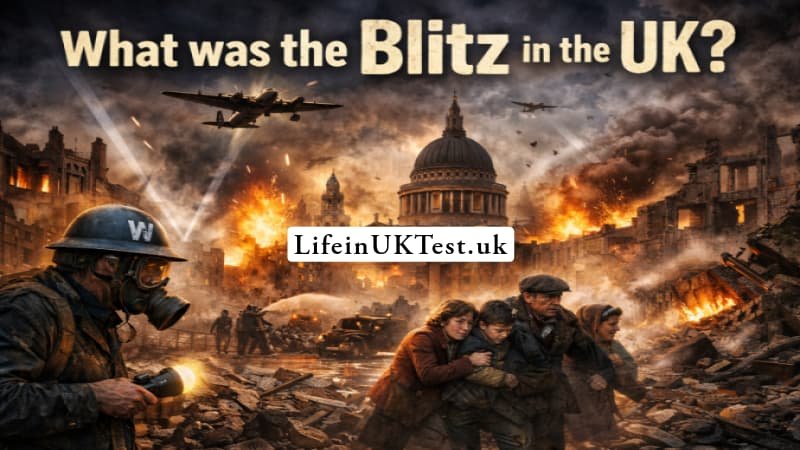
The Blitz was a sustained bombing campaign carried out by Nazi Germany against the United Kingdom during the Second World War, mainly between September 1940 and May 1941. German aircraft targeted major cities such as London, Coventry, Liverpool, and Birmingham, aiming to destroy infrastructure and weaken civilian morale. Despite widespread destruction and heavy loss of life, the Blitz became a powerful symbol of British resilience and unity, and it remains an important topic for the Life in the UK Test and UK history.
What Was the Blitz in the UK?
Lets explore What Was the Blitz in the UK and Everything You Need to Know for Your Life in the UK Test. Look, if you’re preparing for the Life in the UK test, the Blitz is one of those topics that comes up regularly. But honestly, it’s worth understanding beyond just passing an exam—it’s a massive part of British history that still shapes the country today.
What Actually Happened During the Blitz?
The Blitz was Nazi Germany’s sustained bombing campaign against Britain, running from September 1940 to May 1941. The name comes from “Blitzkrieg,” meaning “lightning war” in German. For eight months straight, German aircraft dropped bombs on British cities, particularly London, almost every single night.
Here’s the thing most people don’t realize: this wasn’t just a military operation. Hitler wanted to break British morale completely, force Churchill to surrender, and destroy the country’s ability to fight back. Spoiler alert—it didn’t work.
Why Did Germany Launch the Blitz?
After failing to win the Battle of Britain in the skies, Germany shifted tactics. The Luftwaffe couldn’t defeat the Royal Air Force, so they decided to target civilians instead. The logic? Terrify the population into demanding peace.
The bombing started on September 7, 1940—what Londoners call “Black Saturday.” Over 400 people died that first day, and it set the tone for what was coming. Night after night, German bombers appeared over British cities, dropping high explosives and incendiary bombs that turned neighborhoods into infernos.
Which Cities Were Hit?
London took the worst of it, getting bombed for 57 consecutive nights at one point. But let’s be real—this wasn’t just a London story. Coventry, Liverpool, Birmingham, Manchester, Glasgow, Belfast, Plymouth, Southampton, and dozens of other cities got hammered too.
Coventry’s destruction on November 14, 1940, was so severe that the Germans created a new word: “Koventrieren” (to Coventrate), meaning to utterly devastate a city. The medieval cathedral was destroyed—you can still visit its haunting ruins today.
Major Blitz Events and Dates
| Date | Event | Significance |
|---|---|---|
| September 7, 1940 | Black Saturday – First major London attack | Over 400 killed; marked the beginning of sustained bombing |
| September 15, 1940 | Battle of Britain Day | RAF victory; now commemorated annually |
| November 14-15, 1940 | Coventry Blitz | Cathedral destroyed; 568 killed; created term “Coventrate” |
| December 29, 1940 | Second Great Fire of London | Massive firebomb attack on the City of London |
| May 10-11, 1941 | Heaviest raid on London | 1,436 killed; last major attack of the Blitz |
| May 1941 | End of the Blitz | Germany shifted focus to invasion of Soviet Union |
How Did People Survive?
This is where British resilience became legendary. When the air raid sirens wailed, families grabbed their emergency bags and headed to shelters. Some used Anderson shelters—metal structures buried in back gardens. Others crammed into Morrison shelters, essentially steel cages inside their homes.
In London, thousands descended into the Underground stations every evening. Aldwych, Clapham South, and other stations became underground cities. People brought bedding, food, and even organized entertainment down there. It wasn’t glamorous—it was crowded, uncomfortable, and honestly pretty grim—but it kept people alive.
The government initially discouraged using the Tube as shelters, but Londoners basically ignored them and did it anyway. Sometimes you’ve got to do what works.
The “Keep Calm and Carry On” Mentality
You know that famous poster everyone has on tea towels now? Ironically, it was barely used during the war. But the sentiment was real. People genuinely tried to maintain normal life. Theaters stayed open. Pubs served customers (often with windows blown out). Workers showed up to factories, even when their homes had been destroyed the night before.
The BBC continued broadcasting. Newspapers kept printing. Milk deliveries carried on. There’s a famous photo of a milkman stepping over rubble to deliver bottles—that pretty much sums up the attitude.
What About the Children?
Here’s something that breaks your heart: over 800,000 children were evacuated from cities to the countryside under Operation Pied Piper. Kids as young as five were separated from their parents, tagged with labels, and sent to live with strangers in rural areas.
Some evacuation experiences were positive. Others? Not so much. Many children faced homesickness, culture shock (city kids suddenly living on farms), and occasionally neglect or abuse. But it undoubtedly saved thousands of lives.
The Human Cost
Let’s talk numbers, because they matter. Over 40,000 British civilians died during the Blitz. More than 46,000 were injured. Two million homes were destroyed—that’s 60% of London’s buildings damaged or obliterated.
These weren’t just statistics. These were families torn apart, communities erased, and generations traumatized. My own neighbor growing up still flinched at loud noises because of what she experienced as a child during the bombing.
Civil Defense: The Unsung Heroes
Air Raid Precautions (ARP) wardens became the face of civil defense. These were ordinary people—shopkeepers, teachers, factory workers—who volunteered to patrol streets during raids, enforce blackout regulations, and rescue survivors from collapsed buildings.
The blackout was strictly enforced. No streetlights, no car headlights, windows covered with heavy curtains. The idea was to make it harder for German bombers to navigate. Wardens would literally knock on your door if they saw light leaking out. It sounds petty now, but it was life or death.
Fire watchers stationed themselves on rooftops to spot incendiary bombs and put them out before they caused massive fires. The Auxiliary Fire Service worked alongside professional firefighters, often battling blazes while bombs continued falling around them.
How the Blitz Changed Britain
The bombing actually strengthened British determination rather than breaking it. Churchill’s speeches became rallying cries. Community bonds deepened—people who’d never spoken to their neighbors before were now sheltering together nightly.
Post-war Britain was fundamentally shaped by this experience. The welfare state, the NHS, massive housing developments—all these grew partly from the shared suffering and solidarity of the Blitz years. There was a genuine sense that if everyone could endure this together, society should work better for everyone afterward.
What You Need to Remember for the Test
For the Life in the UK test, focus on these key facts:
The Blitz lasted from September 1940 to May 1941. It was Germany’s bombing campaign against British cities. London was bombed for 57 consecutive nights. Other major cities including Coventry, Liverpool, and Birmingham were also heavily targeted. Over 40,000 civilians died.
People sheltered in Anderson shelters, Morrison shelters, and London Underground stations. Children were evacuated to the countryside. ARP wardens enforced blackout rules and helped during raids.
The Blitz failed to break British morale and is seen as a defining moment of British resilience during World War II.
Key Takeaway
The Blitz represents one of Britain’s darkest hours but also its finest in terms of civilian courage and endurance. For eight months, ordinary people faced nightly bombing raids while continuing their daily lives with remarkable resilience. Rather than surrendering, British society emerged with stronger community bonds and determination to win the war. This period fundamentally shaped modern Britain’s identity and post-war social reforms. Understanding the Blitz isn’t just about passing a test—it’s about grasping what forged the modern British character and why phrases like “the Blitz spirit” still resonate today.
The experience left permanent marks on British culture, architecture, and collective memory. Walk through any major British city and you’ll still see the scars and the memorials. The Blitz isn’t ancient history—it’s living memory, passed down through grandparents’ stories and visible in the rebuilt cityscape around you.
Quick Reference: The Blitz at a Glance
| Category | Key Information |
|---|---|
| What was it? | Nazi Germany’s sustained bombing campaign against British cities |
| Duration | September 1940 – May 1941 (8 months) |
| Main target | London (bombed for 57 consecutive nights) |
| Other cities affected | Coventry, Liverpool, Birmingham, Manchester, Glasgow, Belfast, Plymouth, Southampton |
| Casualties | Over 40,000 civilians killed; 46,000+ injured |
| Homes destroyed | 2 million (60% of London buildings damaged) |
| Shelters used | Anderson shelters (gardens), Morrison shelters (indoors), London Underground stations |
| Child evacuees | Over 800,000 children sent to countryside (Operation Pied Piper) |
| Civil defense | ARP wardens, fire watchers, Auxiliary Fire Service |
| German objective | Break British morale and force surrender |
| Outcome | Failed to break British spirit; strengthened national resolve |
| Most devastating raid | Coventry (November 14-15, 1940) – created term “Coventrate” |
| Heaviest London raid | May 10-11, 1941 – 1,436 killed in single night |
| Why it ended | Germany redirected forces for invasion of Soviet Union |
| Legacy | Shaped post-war social reforms, NHS, welfare state; symbol of British resilience |
This table gives you everything you need for a quick revision before your test. Print it, screenshot it, whatever works—just make sure you’ve got these facts down solid.