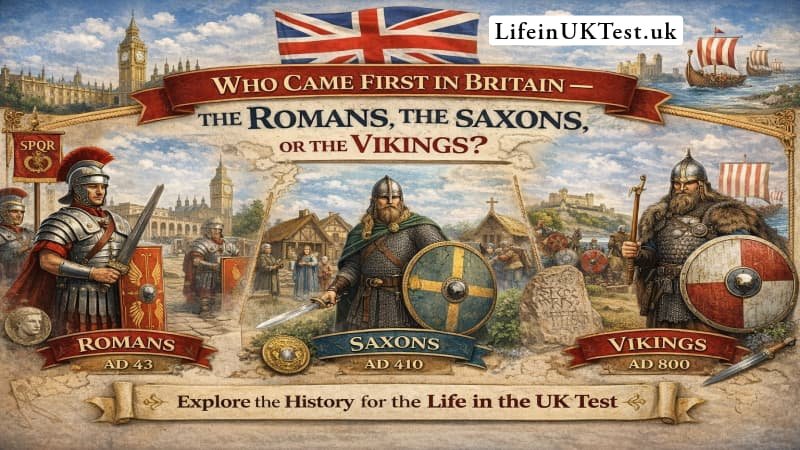
Who came first Romans or Vikings or Saxons? – This is a key question in British history and an important topic for the Life in the UK Test. In this article, we explore the order in which these groups arrived and how each one shaped life in Britain. The Romans came first in AD 43, building roads, towns, and systems of government. After the Romans left around AD 410, the Anglo-Saxons settled across the country, influencing the English language and early kingdoms. The Vikings arrived later, from around AD 800, bringing raids, trade, and new settlements. Exploring this timeline helps you understand how modern Britain developed and prepares you for Life in the UK Test questions.
Who came first Romans or Vikings or Saxons? A Simple Timeline for the Life in the UK Test
Look, if you’re preparing for the Life in the UK test, this question about Romans, Vikings, and Saxons might seem confusing at first. But honestly, once you see the timeline, it all clicks into place.
Here’s the short answer: Romans came first, then Saxons, then Vikings. Simple as that.
Remember it as per alphabetical order R then S then V.
Let me break this down in a way that actually makes sense.
The Order They Arrived in Britain
The Romans showed up in Britain way before anyone else we’re talking about here. They invaded in 43 AD under Emperor Claudius and stuck around for nearly 400 years. Think about that for a second—400 years! That’s longer than the United States has existed.
The Saxons started arriving around 410 AD, right when the Romans were packing their bags and heading back to defend Rome itself. The timing wasn’t a coincidence. When the Roman legions left, Britain was vulnerable, and the Saxons saw an opportunity.
The Vikings? They came much later. Their raids on Britain started around 793 AD with that famous attack on Lindisfarne monastery. By this time, the Saxons had already been in Britain for nearly 400 years.
Timeline: Who Ruled When
Here’s a clear table that shows you exactly when each group was in Britain:
| Group | When They Arrived | When They Left/Declined | Total Time in Britain |
|---|---|---|---|
| Romans | 43 AD | 410 AD | ~367 years |
| Saxons | ~410 AD | 1066 AD | ~656 years |
| Vikings | 793 AD (raids began) | 1066 AD | ~273 years |
Notice something interesting? The Saxons and Vikings overlapped for a long time. The Vikings didn’t replace the Saxons—they lived alongside them, fought with them, and eventually settled in parts of Britain called the Danelaw.
What Each Group Actually Did
The Romans built roads, walls (Hadrian’s Wall, anyone?), bathhouses, and proper towns. They brought Latin, Christianity eventually made its way in during their rule, and created a structured society. When you see those straight Roman roads on a map of Britain today, that’s their legacy.
The Saxons created the foundation of English culture. The language you’re reading right now? It comes from Anglo-Saxon roots. They divided Britain into kingdoms like Wessex, Mercia, and Northumbria. These weren’t just random names—they shaped how Britain was organized for centuries.
The Vikings were raiders turned settlers. Yes, they attacked monasteries and towns at first, but many Vikings eventually settled down, farmed, traded, and married locals. The Danelaw was a huge chunk of eastern England where Viking laws and customs were followed.
Key Dates You Need to Remember
For the Life in the UK test, memorize these:
| Year | What Happened |
|---|---|
| 43 AD | Romans invade Britain under Emperor Claudius |
| 410 AD | Romans leave Britain; Saxons begin settling |
| 793 AD | First major Viking raid (Lindisfarne) |
| 1066 AD | Norman Conquest—end of both Saxon and Viking rule |
That last date, 1066, is crucial. The Battle of Hastings ended both the Saxon and Viking era in one go. William the Conqueror beat both the Saxon king Harold and a Viking army in the same year.
How to Remember This for Your Test
Let’s be real—dates can be boring. Here’s a trick that helped me when I was studying: think of it like layers of a cake.
The bottom layer is Roman (they came first). The middle layer is Saxon (they replaced the Romans). The top layer is Viking (they came last, sitting on top of the Saxon layer). All three layers existed at some point, but the Romans were long gone by the time Vikings showed up.
Another way: remember the phrase “Rome, then Saxons, then Sails” (Vikings came on their longships with sails).
Common Mistakes People Make
I’ve seen study groups get confused about this, so let me clear up a few things:
Mistake #1: Thinking Vikings came before Saxons. Nope. Saxons were already well-established when Vikings started their raids.
Mistake #2: Assuming Romans and Vikings overlapped. They didn’t. There’s a 383-year gap between Romans leaving (410 AD) and Vikings arriving (793 AD).
Mistake #3: Forgetting that 1066 ended everything. The Norman Conquest is the full stop to this chapter of British history.
Why This Matters for Modern Britain
You might wonder why the test even asks about this. Here’s the thing—these three groups shaped everything about Britain today.
English language? That’s Saxon foundations with Viking additions and Latin influences from Rome. British legal systems? They trace back to Saxon laws mixed with Norman changes. Even place names across Britain tell you who lived where: anything ending in “-chester” or “-caster” was a Roman fort. Names ending in “-by” or “-thorpe”? That’s Viking territory.
The Quick Overview Table
| Group | Years in Britain | Main Contribution | What Ended Their Rule |
|---|---|---|---|
| Romans | 43-410 AD | Roads, towns, walls, Latin influence | Decline of Roman Empire |
| Saxons | 410-1066 AD | English language, kingdoms, culture | Norman Conquest 1066 |
| Vikings | 793-1066 AD | Settlements, trade, Danelaw | Norman Conquest 1066 |
What You Actually Need to Know
For the Life in the UK test, focus on:
- The order: Romans → Saxons → Vikings
- Key dates: 43 AD (Romans arrive), 410 AD (Romans leave, Saxons settle), 793 AD (Vikings raid Lindisfarne), 1066 AD (Norman Conquest)
- What each group did: Romans built infrastructure, Saxons created English culture, Vikings settled in the Danelaw
- How it ended: William the Conqueror in 1066 defeated both Saxon and Viking forces
That’s really it. The test won’t ask you obscure details about specific battles or individual kings (well, except maybe Alfred the Great if you’re unlucky). Stick to the main timeline and you’ll be fine.
Final Thoughts
Understanding this timeline isn’t just about passing a test. It’s about understanding why Britain is the way it is today. Every street name, every old building, every word in the English language carries echoes of these three groups.
When you walk around any British city, you’re literally walking through layers of history—Roman foundations, Saxon street layouts, and Viking place names. Pretty cool when you think about it.
Key Takeaways
✓ Romans came first (43-410 AD) – built roads, walls, and towns
✓ Saxons came second (410-1066 AD) – created English language and culture
✓ Vikings came last (793-1066 AD) – settled in the Danelaw, traded and farmed
✓ 1066 is the magic number – Norman Conquest ended both Saxon and Viking rule
✓ Remember the phrase: Rome, then Saxons, then Sails
✓ They didn’t all meet: Romans were gone before Vikings arrived (383-year gap)
✓ Saxons and Vikings overlapped for about 273 years, sometimes fighting, sometimes living peacefully
For your test, memorize those four dates (43, 410, 793, 1066) and you’ll handle any question they throw at you about this topic. Good luck!