
Why is the UK flag called the Union Jack – This is a common question in the Life in the UK Test because the flag represents the history and unity of the United Kingdom. The Union Jack was created by combining the crosses of England, Scotland, and Ireland, symbolising the political union of these nations under one monarch. Originally used on ships and by the Royal Navy, the name “Union Jack” reflects both the union of countries and the flag’s early maritime use. Understanding its origin helps explain key moments in British history and national identity.
Why is the UK Flag Called the Union Jack? (History & Facts)
You’ve probably seen it everywhere—on souvenirs, royal events, even tattooed on someone’s arm at a pub. But here’s a question that stumps most people, even Brits: why is the UK flag called the Union Jack?
Let’s be real, it’s one of those things you assume you know until someone actually asks you about it. And if you’re preparing for the Life in the UK Test 2026, this is exactly the kind of detail they love to quiz you on.
What’s in a Name (Union + Jack)?
The “Union” part makes perfect sense. The flag represents the union of different countries within the United Kingdom. But “Jack”? That’s where things get interesting.
What does jack in union jack mean?
The most widely accepted explanation is that “Jack” comes from the naval term for a flag flown at the bow of a ship. Back in the 1600s, King James I (or James VI of Scotland, depending on which side of the border you’re asking) wanted a flag that represented both England and Scotland after the Union of the Crowns in 1603.
Ships started flying this new flag on their “jack staff”—that’s the pole at the front of a vessel. So technically, it was only called the “Union Jack” when it was on a ship. On land? It should be the “Union Flag.”
Honestly though, most people—including government officials—just call it the Union Jack regardless of where it’s flying. The British Flag Institute even says both names are acceptable now, so don’t stress too much about it.
The Flag Didn’t Happen Overnight
Here’s something you might not know: the Union Jack we see today went through a few versions before it became the icon we recognize.
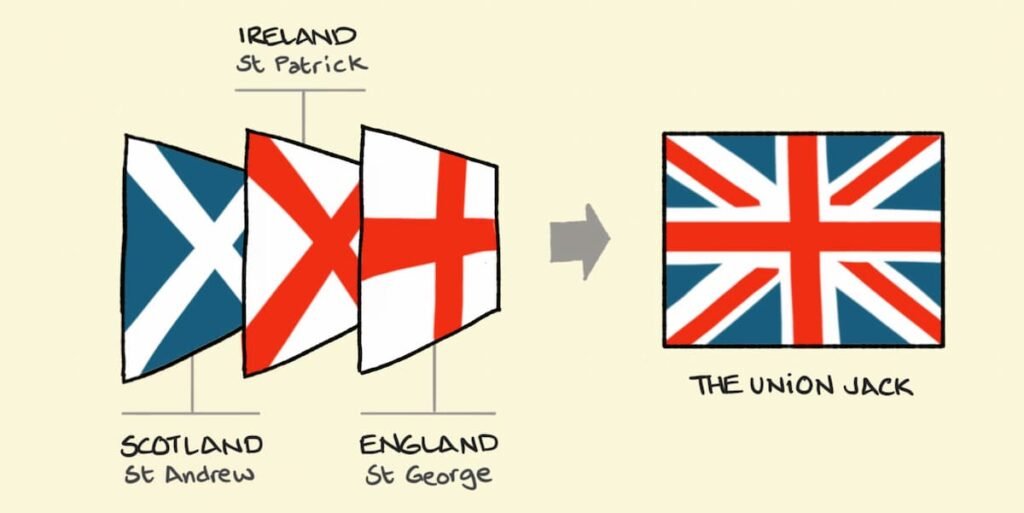
1606 – The First Union Flag When James I united the English and Scottish crowns, he combined the red cross of St. George (England) with the white diagonal cross of St. Andrew (Scotland) on a blue background.
Wales wasn’t represented because, at that time, it was already considered part of the Kingdom of England.
1801 – Ireland Joins the Party After the union with Ireland, the red diagonal cross of St. Patrick was added to the design. This is the version we still use today. And yes, before you ask—Northern Ireland remains part of the UK, which is why the cross of St. Patrick stays on the flag even though most of Ireland became independent in 1922.
How the Union Jack is Actually Made
Ever wondered how they create that distinctive design? It’s not as simple as slapping three flags together. There’s actually a specific construction method, and getting it wrong is easier than you’d think.
The Building Blocks
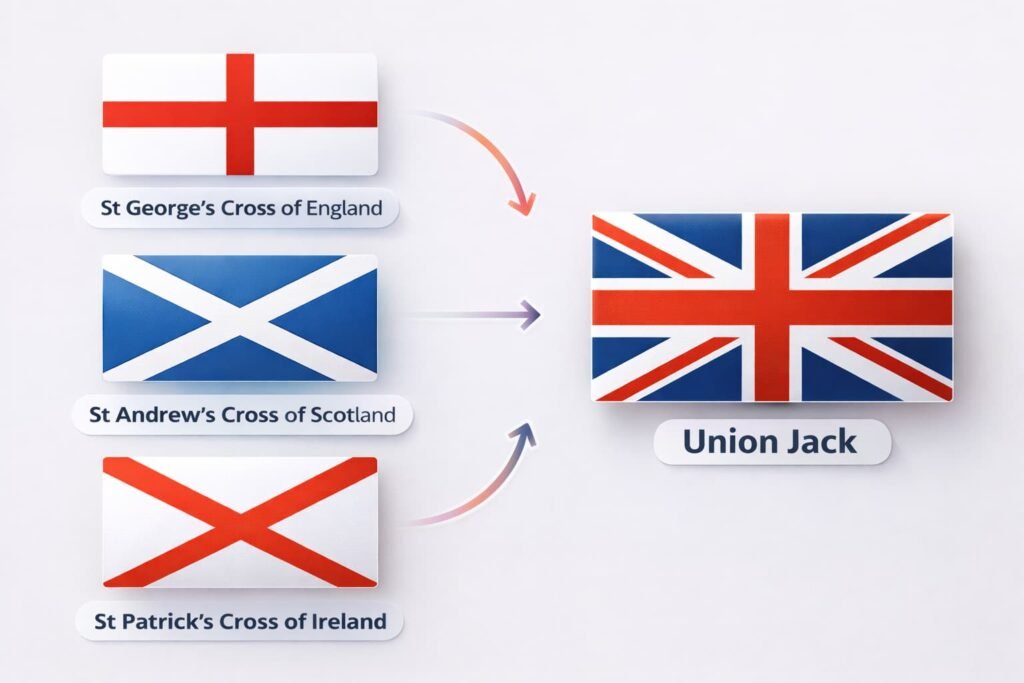
The Building Blocks of the Union Jack
When learning about the Union Jack for the Life in the UK Test, it helps to remember that the flag is made up of different crosses, each linked to a saint and a country. These crosses are layered together to show the union of nations.
St Andrew (Scotland) – The Blue Background
The design starts with a dark blue background, which comes from the Scottish flag. St Andrew is the patron saint of Scotland, and his flag traditionally has a white diagonal cross on a blue background. In the Union Jack, this blue forms the base of the flag.
St Patrick (Ireland) – The Red Diagonal Cross
The next layer is the red diagonal cross of St Patrick, which represents Ireland. This cross is slightly off-centre, which is why the Union Jack is not symmetrical. This was done on purpose so that all parts of the flag could still be seen.
St Andrew (Scotland) – The White Diagonal Cross
The white diagonal cross of St Andrew is then added on top of the red diagonal cross. Its position allows both the red and white diagonal lines to be visible, giving the flag its distinctive appearance.
St George (England) – The Red Cross
Finally, the red cross of St George, the patron saint of England, is placed in the centre of the flag. This bold horizontal and vertical cross is outlined in white and is the most noticeable feature of the Union Jack.
Once you understand these layers, the Union Jack becomes much easier to remember. For the Life in the UK Test, the key idea is that the flag shows the history and unity of England, Scotland, and Ireland.
What About Wales?
Right, so you’ve probably noticed that Wales doesn’t get its own representation on the Union Jack. There’s no dragon, no green, no white. And honestly, this is a bit of a sore point.
Wales had already been annexed by England back in the 13th century through the Laws in Wales Acts of 1535 and 1542. By the time the Union Flag was being designed, Wales was legally considered part of England rather than a separate entity. That’s why the Welsh dragon never made it onto the flag.
Fair? Not really. But that’s history for you.
Flying the Union Jack the Right Way
Here’s a tip that’ll make you look smart at parties: the Union Jack isn’t symmetrical. There’s actually a correct way up to fly it.
Look at the white diagonal stripes. On the side nearest the flagpole, the broader white stripe should be above the red diagonal in the upper half of the flag. If it’s upside down, it’s considered a sign of distress—or just a bit embarrassing if you’re at a government building.
Why This Matters for the Life in the UK Test
The Life in the UK Test loves asking about symbols, history, and what makes Britain… well, British. You might get questions about:
- When the current Union Jack design came into use (1801)
- Which countries are represented on the flag
- Why Wales isn’t on the flag
- The difference between Union Jack and Union Flag (though remember, both are acceptable)
The examiners aren’t trying to trick you, but they do want to see that you understand the basics of British history and identity. The Union Jack is literally on the test handbook cover, so it’s kind of a big deal.
Random Facts You’ll Find Useful
The Union Jack appears on the flags of several other countries, including Australia, New Zealand, and Fiji. These are former British colonies that kept the flag in their own designs even after independence.
During the 2012 Olympics in London, there was a massive Union Jack on the stadium floor. It was probably the most photographed flag in the world that year.
If Scotland ever votes for independence, we’d need a new flag design. There were actually competitions a few years back with people submitting ideas. Some were brilliant. Some looked like they’d been designed by a five-year-old with a crayon.
Key Takeaway
The Union Jack (or Union Flag, if you’re feeling technical) represents the political union of England, Scotland, and Ireland, with St. George’s cross, St. Andrew’s cross, and St. Patrick’s cross combined into one design. It got the name “Jack” from naval tradition, where it was flown on the jack staff of ships. The current design has been around since 1801, and while Wales isn’t represented, the flag remains one of the most recognizable symbols in the world.
For your Life in the UK Test, remember the key dates (1606 for the first version, 1801 for the current one), know why Wales isn’t included, and understand what each element represents. That’s really all you need.
And next time you see one flying somewhere, you can casually drop some knowledge about why it’s called the Union Jack. People love that sort of thing. Or they’ll think you’re showing off. Either way, you’ll know your stuff.
Life in the UK Test Practice Questions: Test Your Knowledge
Right, let’s see if you’ve been paying attention. These are the kinds of questions that pop up on the actual Life in the UK Test. No peeking at the answers until you’ve had a proper go.
Question 1: When did the current design of the Union Jack come into use?
- A) 1603
- B) 1707
- C) 1801
- D) 1922
Answer: C) 1801 This was when Ireland joined the union and the cross of St. Patrick was added to the flag. The 1606 version only had England and Scotland represented.
Question 2: Which saint’s cross is NOT represented on the Union Jack?
- A) St. George
- B) St. Andrew
- C) St. Patrick
- D) St. David
Answer: D) St. David St. David is the patron saint of Wales, and Wales isn’t represented on the Union Jack because it was already considered part of England when the flag was designed. The other three saints (George for England, Andrew for Scotland, Patrick for Ireland) all get their crosses on the flag.
Question 3: True or False: The terms “Union Jack” and “Union Flag” can both be used correctly.
Answer: True Technically, “Union Jack” originally referred to the flag when flown on ships, while “Union Flag” was for land use. But nowadays, both terms are officially acceptable according to the British Flag Institute. So if someone tries to correct you at a pub quiz, you can tell them they’re both right.
Question 4: What do the colors and crosses on the Union Jack represent?
- A) Different regions of England
- B) The four seasons
- C) England, Scotland, and Ireland
- D) British military regiments
Answer: C) England, Scotland, and Ireland The red cross of St. George represents England, the white diagonal cross of St. Andrew represents Scotland, and the red diagonal cross of St. Patrick represents Ireland (now Northern Ireland, but historically all of Ireland).
Question 5: Why isn’t Wales represented on the Union Jack?
- A) Wales joined the UK too late
- B) Wales was already considered part of England when the flag was designed
- C) The Welsh flag was too complicated to include
- D) Wales chose not to be represented
Answer: B) Wales was already considered part of England when the flag was designed Wales had been annexed by England through the Laws in Wales Acts of 1535 and 1542, so it wasn’t treated as a separate kingdom when the Union Flag was created. A bit unfair, honestly, but that’s the historical reality.
Question 6: What does it mean if the Union Jack is flown upside down?
- A) It’s a sign of celebration
- B) It’s a sign of distress or disrespect
- C) It means the monarch is visiting
- D) Nothing—the flag is symmetrical
Answer: B) It’s a sign of distress or disrespect The Union Jack isn’t symmetrical. When flown correctly, the broader white stripe should be above the red diagonal on the side nearest the flagpole in the upper half. Flying it upside down is either a distress signal or just a mistake that’ll embarrass whoever put it up.
Question 7: Which King first introduced a version of the Union Flag?
- A) Henry VIII
- B) James I
- C) George III
- D) William IV
Answer: B) James I James I (who was also James VI of Scotland) introduced the first Union Flag in 1606 after the Union of the Crowns brought England and Scotland together under one monarch. It didn’t include Ireland yet—that came later in 1801.
How did you do? If you got 5 or more right, you’re in good shape. If you got fewer than that, go back and read through the article again. The test isn’t trying to catch you out, but you do need to know these basic facts about British symbols and history. They come up more often than you’d think.