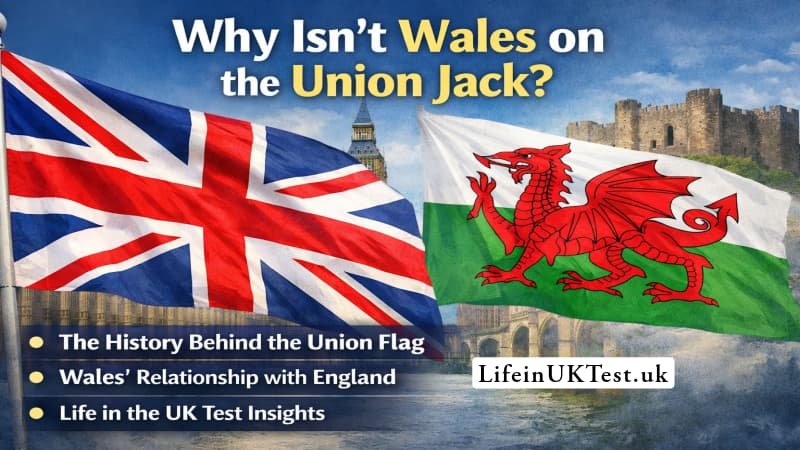
Why Isn’t Wales on the Union Jack? – Why isn’t Wales represented on the Union Jack? This question often surprises people preparing for the Life in the UK Test and those interested in British history. The Union Jack is a powerful symbol of the United Kingdom, combining elements from England, Scotland, and Ireland—but Wales is notably absent. To understand why Wales does not appear on the Union Flag, you need to explore the historical relationship between Wales and England, dating back to the 16th century. In this article, we explain the real reason Wales is not on the Union Jack, its significance for the Life in the UK Test, and what this reveals about the formation of the United Kingdom.
Why Isn’t Wales on the Union Jack?
You’ve probably noticed it. The Union Jack has England’s red cross, Scotland’s white diagonal cross, and Northern Ireland’s red diagonal cross. But Wales? Nowhere to be seen. No dragon, no green and white, nothing.
It’s not because anyone forgot about Wales or tried to exclude them out of spite. The real reason is actually pretty straightforward when you understand the timing of everything.
What Exactly Is the Union Jack?
Before we get into the Wales question, let’s clarify what we’re talking about. The Union Jack is the national flag of the United Kingdom. That blue, red, and white flag you see flying on government buildings, naval ships, and during royal occasions.
The proper name is actually the “Union Flag,” but most people call it the Union Jack. Technically, “Union Jack” refers to when the flag is flown on a ship, but honestly, both names are widely accepted now. Even the UK Parliament uses both terms interchangeably.
It’s called a “union” flag because it symbolizes the union of different countries under one monarch. Each element on the flag represents one of the patron saints of the home nations:
- St. George’s Cross (red cross on white background) represents England
- St. Andrew’s Cross (white diagonal cross on blue background) represents Scotland
- St. Patrick’s Cross (red diagonal cross) represents Ireland
These three crosses are layered on top of each other to create the distinctive design we know today. The blue background comes from Scotland’s flag, and the way the crosses overlap was carefully designed so that neither Scotland nor Ireland would appear more prominent than the other.
When Was Wales Already Part of England?
Here’s the thing: Wales was legally united with England way back in 1536 and 1542 through the Laws in Wales Acts. That’s during the reign of Henry VIII, if you’re keeping track.
So when the first version of the Union Jack appeared in 1606, Wales wasn’t considered a separate kingdom. England and Scotland had just united their crowns under James I (or James VI of Scotland, depending on who you ask). The flag combined England’s St. George’s Cross with Scotland’s St. Andrew’s Cross.
Wales was already represented through England’s part of the flag. Legally speaking, there was no separate Welsh kingdom to add.
What About the Irish Bit?
The flag got its final update in 1801 when Ireland joined the union. That’s when St. Patrick’s Cross got added, creating the design we see today. Even then, Wales still didn’t get its own representation because it remained part of the Kingdom of England in constitutional terms.
Let’s be real—it does seem a bit unfair from a modern perspective. Wales has its own distinct culture, language, and national identity. The Welsh flag with its red dragon is brilliant and recognized worldwide.
Could Wales Be Added Now?
Technically, yes. The flag could be redesigned. But honestly, it would be a massive undertaking. The Union Jack appears on other national flags (like New Zealand and Australia), on government buildings, military uniforms, and countless official documents.
Changing it would require parliamentary approval and would spark serious debate about what design to use. How do you fit a dragon onto an already-crowded flag? Some people have created mock-ups, and they’re… interesting. Not everyone agrees they look better than the current version.
What This Means for the Life in the UK Test
If you’re preparing for the Life in the UK test, remember this: Wales was already united with England before the Union Jack was created in 1606. That’s the key point. The flag represents the union of England and Scotland (1606), with Ireland’s addition in 1801.
Wales has its own powerful symbols—the red dragon flag, the daffodil, the leek. These represent Welsh national identity even if they’re not on the Union Jack.
The Modern Welsh Identity
Wales has gained significant autonomy since 1999 with the establishment of the Welsh Parliament (Senedd Cymru). The Welsh language is protected and promoted. Welsh culture is celebrated.
Not being on the Union Jack doesn’t diminish Wales’s importance within the UK. If anything, it’s a reminder of how the constitutional structure of the United Kingdom evolved over centuries, with Wales taking a different historical path than Scotland or Ireland.
Key Takeaway
Wales isn’t on the Union Jack because it was already legally part of England when the flag was designed in 1606. The Acts of Union with Scotland created the first Union Jack, combining St. George’s Cross (England) with St. Andrew’s Cross (Scotland). Ireland’s St. Patrick’s Cross was added in 1801. Wales was represented through England’s portion of the flag, though this doesn’t reflect the distinct Welsh national identity we recognize today.
Government References
- UK Government – The Union Flag: https://www.gov.uk/government/publications/flying-flags-a-plain-english-guide/flying-flags-a-plain-english-guide
- UK Parliament – Laws in Wales Acts 1535-1542: https://www.legislation.gov.uk/aep/Hen8/27/26/1991-02-01/data.html
- Welsh Government – History of Wales: https://hwb.gov.wales/repository/publishers/